
Why Boston Isn’t Baltimore—And Why It Could Be
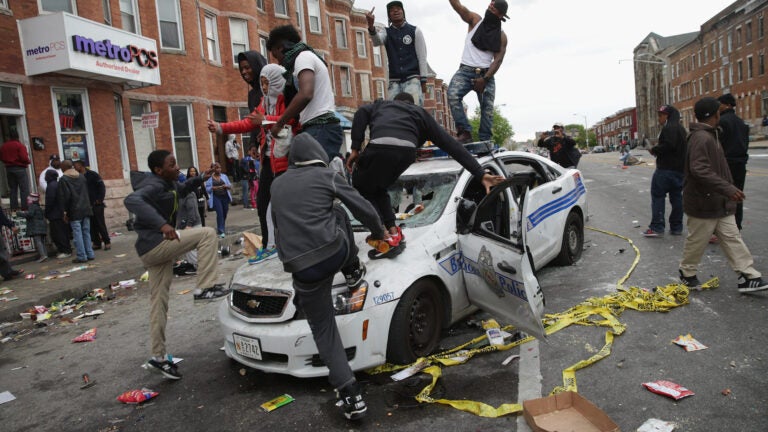
Could the violent outrage in Baltimore happen here in Boston?
The mostly peaceful protests over the death of Freddie Gray — who went into a coma less than an hour after he was arrested and put in the back of a Baltimore police van on April 12 — turned into riots Monday afternoon and night in Baltimore. On the day of Gray’s funeral, his family begged those looting stores, smashing cop cars, and setting buildings on fire to stop.
As Baltimore burned, other cities have looked on.
Boston has been largely immune from the massive protests seen in other cities in the last year. Demonstrators chaining themselves together in the middle of I-93 during rush hour was the biggest disruption, not fires or riots. Other marches and protests have been peaceful, with organizers notifying police before they happened.
Boston.com asked leaders locally: Could Boston experience the kind of overflow of anger seen in other cities? (Boston police did not return a message seeking comment. A representative from Black Lives Matter in Boston did not respond to questions either.)
No. Police here listen
When a Boston police officer was shot in the face after a traffic stop and the shooter was killed, Boston Police Commissioner William Evans turned to local clergy and community leaders to help quell any potential violence. He shared video of the encounter with a small group, to show the shooting appeared to be justified.
That relationship didn’t happen overnight, said the Rev. Miniard Culpepper, part of that select group.
“We set a tone early on that our expectations are much different,’’ said Culpepper, pastor of Pleasant Hill Baptist Church in Dorchester. “We’ve sought to hold them accountable in those ways. We’ll get different results because we approach it differently.’’
Culpepper said local leaders who have the ear of police act as a sort-of buffer for young people in the community. They come to people like Culpepper, and they know their concerns will get passed along.
“It gives the young folks someplace to go, to lodge their complaints,’’ he said. “When you have someone fighting for you to ensure that you get respect, that’s a big thing.’’
Former police commissioner Ed Davis said Boston police has clergy, like Culpepper, that will come to the defense of the police in difficult situations.
“I think that takes some of the heat, the stress off,’’ he said.
Boston is in a better position now than other cities, Davis said, in part because leaders here learned from conflicts like the busing crisis in the 1970s.
“Maybe you need that kind of crisis to understand how important it is to have good communication,’’ he said.
The Rev. Jeffrey Brown, associate pastor of Twelfth Baptist Church in Roxbury and a longtime advocate in the city’s faith-based anti-violence efforts, said after Ferguson, he and other local leaders got a call from Boston police asking them not only how to prevent unrest, but how to get to the root of why people were so upset.
“I thought (it) was a very different approach than some of the folks’ reactions in other cities,’’ he said.
No. Police here would be prepared
Baltimore police had to call in National Guard soldiers and police officers from other jurisdictions to help quell riots Monday into Tuesday. That wouldn’t happen here, Davis said.
“There has to be a very good plan in place and it has to involve enough officers,’’ he said. “I think you see in Baltimore, that just wasn’t the case.’’
Police here also have the support of the mayor, Davis said.
“They go at something like this as a team, and I think you’re seeing a bit of a disconnect in Baltimore that doesn’t exist in Boston,’’ he said.
[bdc-gallery id=”329920″]
Yes. Police brass don’t listen to the right people
Clergy and community leaders might get the message from police, but what about the men and women on the street?
“You have the people with name recognition, but a lot of these young people are not interested and don’t identify with these individuals,’’ said Larry Ellison, a Boston police detective for 30 years and president of the Massachusetts Association of Minority Law Enforcement Officers, Inc.
Ellison said police officials tend to talk to those who agree with them, and not other groups, including his own which represents 4oo Boston officers.
“They want people to believe Boston is turning the page … I just don’t believe that,’’ Ellison said. “I’m hoping it doesn’t happen, but we can’t say it can’t happen here.’’
Nearly two-thirds of people observed, interrogated, or searched by Boston police from 2007 to 2010 were black, according to a study by the ACLU using Boston police data last fall. Even controlling for criminal history and gang affiliation, black residents were still 8.8 percent more likely to be stopped by police than whites.
Are those residents getting the message from police, relayed through clergy?
“The people who are the victims of stop and frisk and other encounters … those are not the people who are saying that everything is fine with the BPD,’’ ACLU of Massachusetts Legal Director Matt Segal said.
“Could there be the same level of dissatisfaction here that there are in other places?’’ Segal added. “The answer is: There very well could be, and the data says there ought to be.’’
Yes. It just takes one questionable call
The night Officer John Moynihan was shot in the face and Angelo West was killed, there was anger on the streets of Roxbury. One man threatened war with police.
Within a day, though, the anger seemed to be snuffed out, in part because of the footage shown to clergy.
But what if there hadn’t been video?
“If that happens again, in the current context … and there’s no video to show the use of deadly force by police is justified, we could see large scale demonstrations at the very least,’’ Segal said.
That’s one of the reasons why the ACLU has demanded body cameras for police. (Segal and the ACLU shouldn’t hold their breath. Evans said in December that he has doubts about the technology.)
“The existence of that video was just lucky,’’ Segal said.
Police misconduct happens in all cities, said attorney Howard Friedman, who has represented families of those killed by police. It’s how it’s handled that makes the difference.
He was encouraged by the way police handled the Angelo West shooting, but that’s been the exception, not the rule, he said. In the past, information has seeped out, instead of immediately shared, according to Friedman, and families he’s represented have waited more than a year to see video or hear whether their loved one’s death was ruled justified.
“There is a distrust of police,’’ he said. “Our current police commissioner is aware and trying to change it, but many people think the police aren’t relating to them as human beings.’’
Yes. It could happen anywhere
“I don’t think any urban city is immune from it,’’ Ellison said.
People in Baltimore and Ferguson aren’t just angry about police. They’re angry about years of discrimination in housing, jobs, and education that have disenfranchised them and their peers, Brown said.
“You’ll see the protesting is not just about police brutality and how police are treating communities of color,’’ Brown said. “They’re frustrated by the economic disparities that exist in the cities.’’
Boston isn’t Shangri-La, Brown said. It’s just as vulnerable as any major city to unrest. But it could be a little less likely to happen in Boston because of the relationships between police and the community.
“The challenge ahead is for both the police department and for the administration to be even more responsive to the needs of the citizenry who aren’t often heard,’’ he said. “Martin Luther King Jr. said it best: ‘A riot is the language of the unheard.’ It’s when people feel like people aren’t listening to their cries and their issues … that’s when they get frustrated and it boils over.’’


To comment, please create a screen name in your profile
To comment, please verify your email address
Conversation
This discussion has ended. Please join elsewhere on Boston.com