
Half a World Away From Family in Crisis
The death toll keeps rising as the road to recovery in Nepal begins.
Pralhad KC’s mother is in her 90s and living in a rainy field.
“Everybody is sleeping out in an open field because of the fear of another earthquake,’’ he said of his mother and siblings, who were forced to relocate after the earthquake in Kathmandu, Nepal. “And it continues to tremor on every few hours. So far there have been several, like over a hundred, going on.’’
KC, whose last name is an old family name and pronounced the way it is spelled, came to the United States in the late 1970s from Kathmandu. He attended Cambridge Rindge and Latin School and both undergrad and graduate school in Boston. He owns Prem-la, a Back Bay shop that sells art and imports from the Himalayan region.
Reaching his family by phone has been hard, and life has been stressful since he got the call about the earthquake Friday night.
Two days after the 7.8 magnitude earthquake hit Nepal, the full extent of the devastation is still unknown. More than 4,000 were confirmed dead as of Monday, and rescue workers are still trying to reach those in remote areas. A Nepali government official told the Associated Press that more than 6,300 people were injured and estimated that tens of thousands have been left homeless. Charities have set up funds to aid in the rescue and recovery process.
Dan Richards, CEO of Global Rescue, a Boston-based firm that provides travel risk and crisis management to its members, said the company had personnel on the ground when the earthquake hit. The company deploys a medical and rescue team each year to the Himalayan region during the climbing season. He said after the earthquake, the company began providing humanitarian assistance in Lukla, one of the primary airfields used by people climbing Mount Everest.
“We were responsible for identifying who was injured significantly and seriously and needed transport to Kathmandu, who wasn’t, and then also finding a place to put the dead,’’ Richards said.
He said it was relatively lucky that the Kathmandu airport was only knocked off-line for under 20 hours, compared to the days that the airport was out in Haiti following that country’s 2010 earthquake.
Scenes from Nepal
(Warning: Graphic Images)
[bdc-gallery id=”330040″]
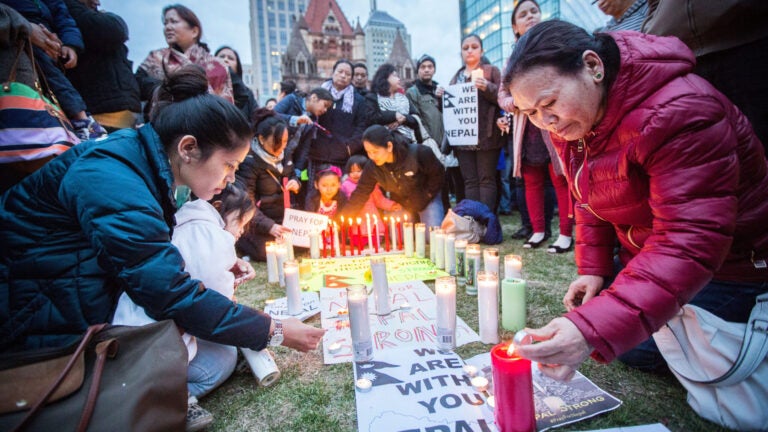
Members of Boston’s Nepali community are trying to support their family members in the region by organizing vigils and fundraisers.
“It’s a devastating situation right now, what’s happening,’’ KC said. “It’s not only for Nepal, but basically it’s a human devastation, what’s going on.’’
A vigil was held in Copley Square on Sunday night, and another hosted by Out of Town News in Harvard Square is planned for Wednesday at 3 p.m..
KC said he is concerned about his mother’s health. He said his relatives won’t be able to get her to a hospital because all the hospitals are full.
“It’s been very hard,’’ he said. “We used to live in the third floor, and they had to carry her down. Because of the heat and her health. It is pouring rain there now, and the weather is very bad… And it’s cold, and the rain hasn’t helped at all.’’
The hardest part, he said, is being so far from his family and not being able to do anything.
“When you have the family together, mourning is a lot easier,’’ he said. “And when you are far away, it makes the pain and the suffering even harder. Because you’re not there, you can only imagine. And what you see on the TV and on the Facebook and the social media and all the things, and here we are comfortable living in the house with running water and electricity and all this we have over here. And our siblings and our loved ones are over there suffering and sleeping in the middle of the field and not having running water, food, health, and all these things. It’s very, very hard.’’
With the earthquake’s destruction of old temples and palaces in the historic part of Kathmandu, the landscape of Nepal and Kathmandu has changed and cannot be rebuilt, he said. His family’s properties were also damaged in the quake.
“It was an open museum for the whole world. People could go over there and see the hundreds and thousands of years old architecture, designs, craftsmanship, workmanship and all the things,’’ he said. “And now it cannot be replaced.’’
Now they survive only in pictures and books, he said.
Richards said it is a matter of time before the aid going into the country is able to make an impact.
KC urged people not to view the situation as only about Nepal, but as a humanitarian disaster.
“We need to come together as a community, as a country, as a whole world to help every possible way,’’ he said.



To comment, please create a screen name in your profile
To comment, please verify your email address
Conversation
This discussion has ended. Please join elsewhere on Boston.com