
Charlie Baker’s Ride-Sharing Bill Comes After Increased Lobbyist Spending
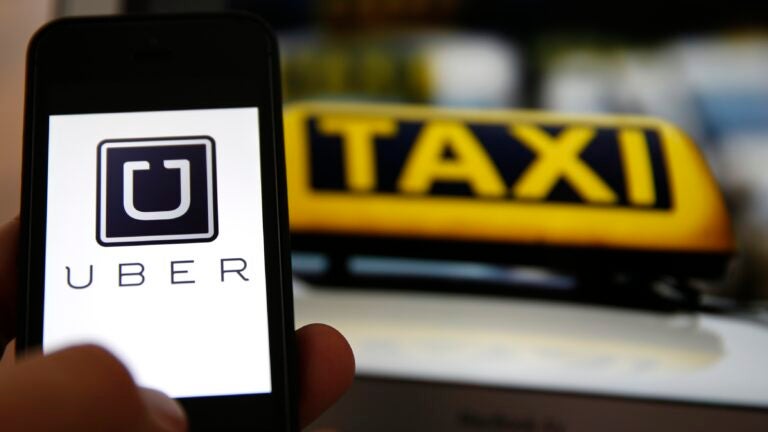
Legislation regulating ride-sharing companies such as Uber and Lyft proposed by Gov. Charlie Baker on Friday was welcomed by those companies, which spent about $140,000 in 2014 alone lobbying Massachusetts officials.
In a statement, Uber said Baker’s bill “will allow Uber to continue offering Massachusetts safe, reliable transportation options’’ and “we thank Governor Baker and his administration for supporting riders and drivers and for promoting innovation in the Commonwealth.’’
Not all drivers will feel supported. Cab drivers spoke out against a similar set of regulations proposed by former Gov. Deval Patrick in his last days in office.
Baker’s bill would give the Department of Public Utilities oversight of ride-sharing services, and drivers would undergo background checks by both the ride-sharing company and the state. Drivers would need liability insurance of $1 million, and the companies would pay an annual tax to help fund the oversight committee.
In a statement, the Baker administration said the bill was written with input from representatives of the ride-sharing companies as well as “municipal leaders’’ and “public safety advocates.’’
This isn’t the only way ride-sharing companies have been able to make their feelings known to government officials. According to the state’s records, Uber and Lyft have spent tens of thousands of dollars over the last three years on lobbyists, ramping up their spending in 2014. Uber dropped Northwind Strategies, its lobbyists in 2012 and 2013, for Beacon Strategies Group and Brown Rudnick in 2014. According to its 2015 filings, those partnerships will continue.
Taxi interests such as EJT Management, the company owned by Boston’s so-called taxi king Edward Tutunjian, have spent almost as much as Uber and Lyft, though some of those funds went to lobbyists on other issues in the industry not related to ride-sharing, such as insurance and disability access regulations.
[fragment number=0]
This is in line with Uber’s efforts in other states. In Connecticut, Brown Rudnick expects to be paid $144,000 by the company for work in 2015 and 2016, according to the Hartford Courant. Taxi companies in Connecticut sued Uber and Lyft last May, accusing the companies of operating outside of regulations taxi companies were required to follow. In 2013, Politico reported on Uber lobbyist spending in Maryland, Illinois, Colorado, Texas, New York, and Washington D.C.
Ride-sharing companies have faced resistance in the state since Uber arrived in Boston in 2011. The state Division of Standards tried to shut down Uber in August 2012 because it was using unestablished “measurement standards’’ to determine fare prices, but that decision was soon reversed. Cambridge then filed a suit to overturn that decision, saying it was an “abuse of discretion,’’ but lost in June 2013.
There have also been several incidents of ride-share-related sexual assaults in the area. Uber has also faced lawsuits accusing it of illegally charging customers a “Logan Massport Surcharge’’ for rides to and from the airport and falsely classifying drivers as independent contractors.



To comment, please create a screen name in your profile
To comment, please verify your email address
Conversation
This discussion has ended. Please join elsewhere on Boston.com