
‘If I had to define Sean Collier in one word, I’d say character’
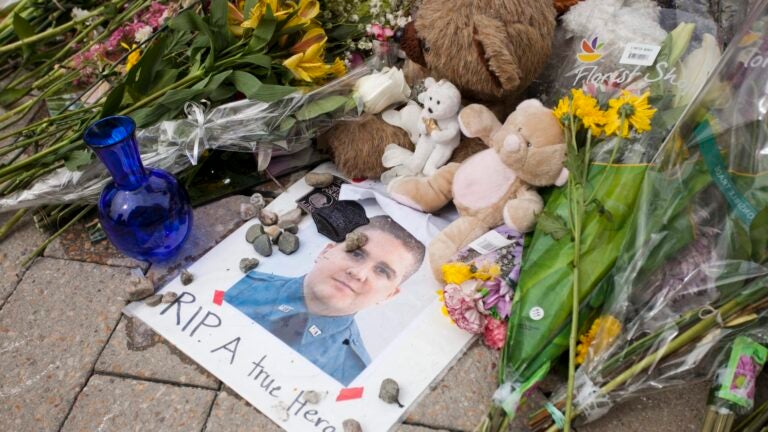
Murdered MIT police officer Sean Collier was remembered in court Wednesday as a firm believer in right and wrong, a man who spent his time helping others, and a community policeman who cared.
Collier’s stepfather Joe Rogers, his younger brother Andrew, and his MIT police boss John DiFava all testified Wednesday as part of the penalty phase of Dzhokhar Tsarnaev’s trial.
Collier’s most defining quality was his moral conviction, they said.
“Things were right or wrong… He would tell us when other children were acting out,’’ Collier’s step-father Joe Rogers said. “He was a cop at an early age.’’
“Sean was someone that was a moral compass,’’ his brother Andrew Collier said, even down to telling him not to unnecessarily kill bugs. “I would do something wrong and get a morality speech on it.’’
“If I had to define Sean Collier in one word, I’d say character,’’ DiFava said. “He had a very well-defined idea of what was right and what was wrong, and he followed that rule all the time.’’
Collier was born to be a cop.
DiFava, who has worked in policing for 42 years, said Sean was one of the “very best’’ policeman he had ever met.
“He understood people,’’ DiFava said. “He was the real deal.’’
As a boy, Collier would make siren sounds, and when he saw a policeman pull over another car, he’d start singing the Cops theme song, Rogers said. And Collier was fascinated by police vehicles, especially when their lights turned on, his brother testified.
Collier had one brush with the law, when he was arrested for being a minor in possession of alcohol after the Red Sox won the World Series. A policeman who broke up a party told Collier to drop the beer and stay where he was.
Most kids would get up and leave, Rogers said, but Collier stayed and did as the policeman said. That made him think that, “Maybe I’d raised him wrong,’’ Rogers joked.
On the ride home from that night, Collier confided to his mother, Kelley Rogers, that he thought God did this “so he could understand what it was like to be arrested,’’ Joe said.
The jury was shown a photo of a smiling Collier at police academy graduation. In the photo, his mother is pinning his badge to his uniform. “That was probably the happiest day of his life,’’ Joe said.
Collier’s family has struggled to recover from his death.
Sean was one of six children raised by Joe and Kelley Rogers, and they have felt deep grief in the past two years.
Kelley had previously lost a newborn baby, Joe said, and fell into depression afterward. Sean was the next child born.
“Sean was special in that he brought her out of [that] depression,’’ Joe said.
Since his murder, though, Kelley was diagnosed with PTSD, Joe said. She’s no longer able to work in her previous job, in which she oversaw about 130 employees.
“She was despondent. It took her a couple months just to get out of bed,’’ Joe said.
One sister moved away to Texas and refuses to talk about Sean’s death. Another sister is depressed. Still another has to deal with the unending press, Joe said.
“It wears you down after a while,’’ he said. “I just feel beat down after two years of this.’’
A career policeman, DiFava said he used to support the possibility that his kids would become policemen and wear a uniform. He’s not so sure anymore.
Collier’s family still gets together for the major holidays. Easter this year came near the two-year anniversary of his death, and the family felt his death like a “cloud.’’
“Even when we’re having fun, there’s always a cloud over whatever event it is,’’ Andrew Collier said. “I miss Sean. I miss everything about him.’’



To comment, please create a screen name in your profile
To comment, please verify your email address
Conversation
This discussion has ended. Please join elsewhere on Boston.com