
What Will Boston’s New Olympics Office Do?
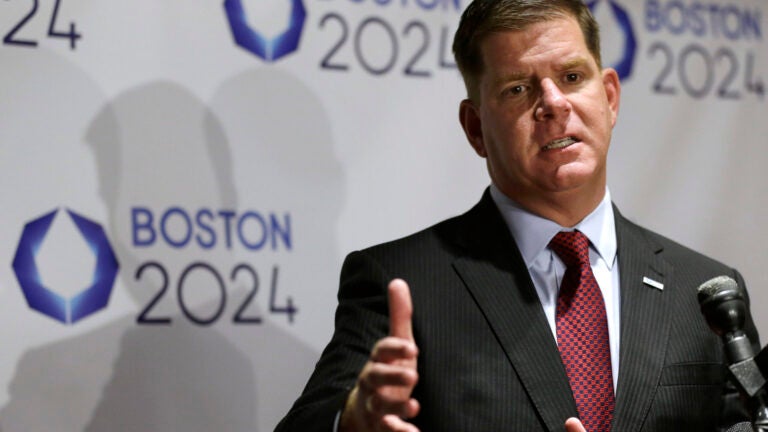
A few weeks back, when bad news for Boston’s Olympic bid just couldn’t stop snowballing, Mayor Marty Walsh’s office said he was planning to establish an “Office of Olympic Accountability’’ in the near future. Now he has: last week, the city announced it had hired Sara Myerson, a former Goldman Sachs employee who has also worked on affordable housing issues, to head a new city office focused on the Olympic bid starting April 27.
But the office won’t be called the “Office of Olympic Accountability.’’ Instead, it is called the Office of Olympic Planning. And it may be more partner than watchdog to bid committee Boston 2024.
“Projects that will fall under the Office of Olympic Planning will include economic analysis, mitigation analysis, public health and safety studies, and transportation planning. The office will work collaboratively with Boston 2024 and the United States Olympic Committee,’’ a news release said.
Boston 2024 will pay for the new office’s operations. If the office existed purely to monitor the bidding group, that dynamic might look like a conflict of interests. But the alternative—that the city pay for the office—would have also been problematic, given the Olympic bid opponents’ insistence that no public money be put toward the games.
How much independence can the office have?
“In addition to reviewing information and planning related to the Olympic bid from Boston 2024, Sara will conduct her own analysis on economic impact, transportation planning, public health and safety, to name a few,’’ mayoral spokesperson Laura Oggeri said in an email. “Any findings or recommendations will be provided straight to the mayor for decision-making purposes.’’
If Myerson’s work were to bring to light some issue that caused Walsh to back out of the bidding process, Boston 2024 would no doubt consider its funding of the office to have been a poor investment. Walsh, however, seems to think the ideas of Olympic accountability and Olympic planning are not necessarily in conflict.
“The Office of Olympic Planning is an important step forward in this process, and it will build a bridge between the city’s planning and the development of the Olympic proposal. … Her [Myerson’s] top priority will be to ensure that Boston will benefit in the long-term from holding the games and that any planning efforts are in line with the city’s overall goals,’’ the mayor said in a statement.
That is in keeping with the city’s approach to the Olympic bid. While Walsh has taken a somewhat tougher stance toward Boston 2024 in the last six weeks—for instance, by publicly urging the committee to release staff and consultant pay details as a gesture of transparency—he is still a big supporter. The city and Boston 2024 have worked in tandem in the Olympic bidding process.
At every city meeting about the bid, a panel of Boston 2024 officials present plans and answer citizen questions. Also, Walsh adviser Joe Rull was hired by Boston 2024 in January. Walsh said Rull would help to represent the city’s interests in Boston 2024’s offices—though his paycheck would come from Boston 2024. Rull is just one of several connections between Boston 2024 and City Hall.
No Boston Olympics, the group opposed to bringing the Summer Games to the city, has been calling for an independent watchdog agency to keep track of Olympics planning and (if they happen) hosting efforts. Chris Dempsey, one of No Boston Olympics’s leaders, said the group has no problem with Boston 2024 reimbursing the city for the costs, but the group’s three co-chairs think there should still be a separate party that checks and balances Boston 2024.
“[T]he city’s watchdog needs to be truly independent. It should be a distinct and separate entity entirely, not one wrapped into the planning function,’’ Dempsey said. “When the two are in the same office, neither function will excel.’’
Meanwhile, at the state level, officials are scheduled to select a company to independently consult on the Olympic bid later this month. The consultant is expected to examine, among other things, the potential risks to taxpayers. While the team to do so will not be employed by the state, the state will pay it to gather information and advise the governor and legislative leaders as the bidding process advances.
The ultimate check on the bid, though, won’t be found in City Hall or the State House. Plans call for a statewide referendum in the fall of 2016, which will allow voters to determine whether the bid should go forward.



To comment, please create a screen name in your profile
To comment, please verify your email address
Conversation
This discussion has ended. Please join elsewhere on Boston.com