
Hernandez Trial Defense Closing: ‘Obviously They Were Friends’
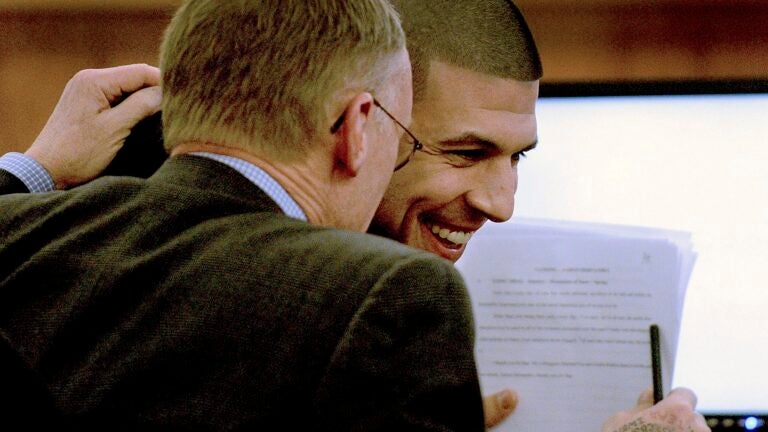
Both sides gave closing arguments in the murder case against Aaron Hernandez today, mentioning the media attention and highlighting forensic and video evidence surrounding the June 2013 death of the former New England Patriot’s colleague, Odin Lloyd.
“Obviously, they were friends,’’ defense attorney James Sultan told jurors of the former New England Patriot and the murder victim. “They were future brothers in law. But the prosecution wants to deny the obvious.’’
During the nine-week trial, the prosecution made a point of deeming Lloyd and Hernandez merely acquaintances. Prosecutor William McCauley later told the court: “What is the evidence of friendship? Were they friends? We asked Shayanna [Jenkins], she said they were ‘cordial.’’’
Hernandez’s lawyers recalled the media circus that surrounded the case from its early stages and called for jurors to remain unbiased, at one point even accusing investigators of leaking information to the media. Sultan displayed a photo of camera crews in front of Hernandez’s North Attleboro home before they arrived to arrested him, and suggested that they had received a tip.
Sultan repeatedly claimed the investigation failed to acquire “proof beyond a reasonable doubt,’’ and said the government never provided a clear motive for Hernandez to kill Lloyd.
“Is there any evidence of any conflict of any kind between Aaron and Odin?’’ he said. “No. Where’s the proof? It isn’t there. They want you to speculate.’’
For the first time in the case, Sultan then suggested that Hernandez was at the crime scene, but that the crime lay in the hands of Hernandez’s co-defendants, Ernest Wallace and Carlos Ortiz. Sultan said the men used drugs such as PCP and had been known to be “aggressive’’ because of it.
“Aaron was 23 years old and witnessed a shocking killing committed by someone he knew,’’ Sultan said. “He didn’t know what to do.’’
Wallace and Ortiz also both face murder charges, and were allegedly in Hernandez’s car with Lloyd on the night of his death.
“We know what happened at Rumor,’’ McCauley said of the nightclub Lloyd and Hernandez were at two days before the murder. “At least we’re going to ask you to consider, that there was a problem.’’
Judge Susan Garsh interrupted the Assistant District Attorney early in his closing argument, asking him to stop using the phrase “we know’’ to explain video and forensic evidence.
“The evidence shows,’’ he continued, “[Hernandez’s] behavior changes at some point.’’ McCauley highlighted the account of a woman at Rumor night club who testified that Hernandez was aggressive, suggesting she should “be grateful’’ the NFL player was paying attention to her.
“Consider his behavior,’’ McCauley said.
The prosecution also claimed that Hernandez’s access to a firearm, his desire to meet up with Lloyd without reason, and discontinued use of his cell phone suggest he was plotting to murder Lloyd.
“Why is the defendant not using his phone at this time? Why is he now using Shayanna Jenkins’ phone?’’ McCauley said. “I’m going to suggest to you, [it’s] because the plan is in play.’’
The prosecutors then showed surveillance from Hernandez’s home, claiming Hernandez had a gun in his hand before leaving to pick up Lloyd two hours before the time of his death.
“Ask yourself first of all… what was the purpose in going to, what I’m going to suggest to you is, the most ideal place to commit a murder?’’ McCauley said. “An industrial park. Nobody is around, it’s almost 3:25 in the morning.’’
McCauley claimed Jenkins later disposed of the murder weapon in a box that Hernandez told her to put in the garbage.
Early in his closing, Sultan pointed to a series of missteps in the government’s investigation, including the removal of chewed bubble gum from a shell casing found at Hernandez’s car rental company. Sultan said investigators never told the forensic examiner that the gum was attached to the shell casing, and never tested that gum for DNA. The forensic examiner never tested that gum for DNA. Sultan also said the government failed to document the placement of items found at the crime scene.
However, Sultan said, they did not waste time providing character evidence such as Hernandez’s interest in women other than his fiancee. The defense accused the government of failing to present hard evidence without “taking benign, innocuous events and cast[ing] them in a sinister light.’’
McCauley called the defense’s mention of PCP use by the codefendants “a distraction,’’ questioning why Hernandez would spend time with Wallace and Ortiz after the murder if he had seen them kill a man.
Prosecution also said Jenkins disposed of the murder weapon for Hernandez, claiming a coded text instructed Jenkins to throw out a box stored in the basement after he returned from the industrial park.
“Ask yourself,’’ the prosecutor said of the North Attleboro crime scene less than a mile from Hernandez’s home: “Why were they there?’’




To comment, please create a screen name in your profile
To comment, please verify your email address
Conversation
This discussion has ended. Please join elsewhere on Boston.com