
Most Bostonians Don’t Want Tsarnaev to Die. Will the Jury?
The 18 people considering Dzhokar Tsarnaev’s fate said they were open to choosing the death penalty. Only a quarter of people in Boston, one poll shows, would make that choice.
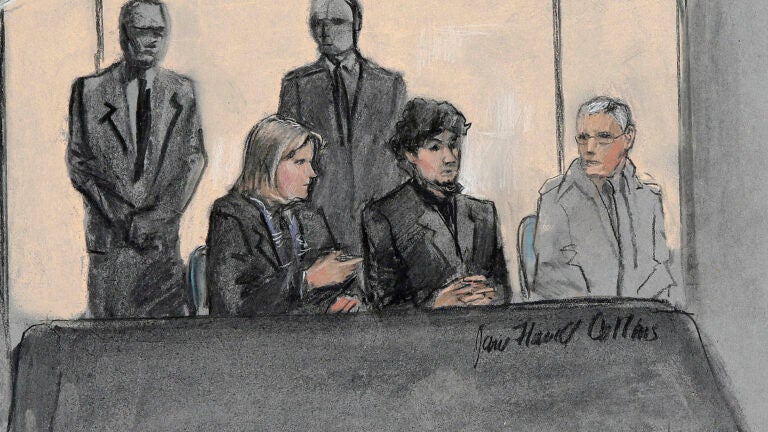
His lawyers admitted he did it. Days of court testimonyhave recountedthe consequences of what he did. But that still hasn’t convinced Bostonians that admitted marathon bomber Dzhokar Tsarnaev deserves the death penalty.
A WBUR poll released this week — conducted after six full days of testimony in the trial — shows that only 27 percent of city residents want to see him put to death.
So does that mean the 18 people on the panel that will judge Tsarnaev’s fate — all of whom said they’re open to the death penalty — aren’t properly reflective of the community?
Not quite, law experts say.
The U.S. Supreme Court has ruled in several different decisions that a capital jury must be death qualified, meaning that they have to fairly consider both execution and life in prison, without a strong predisposition toward either. They have to be open to handing down the ultimate punishment, no matter what most of their neighbors think.
The more than 1,300 potential jurors in the Tsarnaev case were polled on questions that tried, in part, to get at their view of the death penalty. Among the questions: Could they conscientiously vote for the death penalty? Would anyone close to them be disappointed or critical if they voted for life or death? On a scale of 1 to 10, do they strongly favor or oppose the death penalty?
The mandate for capital jurors makes it difficult to get a fair trial in a state that mostly rejects the death penalty, said Robert Dunham, executive director of the Death Penalty Information Center.
“If the community overwhelmingly opposes the death penalty but you are required to support the death penalty in order to serve, then almost by definition, that means you cannot get a trial by jury that’s able to express the conscience of the community,’’ Dunham said.
Having a jury reflective of the community on this issue is impossible, said Robert Blecker, a New York Law School Professor and death penalty advocate.
“(Tsarnaev) is not entitled to a jury of his peers, but a cross section of the community,’’ he said. “They’re not identical.’’
Still, a jury culled from a mostly anti-death penalty community could be a good sign for the defense attorneys trying to save Tsarnaev’s life, said criminal defense and civil liberties lawyer Harvey Silverglate. Chances are, there is a juror among the 18 who told the judge he or she could sign their name to execute someone, but ultimately can’t.
“It’s harder to get such a jury in Massachusetts than it would in Texas where they’re just waiting for the opportunity,’’ Silverglate said.
The poll numbers point to the difficulty of the Department of Justice pursuing a death penalty case in a state that hasn’t executed anyone since 1947 and might not want to start now.
This is the fourth time federal prosecutors tried for the death penalty in Massachusetts. They haven’t been successful.
Two Dorchester gang members were initially charged with capital crimes, but the charges were later dropped and they were instead tried in state court. And a former nurse was sentenced to life instead of death after being convicted of administering lethal injections to patients.
Still unfolding is Gary Lee Sampson’s federal death penalty case. He pleaded guilty in 2003 to carjacking and killing three people in Massachusetts and New Hampshire. A jury said he should be sentenced to death, but a federal judge vacated the decision when one of the jurors was found to have lied during the screening process. Sampson’s new sentencing trial is scheduled for later this year.
Convincing a jury culled from an abolitionist-leaning community isn’t only a struggle in Massachusetts. Jurors in the U.S. territory of Puerto Rico have four times rejected the death penalty in capital cases since 1988. In Vermont, jurors initially sentenced a man to death after he was convicted of kidnapping and killing a supermarket employee. But that man, Donald Fell, will get a new trial because of a rogue juror discovered by his attorneys. (That juror told investigators that he went down to Fell’s house and the location of the kidnapping to see if it matched what defense attorneys were saying in court.)
“There is a reason why jurisdictions who abolished the death penalty have abolished the death penalty,’’ Dunham said. “That’s because the support in those states has eroded and there is not a community consensus that the death penalty could be administered fairly and is worth pursuing.’’
Blecker hopes Tsarnaev dies. Even he questions the Justice Department’s decision to pursue the death penalty in a state that’s outlawed it.
“I don’t see this as much of a federal crime as I do a mass murder,’’ he said. “The only reason they went federally is because Massachusetts doesn’t have the death penalty.’’
Polls show more, not fewer, Bostonians want to see Tsarnaev’s life spared since the trial began. In a September 2013 Boston Globe poll, only 33 percent of Boston residents wanted him to get the death penalty. The number has since dropped to 27 percent, according to WBUR’s polling.
That’s after hearing testimony from injured victims, seeing gruesome photos of the bombing’s aftermath and Bill Richard’s recounting of seeing his eight-year-old son die. This wasn’t a poll question about an imaginary defendant in a made-up case. Poll respondents were asked about a specific, recent crime they’ve been reminded of almost daily. The two year anniversary is three weeks away.
“It clearly shows something about the conscience of the people in Boston and the Boston area,’’ said Dunham. “It shows that being Boston Strong does not mean crying for vengeance.’’


To comment, please create a screen name in your profile
To comment, please verify your email address
Conversation
This discussion has ended. Please join elsewhere on Boston.com