
Blind But Unstoppable. Until This Winter
Arthur Bourgoin died at the age of 78 after being struck by a car.
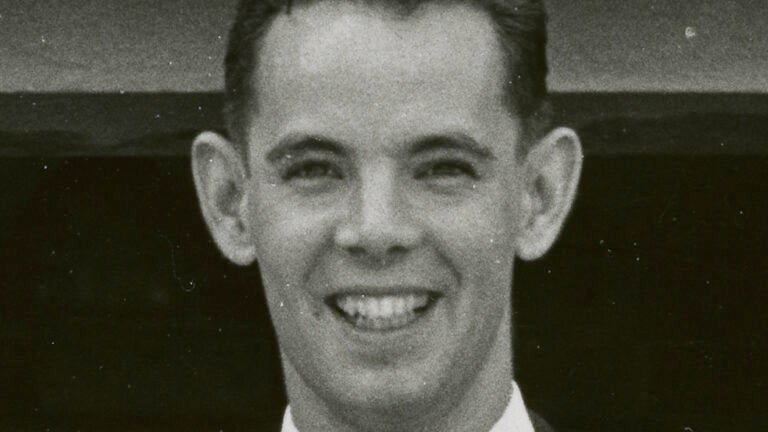
Winters were tough on Arthur Bourgoin. The 78-year-old was blind from birth, but he traveled alone all over town. Each day began with a walk to the Watertown Diner for breakfast at 6 a.m. Nothing kept him from his routine. Not even this year’s snowfall.
“He used to get a little lost sometimes because people wouldn’t shovel, or he’d end up in the middle of the street,’’ said Donna Sivits, a waitress at the diner who knew Bourgoin for 15 years. “This year just seemed like it was more confusing for him because there was so much snow, and the snowbanks were so high. He got lost a couple times coming to the diner, and we knew it, and we had to go find him.’’
At 6:39 a.m. on March 3, Bourgoin was struck by a car just a few blocks from the diner. He died from the injuries on March 12. The Middlesex District Attorney’s Office said the driver was questioned and the investigation into the accident is ongoing.
Friends and family said he did what he wanted: riding a bike when he was young. Occasionally driving a car. Working as a machinist. Playing the piano. And the accordian. Volunteering at a nursing home.
Bourgoin’s younger brother, Roland “Bill’’ Bourgoin, said his brother was determined and never let his blindess hold him back. But this winter he had to climb over snowbanks and wait in the road for the bus because sidewalks weren’t shoveled.
“Everybody told him, ‘Be careful, be careful. You don’t need to go out,’’’ said Bill. But Arthur’s response was always the same. He would do what he wanted, despite the snow.
Arthur was born in Maine, where his brother said both their parents, Arthur L. and Jeanette Huard Bourgoin, worked in a mill. Bill said from the beginning, being born blind didn’t interfere with his brother’s determination to be one of the boys.
“When we were kids, we done some stupid things together,’’ Bill said. “He wanted to do everything that we wanted to do, and he didn’t let his blindness get in the way.’’
Arthur used to ride a two-wheel bike around the gravel yard behind his house, Bill said. There were some cars parked there, but Bill said when his brother crashed into something, he would fall, get up, find out what he ran into, and get back on the bike.
“You gave him lemons, he made lemonade, with no sugar,’’ he said.
The brothers eventually had a two-person bike built so they could ride together.
“I treated him as a brother and not as an invalid,’’ he said. “He didn’t want to be treated that way.’’
Bill said their father let Arthur drive sometimes, and then, while he was at work, the two boys would take the car out with Arthur behind the wheel.
“We never considered him to be blind,’’ Bill said. “He was born to be part of the gang. He was tough, and he would do anything.’’
Bill said the family moved to Connecticut, and Arthur continued to attend the Perkins School for the Blind in Watertown. He graduated and went on to work at Polaroid, where he operated a film-rolling machine for 32 years.
Arthur and his wife, Aline, bought a house in Watertown in the 1960s. After Aline died, Arthur began volunteering twice a week as an inspector in the Perkins Braille and Talking Book Library.
He was never late a day in his life, said Ron Heaton, the warehouse operations manager.
“He’d take the books out of the case, put them onto a machine that re-wound them to the beginning of the cassette,’’ Heaton said. “And then he would have to put them back into the container in numerical order.’’

The empty workstation at the Perkins Library where Arthur Bourgoin used to sit.
One day, Heaton was on the bus when Arthur got on. Heaton teasingly called out to him.
“I say, ‘Hey old bald guy, come and sit down.’’’ Heaton said. “People got irate because they all knew him from traveling so much. And he just leans over and chuckles and says, ‘Should I tell them I know you now or wait until they kick your behind?’’’
At the diner, Sivits said the only day Arthur missed breakfast was the day he fell in the subway about three years ago and broke a hip. She said he would arrive, place his cane in the corner near the counter, sit in his spot, and order his usual: grilled cheese and black coffee.
“He’d walk into the diner and the first thing he’d say was, ‘Oh, good morning, old lady,’ and I’d say, ‘Good morning, old man’,’’ Sivits said.
Peter Fusco, a friend of Arthur’s who met him every morning at the diner, said he too cautioned his friend about the snow.
“I used to call him every night,’’ said Fusco. “I’d say, ‘So you going to stay home tomorrow?’ ‘Like hell not,’ he’d say, ‘I’m going to go out tomorrow.’ Nothing would stop him. Nothing.’’
Heaton said Arthur was on his way to Melrose, where he volunteered at a nursing home, the day he was struck by the car. Heaton said he hadn’t been able to go in two weeks because of the MBTA’s snow shutdowns.
“That was his intent that day,’’ Heaton said.
Sivits said Arthur’s companion Anne Marie lived at the nursing home before she died. He continued to go there even after she passed away to play piano for the residents.
“I loved him more than I can … It’s never going to be the same without him,’’ Sivits said. “The world is just so empty now. It’s just, you know, you expect him to come and he just doesn’t come. It’s never going to be the same. He was a good man. Smart.’’
Heaton said almost all the seats were taken at the funeral service held for Arthur on March 16.
“It was a bad way, the way he end his life,’’ said Fusco. “But at least he died happy. He did everything he wants to do. Nothing could stop him. Nothing stop him.’’




To comment, please create a screen name in your profile
To comment, please verify your email address
Conversation
This discussion has ended. Please join elsewhere on Boston.com