
It’s Been a Long Winter for the Other Mass. Public Transit Systems, Too
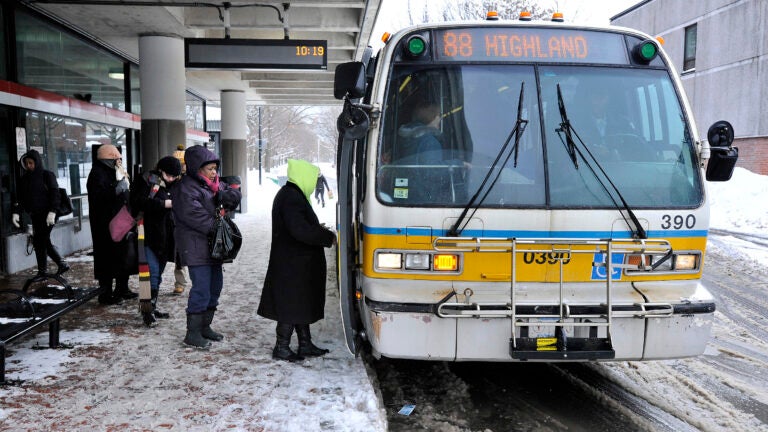
The MBTA is far and away the oldest, the most highly used, and (in the last few weeks, especially) the most regularly maligned of the Massachusetts public transit systems. But it’s not the only one. There are 15 other regional transit authorities, most of which were created by statute about 40 years ago. They’re under the MassDOT umbrella, but they each operate independently. They are directed by boards comprising of representatives from the towns they serve and have their own budgets, their own fares, and their own managers. With the exception of the summer CapeFLYER train, they’re not on the rails, and offer only bus and van services. Like the MBTA, however, they’ve had a pretty rough winter.
Mind you, it’s been nowhere near as bad as it has been for the T, whose February issues dominated headlines and can be reasonably considered a crisis. Compared to the T, the RTAs have gotten off easy. They don’t have to worry about frozen switches and snow-covered tracks, and they only shepherd a small percentage of the daily users the MBTA handles on a day-to-day basis.
Still, it’s been a winter characterized by delays, cancellations, and (of course) a whole lot of snow. Joe Costanzo, the administrator of the Merrimack Valley Regional Transit Authority (MVRTA), said this winter has been the first time the MVRTA has canceled service twice in the same year. (The two cancellation dates were January 27, on which Governor Charlie Baker issued a travel ban, and February 15, the most recent blizzard.)
The last time the MVRTA—which serves upwards of 5,000 people per day in Lawrence, Haverhill, and surrounding communities—took a day off was during the blizzard-based travel ban in 2013. As best Costanzo said he can recall, it hadn’t canceled service before that since the April Fool’s Day Blizzard in 1997. “It’s been an epic season,’’ he said.
Aside from the cancellations, MVRTA riders have also dealt with long waits for buses throughout the winter due to narrowed streets from the snow. That has been compounded by instances of double parking, and people walking in the road because of unshoveled sidewalks. Some routes have been forced into detours. “On-time performance has not been great,’’ Costanzo said last week. “We have some routes that are chronically late. Others are just fighting through it.’’
Costanzo’s circumstances are echoed by heads of other systems. The RTA serving Worcester and its suburbs also canceled service twice, once on January 27 and a few days later during the February 2 storm, WRTA administrator Stephen O’Neil said. Narrowed streets from the snow have caused delays. Buses were often delayed by 45 minutes to an hour, O’Neil said.
Additionally, the WRTA has been forced to adjust some of its routes during snow removal. It uses designated snow routes, which bypass some stops, and was still making adjustments due to narrow roads as recently as today.
O’Neil said therehave been some customer frustrations with the delays, but that the WRTA tries to keep them abreast of all changes on social media and its website. “It doesn’t quell (the frustration), but it at least lets the public know’’ about delays and service interruptions, he said. The WRTA serves ab0ut 15,000 riders per day. O’Neil said the numbers have been down this month, whether as a result of people staying inside due to the snow or finding alternative transportation because of the delays.
The WRTA has also faced an uphill battle in digging outits bus stops from the snow. O’Neil said the service clears out bus stops in downtown Worcester but relies on the public to help in the service’s outer limits. In total, it has 1,500 bus stops.
The Greater Attleboro Taunton RTA (GATRA), meanwhile, says the digging has been among its primary concerns during the winter. It pays to have its bus stops dug out, and its hub plowed. “In December, we were starting to think with gas prices down, we might go under budget’’ for the winter, administrator Frank Gay said. And now, four storms later? So much for that. “We haven’t added it all up, but it has cost more than anticipated,’’ he said.
The GATRA also closed down twice this winter, a rarity for that service as well. When it has been operating, GATRA has also been making route adjustments based on plowing patterns and road conditions, and it has faced delays. Gay said it has been a priority to run the same routes in the afternoon that it made in the morning, especially for its routes that serve to get people to the MBTA’s Commuter Rail and into Boston. “We want to do our best to get everyone home,’’ he said.
Brockton’s RTA, the Brockton Area Transit Authority (BAT), has also seen a budgetary hit. The costs of digging out its maintenance space and bus hubs, as well as bus stops, has brought unforeseen costs, BAT administrator Ray Ledoux said. And while the BAT has only stopped service for one day (January 27), revenue has taken a hit due to the MBTA’s more regular closures. The BAT provides bus service to the T’s Ashmont Red Line station. The bus’s ridership is down 36 percent in February compared to last year, and ridership overall is down 28 percent. Between the loss of revenue due to the ridership dip and the costs of snow removal, Ledoux said the snow has cost the BAT about $175,000—a number he had at the top of his head because he is detailing claims in the event the state receives federal emergency money as a result of the storms.
Other eastern Massachusetts services have been facing similar challenges. The Southeastern, Cape Cod and MetroWest RTAs each shut down with the travel ban on January 27 and have been keeping users up to date with service adjustments on social media over the course of the snowy February.
Taken all together, RTAs have been experiencing service delays, route adjustments, and in some instances full-service cancellations. Those all amount to a pain in the neck for riders on those services and, by extension, their administrators. But hey, they don’t have to worry about train lines freezing over, or the sheer number of commuters left gritting their teeth and thumbing their tweets, like the MBTA has with its more-than-a-million daily ridership. “It’s a massive system,’’ said Costanzo with the Merrimack Valley system. “The size has a lot to do with it.’’
“They’ve got their issues,’’ added O’Neil, but he declined to further comment on the state of the T. “My hands are full enough over here.’’



To comment, please create a screen name in your profile
To comment, please verify your email address
Conversation
This discussion has ended. Please join elsewhere on Boston.com