
Why the Aaron Hernandez Trial Is So Obsessed With Shoes
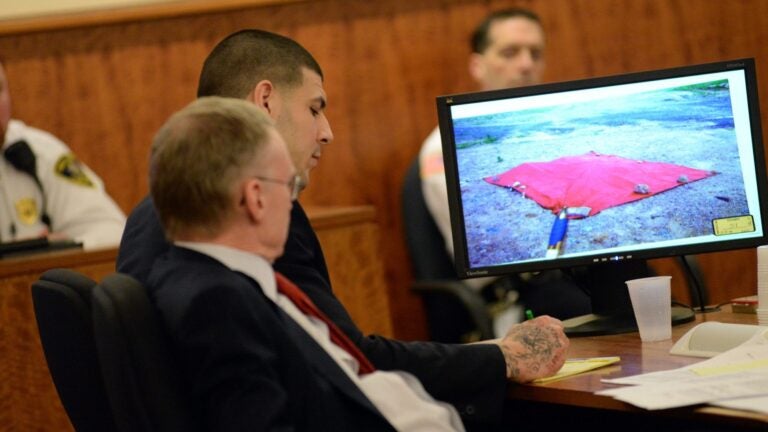
You’d be forgiven for thinking that the lawyers making their case in the murder trial of Aaron Hernandez care more about what was on witnesses’ feet than what’s on their minds.
Matthew Kent, a runner who discovered the dead body of Odin Lloyd in an industrial park in June 2013, said he wore Nike sneakers. David Swithers, the president of a company near the crime scene, testified that he wore orthopedic shoes. North Attleborough police captain Joseph DiRenzo, who investigated the crime scene, said he wore both sneakers and boots.
Why is there such an obsession with sneakers and boots in the Hernandez murder trial?
The emphasis on footwear stems from footprints found at the industrial park where Lloyd, a 26-year-old semi-professional football player, was shot and killed in June 2013. Prosecutors say the footprints at the crime scene come from a pair of retro Nike Air Jordans worn by Hernandez, who is charged with orchestrating Lloyd’s murder in the remote area.
The shoeprints are an important piece of prosecution’s argument because their case largely rests on circumstantial evidence. Prosecutors say video evidence shows Hernandez picking up Lloyd earlier in the night, and that a marijuana joint with Hernandez’s DNA on it was found at the crime scene. The murder weapon was never found.
[fragment number=0]
The shoes were important enough that investigators went back to Hernandez’s home in November 2014 searching for sneakers to help make their case. They did not seize any evidence.
Defense attorneys have argued that there were too many people in the area to prove definitively one way or the other. They have also questioned the quality of the police investigation of the area.
At last Thursday’s proceedings, DiRenzo testified that upon discovering the crime scene, police covered the footprint evidence with a tarp to protect it from an oncoming storm. On cross-examination, Hernandez’s attorneys got DiRenzo to admit that they did not cover the entire industrial park with tarps, and that other footprint evidence was therefore lost to the rain. They said the storm caused the investigation to be completed not in “the normal way.’’
In opening statements, Hernandez’s lawyers cast doubt on the prosecution’s claims of Hernandez as a murderer with a foot (coincidental?) reference.
“He had the world at his feet,’’ defense lawyer Michael Fee said. “In June of 2013, Aaron was planning his future, not a murder.’’
In some ways, the shoe emphasis is similar to O.J. Simpson’s murder trial. In that case, prosecutors said that bloody prints from a pair of size-12 Bruno Magli shoes were found at the murder scene of Nicole Brown Simpson and Ron Goldman. Simpson’s defense questioned the integrity of the police investigation and argued that he did not own any pairs of those shoes.
During his civil court trial, Simpson went so far as to say they were “ugly ass’’ shoes. Prosecutors then presented about 30 photos of Simpson wearing a pair of Bruno Magli shoes at a Buffalo Bills game.
The shoe prints in Hernandez’s case aren’t alleged to be bloody, but, if proven to belong to him, would be more evidence suggesting Hernandez was at the crime scene.
Hernandez’s lawyers may try to make the shoe prints the key issue of the trial and then question their veracity. After all, they might argue, if the shoe prints don’t fit, you must acquit.



To comment, please create a screen name in your profile
To comment, please verify your email address
Conversation
This discussion has ended. Please join elsewhere on Boston.com