
How Do Snow Days Get Decided?
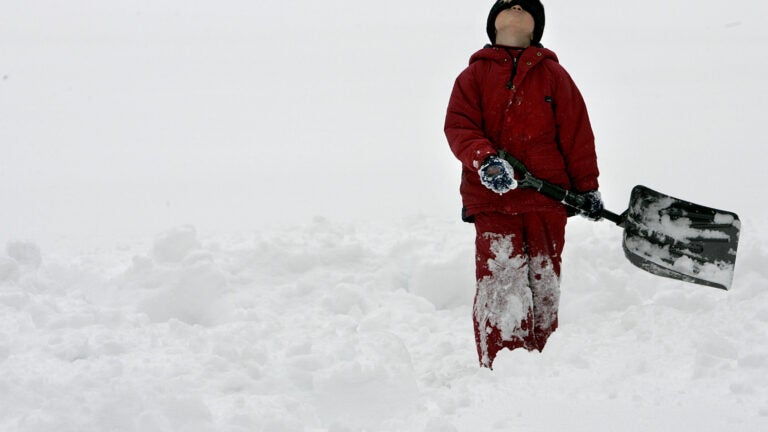
To students, snow days seem like magic — white, powdery, magic that gives parents headaches and teachers an excuse to stay in their pajamas. But snow days aren’t magic, and the way they get decided is even less so.
As kids and parents alike prepare for a snowy winter, we spoke with a wide variety of Boston area schools to see how snow days are decided. Here’s what we found:
Boston Public Schools:
BPS educates 74 percent of all school-age kids who live in Boston. That’s roughly 57,000 students spread among 128 schools, according to the BPS website.
Gabrielle Farrell, spokeswoman for Mayor Marty Walsh, said the snow day question comes down to two people: Mayor Walsh and the Boston Public Schools Superintendent, John McDonough. Together, they determine whether or not the BPS schools should remain open during extreme weather conditions. Farrell said the City’s Office of Emergency Management provides them with information like storm intensity, wind, timing, and snow accumulation. They also consider the impact on morning, afternoon, and evening commutes for children, teachers and other staff to make the decision.
“Their first priority is to keep everyone safe and warm this season,’’ Farrell said.
Lee McGuire, a spokesperson for BPS, said they try to make the decision to close the night before a storm is supposed to hit. The school system has about 700 buses on the road, so they need to have a decision before 5:30-6 a.m., when the buses start to pick students up. “It’s mostly about the timing,’’ McGuire said. “Will we have time to shovel out or will it hit at the peak of students walking to class?’’
Every storm is different, McGuire said, but regardless, BPS tries to give Boston families plenty of notice. “I can’t remember the last time we closed morning of,’’ McGuire said.
Private Schools:
From the Boston area private schools we spoke with, we noticed a few trends.
One trend was that many schools simply follow the BPS cancellations.
The Pope John Paul II Catholic Academy in Mattapan typically follows BPS, according to administrative assistant Linda Sullivan. As Sullivan said, “It’s just easier that way.’’ But she did say that occasionally, the school’s regional director closes school independent of BPS, if conditions are “really treacherous’’ for students traveling long distances.
Another trend we noticed was that at some private schools, snow day decisions are made solely by the headmaster, while at others, it’s a conference call full of people.
At The Commonwealth School in Boston, front office administrator Jaquelin Harris said Headmaster William Wharton makes all snow day decisions by “using weather connections and other reasonable sources at his disposal.’’
Yet at The Benjamin Franklin Institute of Technology, a vocational school in Boston, snow days are decided by the Dean of Students, Michael Bosco, in conjunction with members of an emergency management team. Bosco said he has two major conference calls to talk about weather patterns with the team — one the evening before the storm, and one the following morning before 5 a.m.
“We look at a lot of different things,’’ Bosco said. “Is there a state of emergency, MBTA issues, parking bans?’’
Another trend we noticed among private schools was that they close less often. There are two reasons for this. One reason is that private schools don’t have to deal with buses, so snow days don’t create headaches for coordinating with drivers. Additionally, unlike public schools, private schools have a set calendar. If school closes, they don’t get to make-up a snow day in May.
This holds true for Boston Trinity Academy in Boston. Headmaster Frank Guerra makes all snow day decisions there, and said he tends not to close for snow. “I think in the last five years, maybe we’ve closed for snow four or five times,’’ he said.
Suburban Schools
We spoke with spokespeople from Newton and Wellesley Public Schools to get an idea of how suburban schools handle snow days.
In both districts, the superintendent is in charge of closing school, and consults with the local police department and department of public works to reach a decision.
In a memo to families of students in the Newton Public School System, Superintendent David Fleishman wrote that he takes a variety of factors into consideration: : “weather forecasts, street, sidewalk, and school parking lot conditions.’’
The only difference we noticed between the two school districts was that Newton Schools seem less likely to close midday during inclement weather.
“If a storm occurs during the school day, school will ordinarily remain in session,’’ Fleishman wrote. “We are advised by the Police Department that once students are in school they are better off remaining there than being released early because of a storm.’’
Wellesley schools seem more likely to occasionally close school midday: “There are times when an early release of school may be required in the event, for example, of a storm intensifying mid-day that would make our regular dismissal hazardous. In that case, we would base the early dismissal time on the amount of time needed for our buses to complete their routes at all grade levels,’’ Superintendent David F. Lussier wrote in a memo to the Wellesley school community.





To comment, please create a screen name in your profile
To comment, please verify your email address
Conversation
This discussion has ended. Please join elsewhere on Boston.com