
Counting Crowds is an (Educated) Guessing Game for Cops and Reporters
Reporters get crowd estimates from cops. But where did the cops get the tools to estimate crowds? From a reporter.
I found this out when some beliefs I had about cops and reporters were recently squashed. I used to think cops and reporters had tenuous relationships. Then I started working in Boston. Colleagues told me the Boston Police Department (BPD) holds a grudge. (If that’s true, I haven’t seen it.) And I know from personal experience that newspapers, despite their claims of objectivity, aren’t above being petty.
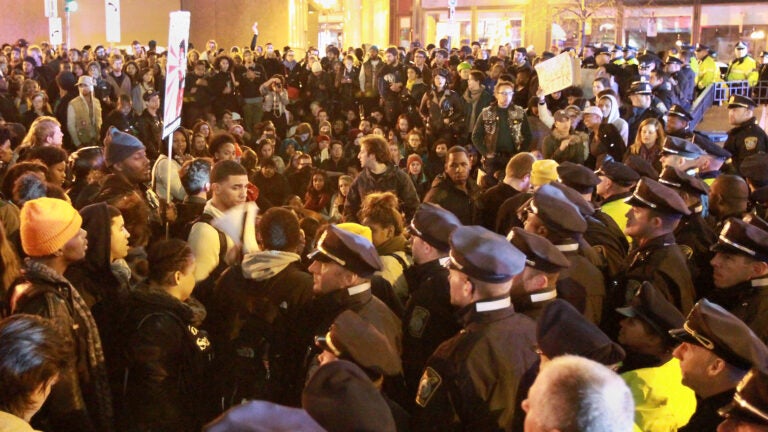
My fist encounter with the BPD came on December 4, when protestors converged on the Boston Common tree lighting. A charming, friendly BPD Spokesman named David Estrada told me police no longer issue crowd estimates. Estrada said local media once criticized the BPD’s methodology for crowd estimates. So the cops stopped answering questions about crowd estimates from reporters.
Every editor I’ve ever had – and I’ve had many – has told me to ask police for crowd estimates when necessary. Whether it be the size of a crowd at a Fourth of July Parade or the number of people attending a protest rally, reporters rely on the local police for crowd estimates.
Now I’m in a town where the cops won’t answer that question. Or so I thought. About an hour after he told me the BPD doesn’t issue crowd estimates, Estrada confirmed a number we heard from an officer on the street.
So, how do they do it? Since it seems like a sensitive topic here, I asked a police officer I know in Rhode Island. His name is Matt Robinson. He’s a detective in East Providence. And he’s a bit of a wonk. I mean that in the best way. Even in a profession populated by men and women who are detail oriented, his attention to detail is incredible. And entertaining.
“Have you ever been in a restaurant and guessed how many customers were there? If you have, like me, then you look around the room. Add up the number of tables. Average the number of persons (density) at each table. And multiply,’’ Robinson said.
“Major public event crowd estimates are done in much the same manner. There are several means to section off areas of a city or event location to estimate the ‘number of tables.’ Officials can measure the width and length of sidewalks and determine the square footage of the area of the sidewalks,’’ he said.
Officials then look to see how densely the measured sidewalk areas are populated. Overhead photographs are also used. Break the photos into grids and you basically have the same formula.
Oddly enough, this brings the conversation back to reporters.
“The Father of Crowd Estimation is Herbert Jacobs,’’ Robinson said.
Jacobs was a newspaperman. He worked for the Milwaukee Journal and went on to teach journalism at the University of California, Berkley.
“Herbert was teaching and witnessed the Vietnam protests. He had a vantage point that was elevated and he could see the protestors as they gathered in an area broken into grids,’’ Robinson said.
This protest inspired his formula, which takes what appear to be arbitrary assumptions and turns them into numbers. Such as:
A. Loose crowd – Each person has about an arm’s length of space, which equates to about 10 square feet per person.
B. Tight crowd – Each person has about 4.5 square feet of space.
C. Mob crowd – Each person has about 2.5 square feet of space.
“The use of Herbert’s density scale in combination with measured areas to calculate crowd estimation is called Jacob’s Method.’’
Armed with Jacob’s Method, officials can calculate the square footage of a sidewalk or grid and guess the population density. This will give them an educated guess as to how many people are in the grid location or on a given sidewalk. The officials add up their population guesses for each area and come up with an overall guess for their crowd estimation.
“During the Million Man March, event organizers wanted the crowd estimate of one million or greater to further their political agenda. Those opposed to the event wanted the estimate to be as low as possible and definitely below one million,’’ Robinson said.
The National Park Service estimated about 400,000 at The Million Man March. Event organizers estimated the crowd at about 1.5 million. The National Park Service stopped providing estimates when Million Man March organizers threatened to sue in 1995. They have since reversed that policy to calculate crowd estimates for preseidential inaugurations.



To comment, please create a screen name in your profile
To comment, please verify your email address
Conversation
This discussion has ended. Please join elsewhere on Boston.com