
At Old Sturbridge Village, Life Is Part Acting, Part History, and Lots of Butter Churning
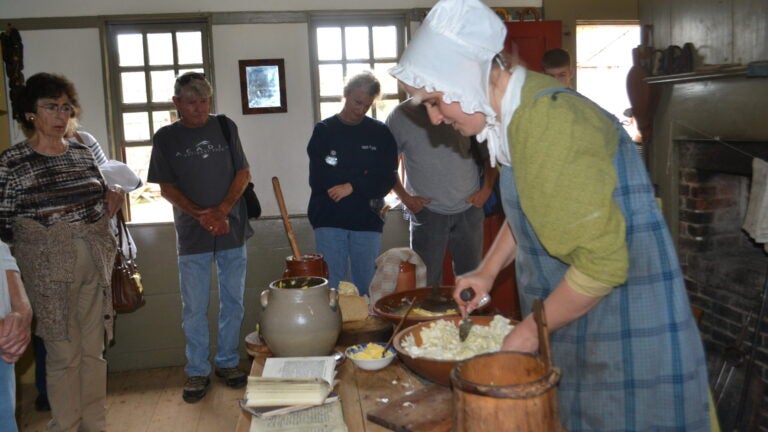
In her perfect world, Victoria Belisle would rise at 4 a.m. She would dress herself in a handmade cotton dress—the green one, dotted with small white flowers — and she would fasten the ties of a bonnet at her neck. Then she would spend the day milking cows, churning butter, feeding chickens, and cooking three meals over an open hearth. If she had time—and the season was right, late December—she’d slaughter a hog. No, she’s not delusional. She’s just the most dedicated interpreter at Old Sturbridge Village, a living history site in Massachusetts.
You can’t really blame Victoria. As she makes her daily walk down the dusty, tree-lined trail to the Village square, modern distractions—cars, telephone wires, and strip-malls—fade away. It’s easy to forget the century when you take your lunch at the red Bullard Tavern, or knit on the steps of the rustic Friends Meetinghouse. Only the occasional ambulance whining is loud enough to penetrate the 200-acre blanket of oak and maple trees hugging the New England town, forever stuck somewhere between 1790 and 1838. Old Sturbridge Village is about 58 miles southwest of Boston, next to the Quinebaug River, and remains the largest outdoor history museum in the Northeast.

Children play at Sturbridge Village.
Victoria works as an interpreter at the Village. Interpreters, also known as “authentically costumed staff,’’ teach visitors about middle-class life in this time period. They’re partly actors and partly historians. The job is attractive to history buffs…and the occasional eccentric.
Victoria falls somewhere in the middle.
She’s one of thousands in the country who spend half their week working at places like Colonial Williamsburg and Mount Vernon, both in Virginia, and the OK Corral in Tombstone, Arizona—i.e., enshrouded in another world. The idea of outdoor museums is not rare to the United States. In fact, this tradition began in 19th-century Scandinavia. Old Sturbridge Village is modeled after the historic town of Skansen, Sweden, just outside Stockholm.
Living history sites are a relatively new custom. But humans have re-enacted history for hundreds of thousands of years—narrating, sometimes dramatically, a collective memory.
Churning Butter
Wood crackles and pops in the brick fireplace. The smell of onions and firewood envelops the room like a cloak.
“I’m making butter. Want to help?’’ Victoria asks.
Her cheeks are rosy with morning activity and sweat dots her brow. The front door of the Freeman Farmhouse is propped open. Seven boys wearing maroon John C. Daniels School T-shirts stand in a half-moon around her. They’re on a field trip.
One of the boys raises a hand. He has spiky gelled hair, a navy hoodie three sizes too big, and black, thick-rimmed glasses.
“Good!’’ Victoria says.
He shuffles forward and grasps the wooden plunger with two small hands. He churns the cream in the barrel slowly at first, and then vigorously moves the thick liquid counter-clockwise.
“When we churn butter, we’re agitating cream. The fat will become butter. I’ll preserve it with salt,’’ Victoria says.
She’s in full interpreter mode. This means she will alternate between her role as 19th-century wife and 21st-century historian in an attempt to teach a bunch of easily distracted students.

Victoria Belisle reads from her book of receipts.
After about a minute, the boy steps back. He pulls a black iPhone out of his hoodie’s pocket. He films Victoria as she resumes churning. Three other students follow suit, pulling iPhones out of pockets and backpacks. One student holds an iPad as big as his face in front of him, zooming in on one of the black flies hovering over the cream.
“Why are there so many flies in here?’’ he asks.
Ah, the flies. Hundreds of them buzz about the ceiling and table. They land on the butter, cabbage, slabs of hog meat—prickly black hairs still in place—and occasionally, the boys’ faces. “Flies are heat seekers,’’ Victoria says. “Unlike chickens, they don’t incubate their eggs, so they have to find a warm place to lay them.’’
Contrary to what most people assume, Victoria and the other interpreters are free to break character whenever they want. If they’d like to live as a 19th-century person when they get home—well, that’s really up to them.
Chopping Cabbage
Victoria is in some ways a fairly typical 21st century 28-year-old. Like many of her peers, she’s worried about the environment, so she drives a Prius. She went to a small artsy college where she majored in art education, and makes the occasional trip to the supermarket for gluten-free rice flour (though she prefers to buy her meat and produce directly from local farmers.)
But Victoria often finds herself in a bit of a conundrum. Unlike most 21st century women, Victoria has a penchant for living like a woman would in the 19th century—1838, to be exact. While this sometimes hinders her (last time she was in a CVS, she became overwhelmed with their new electronic payment system and left), this predilection is extremely useful at work.
While chopping cabbage for a midday meal, Victoria noticed that one student seemed concerned.
“Do you really eat that?’’ He points to a ceramic plate brimming with breakfast hash—a brownish mixture of fried potatoes, root vegetables, and pork. Four or five flies climb over the mountain of cold food.
Victoria smiles. She wipes wet hands on her blue cotton apron.
“Of course I am!’’ she says. “I’m not worried about bugs. This morning, I came in after milking the cows, wiped my hands on my apron, and started cooking. It’s 1831, I don’t have a germ theory yet.’’
To prove her point, Victoria grabs a pinch of hash and pops it into her mouth.
“Ewwwwwww!’’ the boys say in unison. They grin from ear-to-ear.
Victoria is used to repeating herself. About every ten minutes, a new group of students cycle through the Freeman Farmhouse, where she spends most of her time at work. She fields wide-ranging questions. “How often do you brush your teeth?’’ is a common one. (“Almost never, but sometimes I scrub them with honey and charcoal.’’) Once she was asked how cows are artificially inseminated.

The Freeman Farm House
A rooster crows somewhere in the distance.
A white-haired man wearing a denim shirt, denim pants and a black Vietnam veteran’s cap steps through the open door. The wooden floorboards creak under his weight. He watches Victoria intently through heavy, square-shaped glasses as she shovels coal into a small pile in the fireplace. “What do you do when you go home?’’ he asks.
Victoria pauses, mid-shovel. She looks up. “In modern times? Or 1830?’’
“Modern.’’
Victoria laughs. “This. The same thing.’’ She leans the shovel against the wall and resumes her former place at the table, salting butter. She turns the lukewarm slab of yellow over and over in a bowl till it’s good and coated. “I was that 7-year-old kid who read all of the Little House on the Prairie and American Girl books, sitting on a blanket outside,’’ she says. “I love it.’’
She means it.
Victoria says that when she gets home from work, she continues many of her 19th century hobbies. She knits. She plays with her cat. She gardens. Once, she did slaughter a hog.
She’s currently reading John Brown’s autobiography for fun, she says while sitting on the stairs of the Village church. “It’s fascinating!’’
History Buff
Victoria seems to have an encyclopedia-like memory of historical facts. She constantly recites little known details about the past:
“The room in the farmhouse called the buttery comes from the name of a storage room called a butt. Lots of farms had them. You can’t dry cheese in the kitchen where you’d air your babies’ diapers. It would make the cheese smell bad.’’
“A good slab of hog meat will keep for 60 years as long as it’s been brined and no one’s cut into it—it could be a regular family heirloom!’’
“Ladies got married in their mid 20s, but mothers would have drilled into their heads to only get into a situation with a man who’s also a blacksmith,’’ Victoria says.
She knows that using a hard crust of bread to scrape dirt off wallpaper will clean it without leaving scratches. Earwax cures chapped lips. Recipes were called receipts.
Victoria, who does not own a television and uses a woodstove to heat her period farmhouse, learns about the past through a mélange of primary sources—diaries, journals, letters, magazines, periodicals, even seed catalogs. Sometimes, she studies 19th century art.
But the best way to learn is trial and error.
This was how Victoria discovered that for the past 70 years or so, Sturbridge has baked all of its cakes and breads incorrectly. Past interpreters had always thought that pearl ash referred to modern day baking powder on receipts they used for re-enactment meals. After experimenting with measurements at home, it was Victoria who learned that pearl ash was actually referring to baking soda. “Everything tasted terrible!’’ she says of the old cakes. “I felt so sheepish.’’
This is the kind of knowledge that could make other interpreters envious, but I saw no signs of jealousy. When other staffers hear her talk like this, they seem to admire her. In fact, when Victoria recites all the different color sources for 19th century dye (Cochineal beetles make red, indigo plants make blue), volunteer coordinator Kim Adams just laughs. “I don’t even know how to dye,’’ Adams says.
The interpreters are not alone in their awe. A veteran visitor of Sturbridge, a gray-haired retiree named Charlie, slips Victoria a McDonald’s pumpkin pie while making his daily rounds. All of the pigs run to greet Charlie before he tells me that Victoria is “by far, the best’’ interpreter.

Pigs at Sturbridge Village.
Victoria promptly slips the pie into the folds of her dress.
“I can’t eat this in public,’’ she says. Ever historically accurate, she even takes the tag off her English breakfast tea.
Quitting Time
Despite Victoria’s dedication, Sturbridge interpreters don’t make much money. As fellow interpreter Scott Corey puts it, “You couldn’t support a family on this salary. Probably couldn’t even pay your student loans off.’’
So why do they do it?
It’s a crisp autumnal day near quitting time, and Victoria sits near a mammoth acorn tree by the Village’s church. It’s windy out, and the tree’s branches shake, dropping acorns that dance and skittle along the church steps.
“People tell you to care about dressing nicely, having a nice car, a nice house—very materialistically set goals,’’ Victoria says. “I find that as I get older, the value of material things slides off.’’
A herd of sheep lope across the square just as a yellow carriage drawn by two draft horses plods by. A burly bearded man in a top hat cracks a switch with a light ‘thwack!’—“Giddy up!’’ he cries. And round and round he goes, black vest gradually fading to a dot as Victoria watches him.
“I value working and making things,’’ Victoria continues. “I value working to benefit people. I value relationships.’’




To comment, please create a screen name in your profile
To comment, please verify your email address
Conversation
This discussion has ended. Please join elsewhere on Boston.com