
The Louisiana Literacy Test May Be Ancient History, but Not the Hypocrisy Behind It
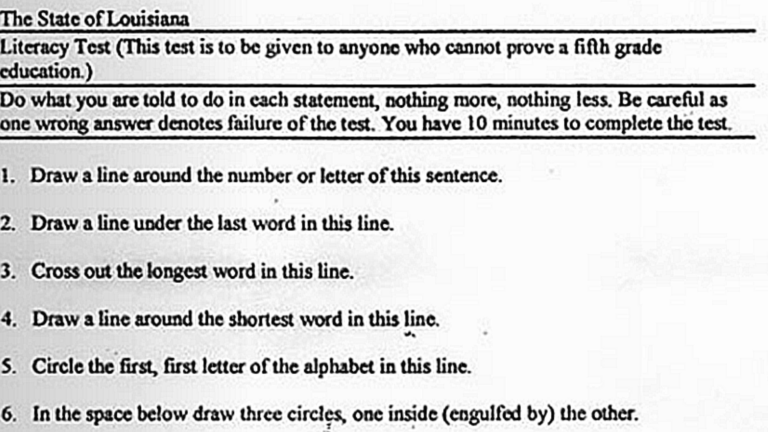
By now, you’ve probably seen or heard about the video featuring current Harvard students taking—and bombing—the Louisiana literacy exam.
[fragment number=0]
The exam was given to blacks in 1964. They had 10 minutes to answer 30 questions, and one wrong meant they failed—and were denied the right to vote. The video shows students marveling at the stupidity of some of the questions. As they should, since the ability to write “backwards’’ forwards is in no way indicative of one’s worthiness to vote.
It’s fairly funny to see kids from one of the world’s preeminent universities struggle with such asinine questions, until you realize that Harvard students were unable to pass a test administered to mostly poor blacks to determine their access to a basic American right.

Harvard students taking the 1964 Louisiana literacy exam
Nobody has to take the test now. But the spirit of the test—the pretense of giving everyone a fair shake while doing the opposite—is alive and well today (for example, in voter ID laws across the country). And it’s part and parcel of our discussions on race and class. Race issues are often recast as issues of class, but when class fails to block the effects of race, we can see things for what they are.
Yesterday, the Washington Post ran a piece by Lawrence Otis Graham, a black attorney, the author of more than a dozen books, and, if his family picture is to be believed, a man who lives 1,000 miles from a decent barber. In the article, he discusses his effort to shield his children from “the moment that every black parent fears: the day their child is called a nigger.’’
By his own admission, he thought his family’s “economic privilege’’—living “between a house in a liberal New York suburb and an apartment on Park Avenue,’’ with “preppy clothes, perfect diction and that air of quiet graciousness’’—could “buffer these adolescents against what so many black and Latino children face while living in mostly white settings.’’
Graham had orchestrated his own respectable, affluent life. He lived in a nice neighborhood, pulled up his pants, stopped making excuses, was a father to his children, and did everything else we tell anyone to do who rages when a cop shoots a black kid.
And then one day, when his oldest son was attending an academic summer program at an elite boarding school, Graham got a call from his son. Two white men in a beatup Acura pulled up next to his son and asked if he was the “only nigger’’ there.
If Graham had realized earlier that a lawyer in the suburbs is still a “nigger’’ to a great many white citizens, he could have saved money on that Park Avenue apartment.
Graham is neither the first black man to drive past the barbershop on the way to a family portrait, nor the first to think that affluence would mask his color. He’s not the first or last American to believe that respectability would do the trick, either. Graham could’ve been a coal miner, or an equally accomplished lawyer with dreadlocks and gold teeth. Neither would have shielded his child. While the path he chose is more outwardly respectable, the only thing it changed was the setting.
Respectability and social mobility make strange bedfellows. Social mobility is centered on the premise that the harder you work, the higher you go. If you buy into that basic causal relationship, you’ll be glad to know that according to a recent Harvard study, mobility hasn’t fallen in over 30 years.
That’s partially because there wasn’t much to begin with. And there’s research that suggests mobility can be predicted by the earnings of one’s great grandparents.
Sadly, buying into the if-then of mobility often comes with a strict adherence to the gospel of respectability: that if those less fortunate would stop being lazy and making excuses, if they would speak better and fix their own issues, they could turn their lives around.
Where mobility is static, respectability is fluid. Mobility can be measured with data; respectability is only measured by your response to society’s ills. If you were born in a trailer park to poor parents and make six figures now, you’ve climbed the income ladder. If you look at your son and hope the police don’t stop and frisk him, the time you spend seething would be better spent searching for employment.
That’s because the only goal of respecability is to move the goal posts, to busy the oppressed with the promise that if only this or that would change, so would their lot in life. It’s the reason we talk about dress code whenever a black person dies, even though MLK was killed in a suit. It’s why we discuss slang, though Henry Louis Gates’s vocabulary didn’t stop anything. And it’s why we tell blacks to educate themselves, forgetting Ted Landsmark had a bachelor’s from Yale when he got his nose broken near Boston City Hall. These conversations are never meant to help anyone. They are meant to appear as such while maintaing the status quo.
But let’s look at Graham again. He’s an affluent lawyer. He has a stable income and a beautiful, healthy family. He has reached the apex of respectability, and we are here because of the sadness he felt over what happened to his son. Should Graham maybe work two jobs?
In the same way we should be less upset over the the Louisiana literacy exam than at the thought behind it, we shouldn’t be lamenting this case of racism so much as asking ourselves what options we have presented to Americans whose accomplishments lag behind Graham’s.
Nobody is knocking Graham for anything but that ode to Jim Crow that is his haircut. His accomplishments deserve applause. But Graham would have been better served to know that preppy clothes could never shield his son from prejudice.
And we would be better served to accept that the flawed logic of respectability will never get us any closer to where we need to be.






To comment, please create a screen name in your profile
To comment, please verify your email address
Conversation
This discussion has ended. Please join elsewhere on Boston.com