
Even to a Cynical Newcomer From NYC, Menino’s Legacy Is Inspiring
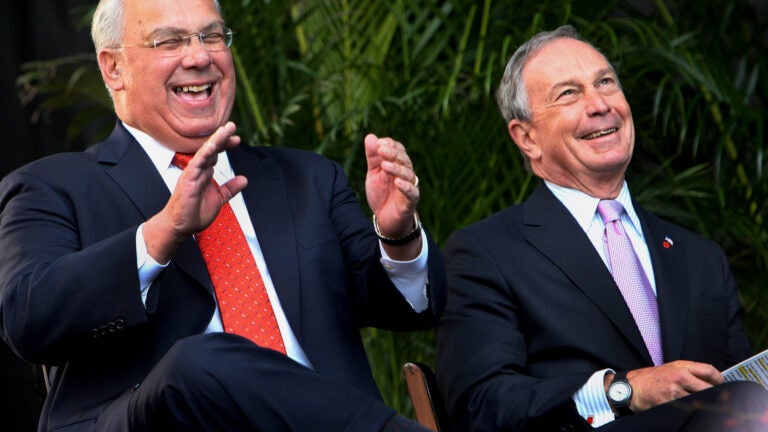
When the news broke on Thursday that former mayor Tom Menino had died, I was not where I wanted to be: in the Boston.com newsroom. Instead, I was stuck in line at a bank near Kenmore. For a while, I wondered if I should announce the news to everyone in earshot, but it didn’t seem right—I’d only just moved here from New York City at the end of September, and this didn’t yet feel like my news to reveal.
But after I’d seen the teller and was on my way out, I overheard a bank employee on the phone sounding confused. “The mayor?’’ he said. I had to say something—so I told him, and anyone who could hear, what I knew.
The mood of the room went dark and mournful. One employee seemed particularly crushed, a customer on line surprised. “He’d been sick,’’ I said. As I left, there were no tears, just quiet.
In one way, I’d been ready for this. When Menino announced he was stopping treatment for his cancer, the newsroom had gotten prepared in a hurry. Stories were written, coverage plans drawn up; all we were waiting for was the news itself. And when it came, it didn’t matter that I was halfway across town—my capable writers and editors executed the plans like the pros that they are.
What I hadn’t been ready for, however, was the depth of the emotion that has poured out in the days since Menino died. Sure, I’d known he was a popular mayor, but I spent the last 16 years in New York, where we kind of hate even (or especially) the popular mayors. When former mayor Ed Koch died in 2013, there was mourning and fond memories—the guy was a real character, after all—but it wasn’t long before critical voices rose up, too, reminding the world of Koch’s failures in dealing with the AIDS crisis and racial inequality. And this was a guy that we basically liked!
It’s impossible to imagine Menino-esque mourning for any of those who followed Koch: Dinkins? Giuliani? Even Michael Bloomberg, whose contrasts with Giuliani were at first heartening, eventually outstayed his welcome; while he’ll be remembered for transforming the city over the course of three terms, a significant portion of the city is not anywhere near happy with that transformation. As for DeBlasio, well, it’s too soon to speculate.
Here in Boston, I keep waiting for the knives to come out, for Menino’s bitter enemies, long silenced, to trot out their lists of failures, miscalculations, and outright crimes. That’s what always happens, right? We lionize—and then we kill our heroes. After all, how could anyone in this world, especially a politician, be wholly loved? And yet the worst I’ve read is that Menino was a micromanager and that he had a bit of a temper. I’ve been googling in search of anything resembling lingering anger, or even pointed criticism, and found almost nothing.
Instead, I keep reading about how every corner of the city both felt and appreciated his efforts. Yes, he launched the big-city mayor projects—the $500 million developments—but he also brought in supermarkets, and he didn’t just walk the streets with the people, he walked every street.
A cynical observer—and as both a recovering New Yorker and a practicing journalist, I should probably be just that—might roll his eyes at the über-folksy image, and yet I’m heartened. This is a place where the rhetoric of unity, whether in the face of daily urban travails (school, crime, the commute) or in the event of calamity (the Marathon bombing), was actually more than rhetoric, and has lasted beyond one man’s lengthy tenure. Boston, to this newcomer, feels like a place that is sure of itself, of all of itself, of its past, its present, and maybe even its future.
Which is not to suggest Boston is some kind of magical urban utopia. I mean, just look at the Green Line. Or, more seriously, look at the city’s public schools, which remain overshadowed by those of its neighbors, leading families both established and newly arrived (such as mine) to look elsewhere in search of educational opportunities.
There are real, ongoing issues here that need to be confronted.
And perhaps the greatest asset that Boston has in confronting them is its people’s belief in Boston, not just as a place but also as an idea: Boston means something, no matter what happens. In New York, by contrast, that kind of unity comes only rarely, usually as the result of a disaster on the level of 9/11 or Hurricane Sandy, and the political, economic, and geographic fissures in that unity appear almost instantaneously. New Yorkers are only New Yorkers when threatened, physically or psychologically, by the outside world. (The rest of the time they’re too wrapped up in their boroughs, neighborhoods, and subneighborhoods to believe in the totality.) Bostonians are Bostonians no matter who’s paying attention. Here, as the outpouring of support after Menino’s passing proves, the idea has outlived the man—and will, I hope, outlive us all.





To comment, please create a screen name in your profile
To comment, please verify your email address
Conversation
This discussion has ended. Please join elsewhere on Boston.com