
Paid Sick Leave Could Destroy the Restaurant Industry! Oh Wait, That’s Wrong—It Totally Won’t
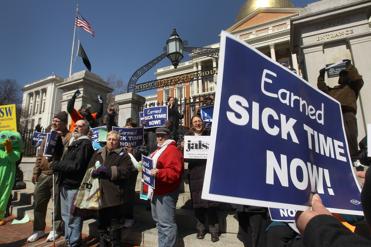
While most of the attention has been focused on the governor’s race, when we go to the polls next week, there’s a much more momentous issue at stake: The entire restaurant, retail, and hotel industries could come crashing to a halt. With one vote, businesses will disappear overnight, turning the city into a derelict ghost town. Every other storefront you pass by will be boarded up, left to the destructive effects of entropy and the elements, as marauding gangs of scavengers, now jobless, fight packs of feral hyenas in the alleyways for scraps of bone.
It’s a grim future. And all because businesses might have to start providing workers with paid sick leave.
At least that’s the apocalyptic picture painted by opponents of Question 4. Bob Luz of the Massachusetts Restaurant Association implied as much in an op-ed in the Boston Herald earlier this month, calling it a “rigid job-killing mandate.’’ His is an outlook echoed by the National Restaurant Association, a group only slightly less odious than its acronymous namesake, who’ve introduced paid sick leave preemption bills in states throughout the country in order to help curb this encroaching menace of basic decency in working conditions. For powerful lobbyists in the restaurant industry, there’s no alteration of the status quo—one in which restaurants are barely required to even pay their employees in the first place—that isn’t a harbinger of doom. Paid sick days? What’s next, a living wage? One wonder what the point of even going into business is if you’re going to have to treat your workers fairly.
But despite the hand-wringing, the march toward paid sick leave for workers in America has been progressing at a heartening rate. It’s about time, too. The United States is one of only 22 wealthy countries that doesn’t provide for paid sick leave for workers, according to a report from the Center for Economic Policy and Research. As Think Progress notes, the pace of such laws has intensified in the past couple of years, as cities and states throughout the country have joined San Francisco, Washington D.C., Seattle, and Connecticut, among a dozen others, in enacting paid sick leave laws. In 2013 Portland, Oregon, and Jersey City, N.J., joined suit, followed this year by the state of California. A similar law to the one under consideration in Massachusetts is also making its way through the state legislature in New Jersey at the moment, along with Maryland, Vermont, Washington, and Oregon.
As you may not be surprised to hear, restaurants are still in operation in those locations.
While it’s a positive start, it’s still far from perfect.
“Currently, 90 percent of restaurant workers report not having paid sick days, and 60% report having to work while sick,’’ Maria Myotte, of the workers rights group Restaurant Opportunities Center United, tells me.
“Workers without paid sick days are 1.5 times more likely to work while sick with a contagious illness, which costs an estimated $160 billion each year in lost productivity,’’ she says. “The lack of paid sick days, and the NRA’s campaigns against paid sick days and voters, is a major public health concern. The NRA is lobbying to protect the interests of corporations, not the public, and definitely not restaurant workers.’’
While the law in Massachusetts would apply to any employer with more than eleven employees, allowing workers to earn and use up to 40 hours of paid sick time each year, and allow workers at smaller businesses to earn unpaid sick time, I’m focusing on the restaurant industry, not only because it’s so self-evident why we shouldn’t want sick people preparing and handling our food but also because it’s something I’ve seen myself, having worked in the restaurant industry for many years, and among friends and colleagues, nearly every one of whom has a story about being forced or feeling pressured to work despite being unwell. If you haven’t puked in a restaurant bathroom with a fever, then you haven’t worked in a restaurant.
A report by the National Opinion Research Center at the University of Chicago found that 23 percent of workers lost their jobs or were made to fear for losing their jobs by taking time away from work for being sick, or for a family member being sick.
Feeling the pressure to work when sick isn’t always a top-down directive from bosses, although there is certainly plenty of that in play; often for workers in industries like food service, missing a day’s pay simply isn’t a viable option.
“I went to the hospital last summer because I had headache so terrible I was losing vision,’ Anthony Lucivero, a server in Cambridge, tells me. “I got diagnosed with cluster headaches, and I got hooked up to an IV of morphine. But I had to leave for work because, you know, rent was due.’’
So just what is it that’s worth sacrificing the health of our workers, and the health of customers, for in the eyes of restaurant lobbying groups?
In 2011, Connecticut was the first to pass a state-wide paid sick leave law. Around that time I heard similar sky-is-falling rhetoric from business associations about how detrimental such an allowance would be to the economy. And yet, somehow, against all odds, small businesses still exist in the state. In fact, the effects seem to have been minor, according to a study by the Center for Economic Policy Research, the Murphy Institute and the City University of New York.
“Only a small minority of employers reported that they had made changes in their operations due to increased costs associated with the new law,’’ the report found. “Virtually none reported reducing wages, nearly 90 percent did not reduce hours, and about 85 percent did not raise prices. Fewer than 4 percent reduced operating hours and fewer than 2 percent reduced the quality of their services.’’
Connecticut’s law is a bit less restrictive, applying to businesses with 50 employees or more. In Seattle, on the other end of the spectrum, the law applies to businesses with 4 or more employees. An audit from Seattle’s Office of the City Auditor and the University of Washington found similar results, however:
“Costs to employers and impact on businesses have been modest and smaller than anticipated. The majority of employers have seen no effect of the Ordinance on customer service, employee morale, predictability of employee absenteeism, or profitability. Anecdotal cost information puts the cost of providing leave at about four tenths of one percent of total revenue. There is no evidence that the Ordinance caused employers to go out of business or leave Seattle.’’
If you believe Luz and the MRA, Massachusetts will be different for…well, he doesn’t really explain why. Workers will delight in their newfound excuse for absenteeism, he suggests, because as we all know low-wage workers aren’t to be trusted. Besides, he says, many workers already have the option of begging friends and colleagues to cover their shifts. What more do these people expect?
I’ve spoken to plenty of restaurant owners and managers who have brought up plausible concerns for why this law might have an impact on their businesses, and I’ve got no doubt they’re actually worried about it. The thing is, I just couldn’t really care. We hear so much sanctifying rhetoric about the health of the small business owner in this country, which is just a phony, coded way of saying slightly less poor people who’ve pulled themselves up by their bootstraps. Guess what? No one promised you a thriving small business.
Here’s an argument from the Very Serious and Concerned Businessman side: If the economics are such that you can’t operate without paying your employees a fair wage and providing them with reasonable sick leave, then maybe you shouldn’t be in business in the first place?
Bringing our state up to the level of the rest of the wealthy, progressive countries in the world, and increasingly, our best cities, is about more than a few percentage points on a businesses’ bottom line, it’s about the health of our society. So vote yes on Number 4. Anything else is enough to make you sick.




To comment, please create a screen name in your profile
To comment, please verify your email address
Conversation
This discussion has ended. Please join elsewhere on Boston.com