
Keene Is Not Ferguson—Despite the Police, Fires, and Tear Gas
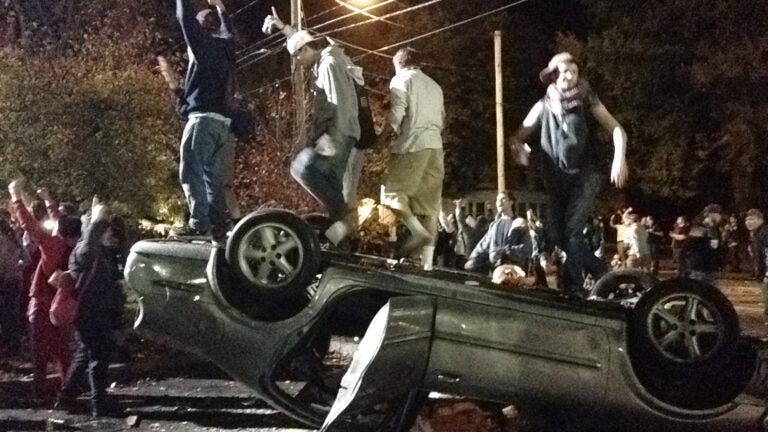
On Saturday in Keene, N.H., parties held in the vicinity of Keene State College, ostensibly in celebration of the city’s annual Pumpkin Festival, overflowed into the streets, leading to a night of near chaos. Dozens of injuries were reported—albeit none too serious, it seems—and images of wounded partygoers, some hit by bottles thrown as projectiles, abounded on social media. It was hard not to see a parallel between the images of mayhem—fires, overturned cars, unruly crowds, and, in particular, police in riot gear—and the protests that have transpired on and off for the past couple of months in Ferguson, Missouri.
So, too, was it tempting to conflate the response of the police—including law enforcement from throughout New Hampshire and Massachusetts—with the troubling pattern of police militarization that has been, rightfully, pushed to the forefront of the national opinion-trafficking agenda since the shooting death of Michael Brown in Ferguson. As in Ferguson, officers in Keene deployed tear gas and rubber bullets (but not, it seems, their $286,000 BearCat armored vehicle, which had been notably mocked as an exemplar of the military-police state run amok by the likes of Stephen Colbert). Others observed the conspicuous differences in the language used by the media to describe the incidents in the two cities: the “rowdy students’’ in Keene, as the Herald portrayed them, versus the violent “thugs’’ in Ferguson. Here’s CNN referring to Keene’s “bonfires,’’ as opposed to what they really were: acts of arson. And here’s CNN being taken to task on Twitter:
[fragment number=0]
[fragment number=1]
But that’s where the similarities seem to dry up—which is as it should be.
If anything, comparing Keene to Ferguson is a gross misrepresentation of what’s at the heart of the latter. People are right that we aren’t using the correct words to describe what happened in Keene, and in the numerous other instances of similar party-born destruction that transpires on college campuses through the country every year, like the massive riots at UMass–Amherst earlier this year, or riots Saturday in Morgantown, following West Virginia’s victory over Baylor. We’re actually not being hard enough on them.
In all of the coverage of the tumult in Keene I read over the weekend, a few things stood out. Certainly the photo of three men standing on top of an overturned car and the one of a backpack-wearing idiot leaping off of a roof into a crowd number toward the top. But even more than those, even more than the now overly familiar photos of police in riot gear standing in formation against a backdrop of night-lit billowing gas, or helicopters circling overhead of citizens amassed in the streets, was a particular quote from an attendee.
“It’s fucking wicked,’’ an 18-year-old from Haverhill, Mass., told a Source Sentinel reporter. “It’s just like a rush. You’re revolting from the cops… It’s a blast to do things that you’re not supposed to do.’’
Granted, it’s a chug-fueled quote from a random doofus, but that’s exactly the point. It’s a quote that so perfectly encapsulates what incidents like these are about that it almost feels like it was scripted. Actually, a film student would be laughed out of his screenwriting workshop for devising such a glaringly obvious villain of boorish, unworried privilege. (It’s probably worth mentioning here that a mere 0.8% of the students at Keene State are black.) For the students and their fellow party animals in Keene—as for those on every other college campus where a cocktail of fawn-legged inebriation conspires with a surfeit of leisure time and a dearth of actual strife to concoct a pantomime dawning of oppression drag—people like these seek out the ire of police as if it were, well, a party game.
Would that it were so easy for the folks in Ferguson and other communities around the country where a party invite addressed to the local police force need not be flung in the form of a vodka bottle, as it’s assumed they’re going to pop by later anyway.
Perhaps it’s something that’s just particularly troubling to me as I think about the 10th anniversary of the mayhem following the Red Sox World Series win in 2004 today—a night in which Emerson College student Victoria Snelgrove was tragically, wastefully, rage-inducingly killed by being struck by a rubber bullet fired errantly by police into a crowd—but I can’t help but think that there are some things that just aren’t worth taking to the streets over. None of which is to by any means place any of the blame on Snelgrove, who was merely a peaceful sports fan in the wrong place at the wrong time. But the impulse among young people to flood into the streets, like so many do when any sort of major sporting victory, or loss, takes place, to flirt with the idea of protest and rioting, is one that persists. As we’ve seen in Keene, sometimes it doesn’t even require a World Series to fuel the fire, but a mere celebration of pumpkins.
The events in Keene this weekend have nothing whatsoever in common with Ferguson, unless you consider a 30-year-old Beastie Boys song a strong model for civil disobedience. Ferguson can be rightfully and emphatically called a protest, a response to a serious injustice, and a systematic overstepping of authority that takes place day by day outside of the nation’s college campuses. I think we’ve got the wrong idea about who the thugs are here. Taking to the streets without a cause isn’t a righteous protest, after all—it’s nothing more than a mob.






To comment, please create a screen name in your profile
To comment, please verify your email address
Conversation
This discussion has ended. Please join elsewhere on Boston.com