
Will Somerville Put Its Money Where Its Mouth Is on Campaign Finance?
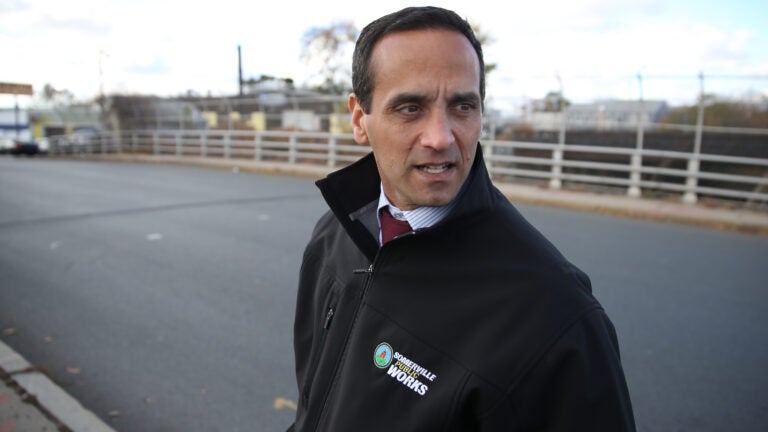
Somerville Mayor Joe Curtatone issued his first-ever veto of an ordinance passed by the city’s board of aldermen last week. The ordinance would set tougher restrictions on campaign financing in the city, which likely would have had the greatest impact on Curtatone’s own fundraising efforts.
Let’s back up a bit.
Last year, a few aldermen introduced a law that would limit campaign contributions for city elections to $300 for individuals who were, or whose companies were: looking to gain a no-bid city contract; looking to make a real estate deal with the city; seeking financial assistance from the city; and, most notably, looking to do significant construction or renovation in the city. Remember that last part—it’s important.
State law sets the current maximum donation at $500, so it’s not like the ordinance would have a massive effect on Somerville’s campaign war chests. But the legislation would be the first of its kind in the state, and would come at a time when money and politics are widely seen as overly codependent. You could argue its passage would be somewhat symbolic, but it also would knock at least a little bit of money out of Somerville’s local elections.
Curtatone responded to the proposed law last spring by introducing his own dueling take on a campaign finance reform ordinance. The two ordinances were similar, but the mayor’s put the donation limit at $250 rather than $300. And notably, it removed the limit for real estate developers, making for the most marked difference from the original proposal. (The mayor’s ordinance also differed by applying the limit on those seeking employment with the city, and included a requirement for lobbyists to register with the city clerk.)
The two ordinances went into committee for more than a year, and in the end, the original ordinance prevailed with some adjustments, such as its adoption of the $250 limit proposed by Curtatone. It was complete with language about real estate development, specifically applying to developers looking to do greater than 10,000 square feet of renovations or new construction. Over the course of deliberations, the development issue proved to be the divisive one, and Curtatone threatened to veto the ordinance if it went forward.
Earlier this month, aldermen voted 7-4 to pass the ordinance, despite that threat. Curtatone followed through on the veto warning last week. The board of aldermen can override the veto later this fall, but will need eight votes in order to do so—something it doesn’t seem likely to reach.
So why was the developer issue enough to lead the mayor, who with his own proposed ordinance had said he supported campaign finance reform, to lower the veto on the passed law?
Before passing the ordinance, some aldermen suggested that Curtatone’s issues with it had to do with his own political riches—and the real estate and development companies that help to bolster them.
From The Somerville Journal::
“We should not have a system that allows the Maguire Group to give $6,000 to the mayor in one day – one day – from various executives within that company. That is a system that is flawed,’’ (Alderman Rebekah) Gewirtz said. “It doesn’t mean the recipient, the person on the other side, is influenced by that, but clearly there’s intent. I don’t think anyone would deny that exists.’’
And:
Ward 4 Alderman Tony Lafuente shared Gewirtz’s concern about the donations the mayor receives from development groups…
The ordinance would have had the biggest impact on the man who vetoed it. No mayor outside of Boston fundraises quite like Curtatone, who has $146,000 on hand—and is known to have interest in running for statewide office. (He publicly flirted with a gubernatorial campaign last year.) In an uncontested 2013 election year, Curtatone received nearly $18,000 from people who identified as a “real estate developer,’’ a “real estate asset management’’ worker, a “property manager,’’ or other related titles. Another $9,000 came from presidents, principals, and owners of real estate-related companies, and $10,000 came from people working in constructing and contracting companies.
Many, but not all, of those people donated more than $250 (the limit the proposed ordinance would set). And all together, it’s only a portion of the mayor’s overall 2013 fundraising efforts.
But the point stands that those involved in real estate development help the mayor bring in a lot of cash. And many of those donors would be the people to whom the law would apply.
Development in Somerville is done with the approval of Somerville’s planning board and/or its zoning board of appeals. The people who would want to do this kind of development get permission from those mayoral appointees. And that plays into the mayor’s political finances, too. As a Dig Boston series published in 2013 (which, full disclosure, I helped to write) found:
Of the 45 biggest projects that the ZBA approved between 2010 and 2011— their case load minus small-scale residential applications — all but nine were for applicants who donated, either directly or by proxy, to Curtatone.
Long story short: Aldermen think the mayor vetoed the ordinance because it could cut into his own fundraising, which is partially driven by real estate development at a time when real estate development is one of the first few words that come to mind when you think of Somerville.
Curtatone says that’s not right. He wrote a letter to aldermen ahead of their vote saying his issues with the ordinance were essentially that it leaves a lot of loopholes, and that it could politicize the zoning and planning boards.
Curtatone’s argument seems odd when the entire notion of the ordinance is to depoliticize projects. If two projects were facing the ZBA and one was in violation of the new ordinance, it would not be able to go forward unless the candidate in question gave the money back. That would seem to wipe the politics out of play—especially considering the appearance that they are currently in play. For example, there’s the donation trend cited above. There’s also the fact that one of Curtatone’s biggest fundraisers is an attorney who regularly appears in front of the ZBA, and the board’s chairman has in the past been a client of that very attorney.
Mayoral spokesperson Dann DeMaina said that the ordinance would get in the way “of having those boards follow state and case law that requires that they review specific projects and not applicants, based upon the merits of the project, based solely upon the application of the zoning ordinance.’’ Again, that’s sort of the point of the ordinance. If you donate too much, you don’t get to build.
As for the mayor’s other argument, that the proposed ordinance would leave significant loopholes, DeMaina offered a couple theoretical examples. Would somebody who donated to a losing campaign still be unable to build a year later because of that donation, which would be more difficult to refund than it would from a winning campaign? Or, what if a project is presented in front of the board and then sold to somebody who had made donations with the project in mind?
Fair points, both of them. But with the veto, you have no campaign finance reform at all.
Asked why it wouldn’t make sense to allow the ordinance to pass in its current form and then build from there, DeMaina said it would amount to “window dressing.’’ “We’re not interested in making headlines—we’re interested in good legislation,’’ he said.
To hear Curtatone’s administration say it, the problem with the vetoed law wasn’t the inclusion of real estate developers. It’s that regulations on those applicants, who were left completely unaddressed in the mayor’s original ordinance, wouldn’t go far enough.
Asked directly whether any form of the law would be acceptable if it included the development language, DeMaina said yes—if it was “enforceable, effective and comprehensive,’’ and then pointed to the logistical problems mentioned above as what would first need to be solved.
Aldermen have good reason to be skeptical of a mayor whose fundraising efforts rely quite a bit on real estate development, and whom this ordinance would most affect. That skepticism is doubly justified when this is Curtatone’s first veto of an ordinance after more than a decade in office. In the face of that veto, though, they’d probably need to address some of the nitty gritty cited above to tell whether the mayor is bluffing when he says he’s on board with the reforms but for an issue here or there.





To comment, please create a screen name in your profile
To comment, please verify your email address
Conversation
This discussion has ended. Please join elsewhere on Boston.com