
Harry Wasserman, 93, of Lexington; organic chemistry professor’s art illuminated science and much more
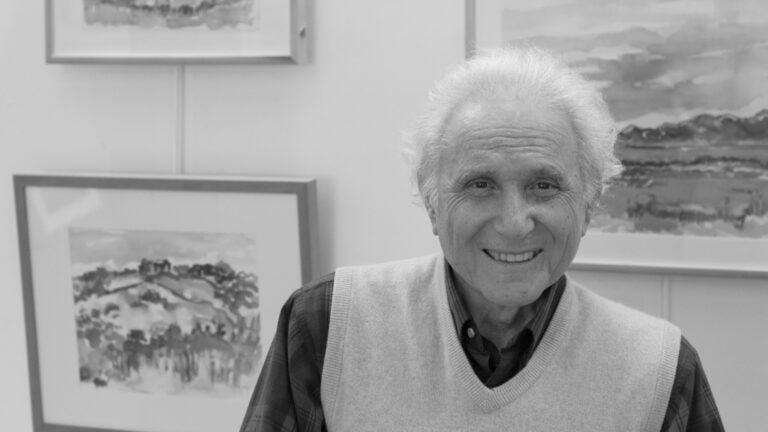
Before beginning studies at Massachusetts Institute of Technology at 16 and stepping onto an academic path to Harvard, Yale, and life as a science professor, Harry Wasserman was an artist, deftly capturing details of everything he encountered.
“As far back as I can remember, I had a consuming interest in drawing,’’ he wrote in the exhibition catalog for “From Battell to Bologna,’’ a 2004 show of his watercolors at Yale University. “Whenever I had a pencil and paper, I drew pictures and designs, and as a student, I liked to liven up any notes that I took in class or lecture with illustrations or graphical embellishment of the subject material.’’
When he moved from his desk among students to the front of the classroom as a professor at Yale, Dr. Wasserman kept drawing, illuminating the intricacies of organic chemistry with the precision he brought to watercolors of dunes on Cape Cod or line sketches of passengers on Boston’s subways.
“Harry had these gifts as an artist, and the language of organic chemistry is often spoken in schematic drawings of molecules, most often on a blackboard with three-dimensional representations,’’ said Scott J. Miller, a former colleague of Dr. Wasserman’s at Boston College and now the Irénée duPont professor of chemistry at Yale. “Harry was such a gifted artist that he could convey all the aspects of the molecules through his perfect drawings.’’
Dr. Wasserman, who was the Eugene Higgins professor of chemistry emeritus
at Yale, and who in retirement was a visiting professor at BC, died at home Dec. 29 of complications of vascular dementia. He was 93 and lived in the Brookhaven at Lexington senior community.
“He had this great sense of wonder,’’ said his son Dan of Milton, the Globe’s editorial cartoonist. “It was in his art, it was in his chemistry, it was even in his sense of language. He explored and invented in a series of endeavors. He was truly curious about other people in the same way he was about his art and the work he did in the lab.’’
That curiosity extended from those he met during travels to places as distant or near as Wyoming or Wellfleet to every student who had the pleasure of taking one of his classes, and many were effusive about being taught by Dr. Wasserman.
In 1977, Yale awarded him the DeVane Medal
for excellence in teaching, and, in 1985, he was the recipient of Yale’s undergraduate teaching prize.
“He captures the attention of his audience by traveling among his students with microphone in hand,’’ that citation noted. “Many students feel that Professor Wasserman has accomplished the impossible, for he succeeds in making a large lecture hall seem small.’’
His talents were not confined to the classroom. In an early 1970s faculty profile for Yale Scientific magazine, the authors paused before delving into the specifics of his laboratory research to note that since 1951 he had been part of The Gloom Exterminators, a jazz ensemble that “featured Dr. Wasserman on a smoking-hot clarinet.’’
A member of the National Academy of Sciences and the American Academy of Arts and Sciences, Dr. Wasserman was an award-winning chemist who researched inventive ways to design and synthesize natural products and antibiotics. He took time to elevate the teaching of organic chemistry to the level of performance art. A biographical description for a Catalyst Award for quality teaching that he received from the Chemical Manufacturers Association in 1985 mentioned that on a given day, he might use the family’s golden retriever to deliver materials during a class.
“His lectures have been described as ‘artistic and dramatic,’ ’’ the essay noted. “They were, as one student writes, ‘the excitement of a college day.’ ’’
The second of four children, Harry H. Wasserman grew up in a series of apartments in Revere. During the Great Depression, his father sold shoes when jobs were available. His mother played piano for silent movies.
“I never understood why we moved so frequently,’’ he wrote in 2001. “Most probably it was because we were always looking for cheaper accommodations or were desperate to get out of a bad location or untenable situation. Bad locations were easy to come by.’’
Dr. Wasserman added that “although we lived in poverty, family life was happy.’’
A shoestore job for his father in Central Square brought the family to Cambridge, where he graduated early at the top of his Cambridge High and Latin class and was awarded a four-year scholarship to MIT.
“Even then, I remember his classmates used to come to him and ask him to draw posters for them when they were running for office,’’ said his brother, Herbert, of Lincoln. “Art for him developed very early, and he never stopped drawing.’’
Dr. Wasserman graduated from MIT with a bachelor’s degree in chemistry and began graduate studies at Harvard in the lab of Robert B. Woodward, who in 1965 was awarded the Nobel Prize in chemistry.
In 1943, he joined
the Army Air Forces, becoming a captain and helping to protect bases in Africa and the Middle East.
Returning to Woodward’s Harvard lab, he met another chemist, Elga Steinherz, and they married in 1947.
“He showed his affection to my mother till just about the last day,’’ said their daughter, Dr. Diana Wasserman of Acton.
Dr. Wasserman began teaching at Yale in 1948, the year before he received a doctorate from Harvard. During some 4½ decades at Yale, he was awarded a Guggenheim Fellowship, and the American Chemical Society twice honored his work.
“My father was a wonderful teacher,’’ his daughter said. “That was true not only in his professional life.’’
At home, he often would unwind by playing clarinet, his daughter said, and “would put on a famous LP of one of the jazz greats and play along with it and learn all the 1940s jazz.’’
A memorial gathering will be announced for Dr. Wasserman, who besides his wife, daughter, son, and brother leaves another son, Steven, of San Diego; seven grandchildren; and a great-granddaughter.
“He was just beloved,’’ said Miller, who met Dr. Wasserman at Boston College. “People were inspired by him scientifically and by his personality. Everyone was elevated in every way by his contributions.’’
Faculty, Miller added, “are often judged on their scholarship, their teaching, and their service to the scientific community, and Harry was really a paragon of excellence in all three.’’
Dr. Wasserman painted subjects he saw in his travels.
“I have been fortunate to have the benefit of my wife’s critique,’’ he wrote in the art catalog. “She provides encouragement and advice regarding that important guideline in achieving success with watercolors, the sense of when to quit.’’



To comment, please create a screen name in your profile
To comment, please verify your email address
Conversation
This discussion has ended. Please join elsewhere on Boston.com