
Scientists shake up studies; the results could intoxicate
Bar becomes a temporary physics lab
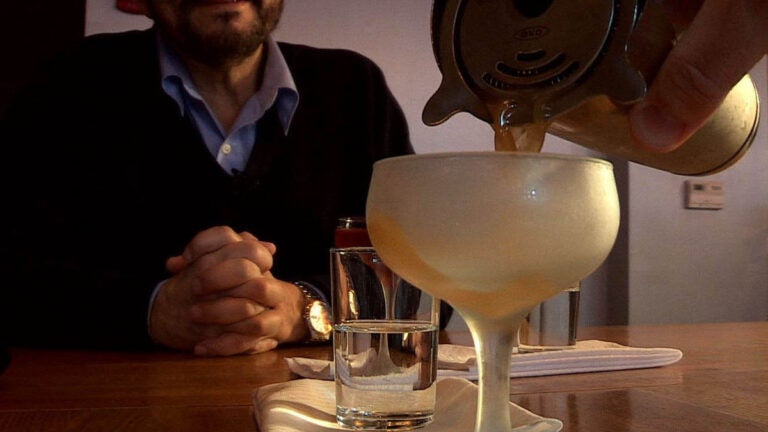
Two physicists walk into a bar and pull up corner seats. The bartender asks what they’re drinking. The professor and the graduate student order cocktails for a scientific palate. There’s one drink that suddenly turns cloudy. In another, bartending alchemy turns liquid ingredients into a solid. And there are two Manhattans (an experiment better known as shaken vs. stirred).
David Weitz, a professor of applied physics at Harvard University, and Naveen Sinha, a graduate student, usually spend their afternoons in a laboratory, studying the physics of “soft condensed matter’’ – better known as squishy things. But teaching a class on the science of cooking got them interested in taking a closer look at everyday eating.
The simple act of shaking a drink, both realized, is really an experiment – a fun, even intoxicating one that sneaks some basic scientific principles into each sip.
Sinha spent time with John Gertsen, the general manager of Drink, a Fort Point cocktail bar, talking and tasting, and recently published an article on cocktail physics in the magazine Physics World.
So one afternoon, at the request of the Globe, Sinha and Weitz left the lab and bellied up to the bar at Drink to show how something as frivolous and festive as a cocktail can double as a science lesson.
“We study the way materials around us behave – foams, emulsions, materials that very sophisticated drinks’’ are made of, Weitz said.
While Sinha and Weitz’s approach differs from Gertsen’s – Weitz talks about “instrumenting’’ a drink with specially placed thermometers and using weights to measure the properties of a foam – there are even more simple principles that can be taught in a bar.
“We use this as a way of teaching science,’’ Weitz said. “[People] are learning about science, but it’s being disguised as something that’s lots of fun.’’
The physicists asked Gertsen to start with a classic drink and a classic question: Shaken or stirred? Gertsen fixed two Manhattans – one mixed with a smooth, steady stir, the other vigorously shaken.
He set the drinks down, and the difference was visible. The stirred drink was dark but clear and calm. The shaken drink was cloudy, with bubbles, and frothy on top.
The moment of truth came when the physicists took their first sip. With the shaken drink, Weitz could feel the bubbles on the top of his mouth, he said. The stirred drink, on the other hand, had a totally different texture and seemed to deliver the flavors in a different way – Weitz tasted the alcohol a bit later.
Seeking more adventurous physical phenomena, the physicists requested a drink called the half sinner, half saint, which contains absinthe. In the bottle, absinthe is clear. But when Gertsen gingerly poured it over the back of a spoon, the absinthe floated atop a dark mixture of vermouth, forming a cloudy white halo. Absinthe, the physicists explained, contains oils that form “spontaneous emulsions’’ – droplets of oil in water that scatter the light, making it look opaque.
Last, the physicists requested a Ramos gin fizz, made with ingredients that include an egg white – and produced with lots of shaking. The scientists spoke of surfactants and nucleating bubbles as Gertsen poured the drink into a tall glass. When he reached the rim, he kept going, creating a tower of fizzy foam. Just as the scientists had said, the liquid ingredients had been transformed into a solid made of liquid and air – a stiff foam that held up a metal straw.
Gertsen studied science in college and takes a rigorous approach to bartending, using infrared thermometers and experiments in which multiple bartenders shake drinks using the same volume of ice. Still, what makes a drink great is how much it appeals to the person holding the glass, he said.








To comment, please create a screen name in your profile
To comment, please verify your email address
Conversation
This discussion has ended. Please join elsewhere on Boston.com