
Romney’s Medicare plan short on details
Partial privatization seen as bold, vague
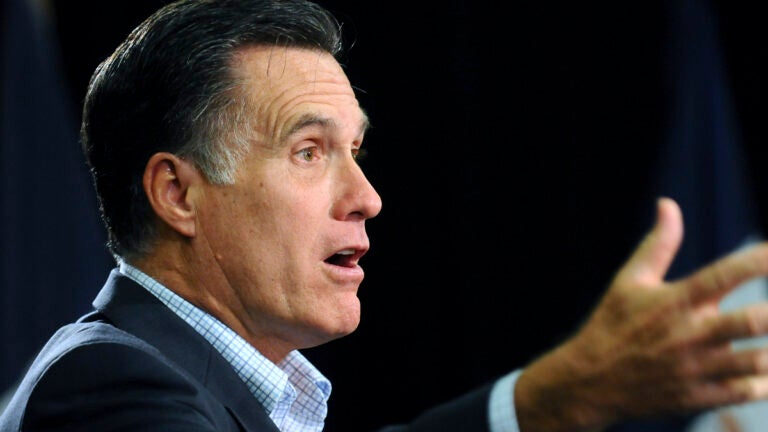
WASHINGTON – Mitt Romney’s ambitious plan to rein in federal Medicare spending would give America’s seniors a choice: choose government insurance or use a federal voucher to buy medical insurance from private companies. The idea, according to Romney, is to drive down costs by introducing market competition.
The proposal is similar in some respects to the plan Romney introduced as governor of Massachusetts and partially borrows from ideas pursued by Republicans in Congress and floated by a bipartisan group in Washington.
But while Romney’s partial privatization route is applauded by some as a courageous solution to runaway costs, Democrats and some other critics say that it relies too heavily on unreliable market forces to lower costs. They contend it lacks strong regulatory checks on runaway medical inflation.
Romney’s plan also is vague on politically sensitive points.
It does not spell out what share of premiums seniors would be required to pay from their pockets. While Romney proposes increasing the eligibility age for future Medicare enrollees from the current 65, he does not say what the new age should be nor how quickly it should rise.
Clearer, perhaps, are the political implications for the 2012 election campaign.
If Romney wins the Republican nomination, his plan promises to become a major issue in the general election against President Obama. Obama’s forces have begun characterizing Romney’s solution as a bid to dismantle Medicare, even though it contains concepts that have been backed by some Democrats.
“It shouldn’t be a surprise that Romney’s Medicare plan is missing the details,’’ said Kara Carscaden, an Obama campaign spokeswoman. “Romney wants to privatize a program seniors depend on and end Medicare as we know it.’’
Romney’s campaign did not respond to multiple requests for details and comment. A Nov. 4 press release issued about his plan said that the candidate “continues to work on refining the details of his plan.’’ In a fiscal policy speech that day, Romney said seniors on Medicare and those close to retirement would not be affected by his proposal.
Romney’s voucher system would allow Americans over 65 to shop for their health insurance while giving the government a tool to cap how much it spends on each beneficiary. That would solve part of the budget problem with the current “fee-for-service’’ system, in which Medicare pays whatever doctors and hospitals bill, with no overall limit.
Romney’s approach resembles a bipartisan plan developed last year by Alice Rivlin, a Democrat and budget director under President Clinton, and Pete Domenici, a Republican and former Senate Budget Committee chairman. Their plan would create a Medicare exchange and voucher system allowing seniors to pick among private plans and traditional Medicare. It would save the government money because the growth in the value of the vouchers would be limited to one percentage point faster than the growth of GDP. If health care costs rise faster, seniors would pay higher premiums.
Romney’s and the Rivlin-Domenici plans don’t go as far as one introduced this year by Paul Ryan, chairman of the House Budget Committee. The Wisconsin Republican would privatize Medicare and constrain the value of the vouchers to the rise of the general inflation rate.
Republicans, and some Democrats, had urged a bipartisan deficit reduction panel to consider establishing a federally supported voucher system for seniors to buy private insurance, but the idea collapsed this week with the supercommittee.
Romney gets credit from deficit hawks for taking on an entitlement program with costs that will skyrocket as legions of baby boomers reach the age of 65. Douglas Holtz-Eakin, president of American Action Forum and former director of the Congressional Budget Office, thinks the plan will achieve Romney’s goal of reducing Medicare costs.
“It will control the federal budget because it caps the taxpayers’ exposure,’’ said Holtz-Eakin, who was chief economic adviser to Senator John McCain’s 2008 presidential campaign.
Current fee-for-service Medicare payments are not limited, and most analysts agree the system contributes to rapid inflation in the program. Under Romney’s plan, beneficiaries would be given a fixed amount of money to either buy into the Medicare program or buy private insurance. Lower-income seniors would receive a more generous allowance, while wealthier seniors would get less. Those who choose less expensive plans would be allowed to keep the difference for other health expenses.
“By saying to insurers, ‘Look, this is the money for this year. Find some efficiencies and deliver a standard of care,’ they have a much stronger incentive to say, ‘OK, the game’s over. We’re not going to get an infinite amount of money out of the feds,’ ’’ Holtz-Eakin said.
The downside for seniors is they would be exposed to potential costs that they do not pay now. Some analysts fault Romney’s plan for its lack of detail on this crucial point, saying it amounts to a politically calculated attempt to appear simultaneously bold yet protective of the popular entitlement.
“He’s trying to put in place something but he doesn’t want to admit what it would do,’’ said Stuart Altman, a national health policy professor at Brandeis University. “It’s going to start extracting more money from beneficiaries. Romney’s been very vague to hide what are tough political issues. He clearly wants to have his cake and eat it too.’’
But Altman, an Obama supporter, said he believes Romney’s plan contains some valid points.
“In principle, I can be supportive of asking middle-class Medicare beneficiaries to pay somewhat more,’’ Altman said. “Of course people don’t want to hear that. It’s political suicide.’’
Dr. Ezekiel Emanuel, a senior fellow at the left-leaning Center for American Progress and former Obama health adviser who helped craft the health reform law, criticized Romney for failing to address a crucial point: “This is nothing more than a cost shift from the government to individuals. There’s nothing built in that has any serious cost control.’’
Other important details are missing from his plan, health policy analysts say, including the size of vouchers and how they would grow. Romney also does not provide estimates on how much the plan would save the federal government. Nor does his proposal address how geographic variances in costs may affect premiums and seniors’ options. Without knowing these answers, the plan is difficult to evaluate, analysts say.
“The details really matter because they ultimately determine what it will mean for seniors’ costs and for Medicare spending,’’ said Tricia Neuman, a senior vice president at the Henry J. Kaiser Family Foundation and director of the organization’s Medicare research.
Senior advocates lambasted Romney’s plan. While it preserves traditional Medicare as an option, they contend, it would ultimately erode the program.
“Instead of eliminating Medicare, this is an approach that would lead to it withering on the vine,’’ said Max Richtman, chief executive of the National Committee to Preserve Social Security and Medicare.
Older, sicker seniors would be more likely to opt for traditional Medicare while younger, healthier ones would choose cheaper, less comprehensive private plans, Richtman said. That would mean the Medicare plan would cost the government more, because it would be paying to care for the sickest patients.
Richtman said his group also strongly opposes raising the eligibility age, a controversial change that Democrats, including Obama, have been willing to entertain. Critics fear it would lead to higher costs as more uninsured seniors delay seeking care, exacerbating their medical problems.
Seniors already can choose private plans under Medicare Advantage, a program established with the goal of providing a more efficient model of health care. But the federal government has subsidized the Advantage plans to the tune of several billions a year, and under the health care overhaul those subsidies will gradually be withdrawn.
John Rother, chief executive of the National Coalition on Health Care, said he does not think competition alone would make a large enough dent.
“The idea of offering people choice is always an attractive, easy sell,’’ Rother said. “What’s tricky here is how to keep it from costing people more. And that depends on the details.’’




To comment, please create a screen name in your profile
To comment, please verify your email address
Conversation
This discussion has ended. Please join elsewhere on Boston.com