
Health care? Not buying it
N.H. residents say they have more to fret about
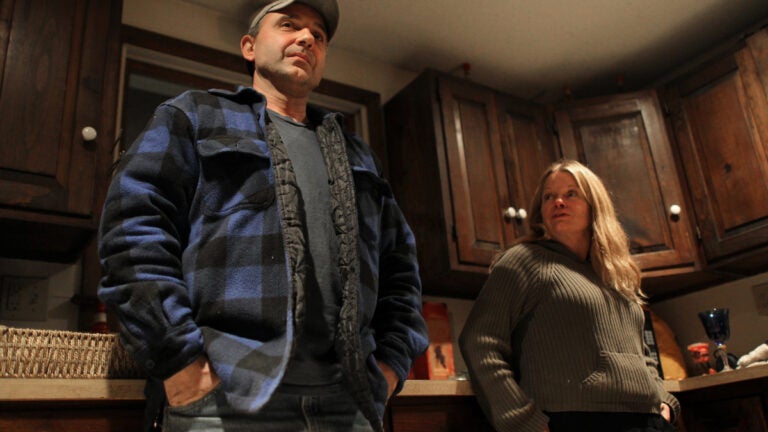
ASHLAND, N.H. – Darlene Troila spied a man photographing her family’s rented house, a jog down from Bob’s Shur-Fine Market here. “Who are you?’’ she’d asked. “I’m from the bank,’’ the man replied. Their house was being foreclosed on. So began the hunt for a new house, big enough for their four boys – two grown but unable to find work.
Surely the bills will follow them: bills for her ACL surgery and her husband Michael’s staph infection a few years back. She’d skipped physical therapy and he’d let Darlene change his dressings rather than nurses. But without health insurance, the unpayable bills still ran into the thousands. Michael earns $20 an hour as a carpenter. Darlene buys underpriced Craigslist items and resells them. Recently, she made $40 on a water heater.
They’d like health insurance. But it’s too expensive. President Obama’s plan for subsidized health care is an abstraction, something they’ve heard about, but not banked on. They voted for Obama in 2008. Not next year.
“Health care is not the anxiety,’’ Darlene said. “Basic needs are.’’
In this central New Hampshire working-class town, long a bellwether of Republican sentiment in the first-in-the-nation primary state, health care is an afterthought for many as they sort through their choices in the upcoming Republican primary. A growing number of independents, the bulk of voters here, who were supporters of or neutral about the Obama plan now say they view it as unlikely to help them with what they really need: a fix for the economy.
The sentiment is reflected in a poll by the nonpartisan Kaiser Family Foundation released last month. It found Americans are more than twice as likely to say the law won’t make much difference for them as they are to say the law will leave them better off – even as the first dividends of the new law have begun to pay off for some, including seniors who are getting additional help with their prescriptions and young people who have been able to remain on their parents’ health plans.
The tilt in opposition to national health care would seem to endanger Mitt Romney, the creator of the universal health care plan in Massachusetts that served as a model for Obama’s plan. Republican contenders have sought to tar him with “Romneycare,’’ even as he joins them in vowing to rid the country of Obama’s health care plan.
Many in Ashland say they know little about Romney’s plan. (This could change, of course, once the onslaught of television ads begins and Romney’s competitors remind voters.) Among those who do know of his plan, some offer a New Hampshire libertarian’s shrug.
“Romney did what was best for Massachusetts,’’ said Tim Stevens – a father of six, three of them adopted children with Down syndrome – who is a military retiree and opposes national health insurance as an overreach of the federal government. “It’s not necessarily what’s best for New Hampshire.’’
Other Republicans here say they can forgive Romney’s health care plan because they figure he’s the one most likely to boot Obama.
“[Romney’s health plan] gives me huge, huge pause,’’ said Tom Peters, a former Ashland selectman who installs electronics systems. Peters favors Ron Paul, “but he never gets the exposure.’’ So he is considering Romney.
Peters has no health insurance. He could, perhaps. His business has done well, his children are grown, and he owns a home, along with several properties in town.
But like many around here, he’s a do-it-yourselfer. He built his house, and he prefers to pay his own way on health care.
“It is a gamble, but just shoot me,’’ he said. “I am not going to pay $2,000 just for health care.’’
He’d rather patch himself.
He bent at the waist and pointed to his pate. A tender scar runs down a third of its length. A few weeks earlier, he had gashed open his head reaching for a key hidden at the house where he was doing work. “If I had insurance, I’d have run to the hospital and had 20 stitches and it would have cost $1,000. Instead, I got some tape and pulled hard and really tight and closed it up. And well, it’s healed.’’
By the numbers, Ashland, a one-time mill town with a population of 2,076, is faring all right. Its unemployment rate is 4.1 percent, lower than the national average. But residents say the number masks a big hole: Too many jobs in the area are part-time with no benefits, including health care.
“Sure, they’ll hire you – for 39 hours,’’ goes a common refrain around here.
It’s difficult to determine how many Ashland residents are without health insurance. The state doesn’t collect the data, and national groups, such as Kaiser, do a state-by-state tally but don’t break the data down into bits as small as Ashland.
For those without insurance, health care is a patchwork of free and subsidized services.
Sherrie Downing owns the hair salon up the block from the Civil War Monument and the shuttered L.W. Packard & Co. Inc. woolen mill. “Come on in,’’ she told a caller on a recent morning, a man in need of a trim of the white beard he was growing for Santa Claus duty. She hadn’t planned to work, but with a paycheck of $200 on a good week, there is no forfeiting a client.
She and her machinist husband make a combined $41,000 a year, not enough to cover the health insurance premiums on the plan offered by his job. They insure their children with the New Hampshire Healthy Kids Gold program, which is Medicaid-funded, receiving half its money from the federal government and half from the state.
For their own health care, she and her husband rely on luck and maintenance.
“I keep active and try not to get sick,’’ she said.
When that falls through, she qualifies for the free clinic in nearby Plymouth, open on Tuesdays from 6 p.m. to 8 p.m. and staffed by a volunteer doctor and nurse who see patients without health insurance and who earn less than 200 percent of the national poverty level.
For emergencies, like the time she broke her thumb chaperoning her son’s ski trip, she goes to Speare Memorial Hospital, also in Plymouth. The bill ran into unthinkable amounts.
Then one day Downing was at the hospital registering her children for the Healthy Kids insurance. The woman who handles registration is a client of Downing’s. “She took one look at my thumb and said, ‘How are you paying for that?’ ’’
The woman helped Downing apply for Community Care, a hospital-run program that picked up a portion of her bill – part of the $3.4 million in unreimbursed costs the hospital swallowed in fiscal year 2010.
“New Hampshire has all these great programs,’’ Downing said. She opposes Obama’s plan, for fear that it would take the state programs away.
Like many rural areas, Ashland has shed its medical services. From its incorporation in 1868, Ashland had two, sometimes three, doctors. In 1953, the number shrank to one, Samuel Feiner. He left town in 1955, selling his home and practice to Lawrence Rockwood, who departed in the early 1960s.
Ashland’s last general practice doctor, Glenn Bricker, an imposing man who is said to have delivered half the town’s population, left in 1999. The nursing association, established in 1918, which provided in-home care including light household chores, is gone, as is the pharmacy.
It’s a small irony, a medical vacuum in the town whose most famous native son is George Hoyt Whipple, winner of the 1934 Nobel Prize in medicine for discoveries that led to a cure for pernicious anemia, which, the 1968 Ashland Centennial Booklet crowed, prolonged “the lives of countless persons.’’
Most people say it’s not a hardship going to Plymouth. For those without transportation, there is help available at the Community Center.
Nancy Cross runs the Community Center, which also operates the food pantry and offers limited financial assistance to town residents for things like rent, electricity, and prescription drugs.
The center’s thrift shop is the busiest spot in town on Thursday afternoons, with ladies hauling away bags of wool, picnic baskets, and LL Bean jackets for pennies on the dollar.
Cross, a social worker and 40-year-resident of Ashland, gladly offers the help. But charity, from a steely Yankee’s perch, should be a local affair. Obama’s plan for national health insurance makes her nose involuntarily wrinkle.
“It’s an entitlement and it takes away ingenuity,’’ she said. “I don’t think I can be open-minded because I am so against the philosophy.’’
On a Saturday morning, rushing to beat the October snowstorm, Eric Murdock offered a different view.
“Everyone should have health care,’’ the 45-year-old construction worker said as he hauled a new frame for his jeep, the Gray Ghost, into his metal shop.
The key, he said, is who pays. Like many in town, Murdock’s frustration at Wall Street is mounting. As he sees it, the bankers got bailouts; Ashland residents like himself wagered their lives without health care.
“All these special-interest groups and billion-dollar corporations ought to pay their share,’’ he said. “Guys like me are the backbone of the country and we get the short end of the stick.’’
Murdock has no health insurance. He did have it when he came down with non-Hodgkins lymphoma 10 years ago. “Thank God,’’ he said. But a divorce set him back financially and health insurance is now too expensive.
He’s not sure which presidential candidate offers the right view for health care.
“I don’t pay much attention,’’ he said. “No time.’’
His two girls’ tree house needs finishing, the Gray Ghost needs rebuilding, and the folded laundry on the kitchen table needs putting away.


To comment, please create a screen name in your profile
To comment, please verify your email address
Conversation
This discussion has ended. Please join elsewhere on Boston.com