
Auto employers are struggling to recruit more women
Automative companies are increasingly coming to Boston's Benjamin Franklin Institute of Technology seeking female workers.
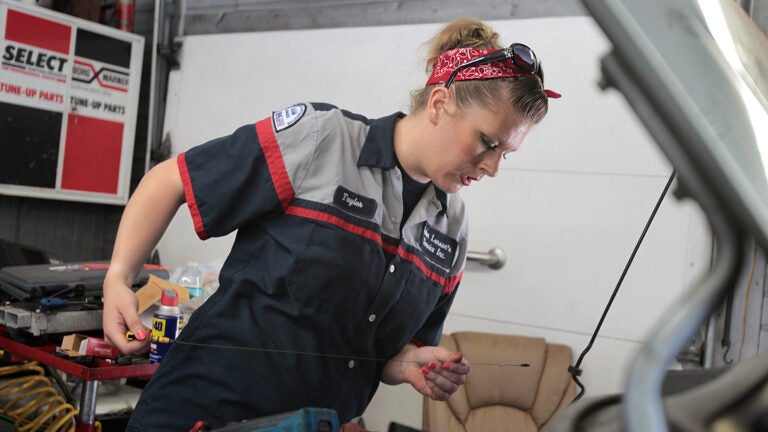
Automative companies want more female employees, but women say gender stereotypes persist in the field, causing many to leave.
With technicians in high demand and women drivers outnumbering men, the automotive industry is doing more to attract women to the field, according to The Boston Globe, yet having a hard time keeping them there.
Car makers like General Motors Co., the first major car company to have a female chief executive, have laid out plans to recruit and better support female employees, while organizations like The Automotive Women’s Alliance Foundation and the Car Care Council Women’s Board have attracted more corporate sponsorships in recent years, allowing them to greatly increase the number of scholarships they award.
But despite their efforts, the share of women working as mechanics, managers, and in auto parts sales has declined in recent years, even as the number of women taking automotive classes has remained steady or risen in schools around New England.
At the Benjamin Franklin Institute of Technology in Boston, for example, women make up just 10 percent of approximately 150 automotive students.
Women in the industry cite persisting gender stereotypes as a big deterrent to entering the field.
Related Links
In a study of 6,000 MBA graduates by Anna Beninger, director of research at the women’s advocacy group Catalyst Inc., Beninger found that of those who went into automotive, high tech, manufacturing, and other male-dominated fields, 53 percent of women left to work in another industry, compared to 31 percent of men.
Why? Respondents cited feeling like outsiders, having a lack of female role models, and experiencing “both overt and unconscious discrimination.” Take Samantha Briody, for example, a parts specialist at a Volkswagen dealership in Norwood, who told the Globe she’s still often asked, “Is there a guy here?”
Read the full Globe story here.



To comment, please create a screen name in your profile
To comment, please verify your email address
Conversation
This discussion has ended. Please join elsewhere on Boston.com