
What Emerson’s president thinks about work-life balance, cover letters and his walk to work
M. Lee Pelton became a college president at the age of 46
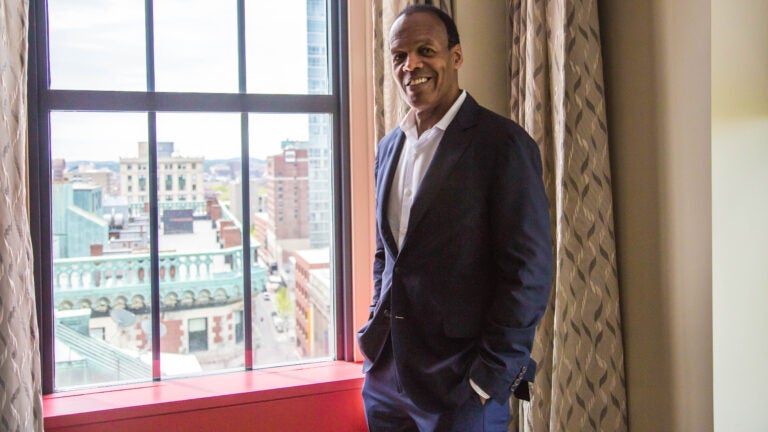
When M. Lee Pelton, the 12th and current president of Emerson College, was growing up in Wichita, Kansas, he was such a skilled orator by age 6 that his neighbors thought he would end up being a preacher.
“I don’t know that I can describe from whence that instinct derived, it was just always there,” Pelton said on a recent spring day from his 14th floor office at 180 Tremont Street.
Instead, the knack for presentation, and a further knack for management, helped the Harvard University graduate navigate his way through an impressive career in academia: Prior to his current role at Emerson, Pelton was dean of the college at Colgate University and Dartmouth College before becoming president of Willamette University for 13 years.
Since joining the Emerson community, Pelton has focused on diversifying the student body, encouraging innovation, increasing the school’s global reach, and strengthening Emerson’s commitment to civic engagement — all hefty tasks that prevent Pelton from obtaining much work-life balance.
But he’s okay with that if it means he’s doing his job. “There’s no such thing [as work-life balance]. You show me the president who can manage work and life balance and I’ll show you someone who’s not very effective,” Pelton said.
Related Links
Boston.com met with Pelton recently to find out what it’s like being a college president in Boston, a mecca for higher education. Here’s what he had to say:
Describe your job.
I have three broad roles. One as chief strategist, chief friend, and chief fundraiser who is responsible for bringing in the resources to bring the strategy to life. And I am the chief cheerleader. That is to say my job is to ensure that Emerson is always in a state of momentum.
What’s a typical day like for you?
There is no typical day, which is true for most college presidents. One of my great joys is that there is no typical day. Being college president puts into play all of your intellectual, financial, and emotional capacities.
So in a single day, it could include the following: raising money, promoting the institution, overseeing and managing human resources issues, legal issues, student affairs issues, academic issues, facilities issues, planning and strategy issues, civic engagement and civic leadership. It’s a long list of capacities that require me to be an active listener, collaborator, and decision maker.
What skills does a good leader have?
Good leaders have the following skills: critical thinking, the capacity to communicate well, and in particular to communicate complex issues in a way that they are understandable. The best leaders are creative and collaborative, and by collaborative, I mean the best leaders are able to bring into full play or measure the talent that exists in the organization.
Describe your path to becoming a college president.
Well you know when I was very young I had an instinct and a passion for leadership. I went to grad school at Harvard with the intent of being a professor of English and wearing a cardigan and smoking a pipe.
I discovered that while the contemplative life of being an English professor was highly satisfying, it was not as satisfying as being a leader among a community of professors. I knew that early on…I was told by many people that I’d be a college president in my late 20s. The question was when I was going to be a president. I thought I’d be a president by the age of 40, and it didn’t quite turn out that way. I was 46.
What is the best part of your job?
There’s so much. First of all, we educate students. That’s our business. So I’m very passionate about ensuring that the students who come here receive the best education that’s available to them. Students inspire me to do my very best work. And I’m inspired by Emerson students — by what Emerson students achieve while at Emerson and inspired by what they do as alumni.
And I get great satisfaction in bringing the strategy for the college to life.
What about the hardest part of the job?
The most challenging part — and this is probably true for any chief executive officer — is sustaining momentum in an institution or organization for a long period of time. It’s easy to come in and inspire and create momentum for one or two or three years, but it’s much harder to sustain that over a five or 10 year period. Most people are not capable of that… and I live in a state of discomfort and sheer terror that I might not be able to achieve what I set out to achieve long-term.
What is something that would surprise people to know about being a college president?
What’s been important for me is to establish myself as a civic leader in the city so I’m a trustee at the Museum of Fine Arts, I’m on the board of directors at WGBH, and I’m a director at the Museum of African American History.
I think most people know presidents work long hours. But when you become a college president you turn yourself over to it completely. It’s all consuming. During the academic year and most of the summer I work late, until 10 p.m. or so.
I also belong to this listserv for college presidents and one question was from someone thinking about applying for a job. They asked if they should write a cover letter. I said, “I’ve never written a cover letter and never would.” I’ve never had to apply. I’ve always been recruited.
How do you unwind from work?
I don’t know. I’ll tell you where I’m most comfortable outside of work. Four places: book stores, kitchen stores, a gymnasium and fitness center, and in the mountains. Any mountain — I’ll climb anything. Any of those four places make me happy, outside of family.
Do you have a favorite Boston spot?
Yeah, there are days when I walk to work from the president’s house across Boston Common and I’m so struck by the beauty of the Common as well as the beauty of the diversity of people, whether it’s the homeless guy, the jogger, the family with their young kids in strollers, Emerson students playing Quidditch, that I am moved to tears. I really am. And so my walk to work every day gives me enormous pleasure and I think to myself how lucky I am.





To comment, please create a screen name in your profile
To comment, please verify your email address
Conversation
This discussion has ended. Please join elsewhere on Boston.com