
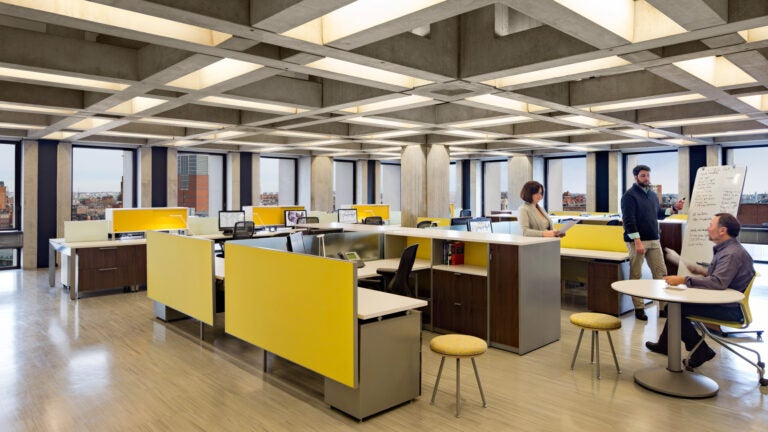
Collaborative space at work in Boston City Hall
-

An experiment is underway at Boston’s City Hall. Watertown-based design firm Sasaki Associates Inc. has converted Suite 709 into a collaborative workspace for employees of Boston’s Environment Department. Sasaki and Netherlands-based firm Mecanoo Architecten are collaborating on a new design in the Ferdinand Building in Dudley Square that will eventually be the headquarters for Boston Public Schools.
-
Sasaki Principal Victor Vizgaitis says the firm focused on how to make both the space in City Hall and the Dudley Square space more efficient, worker-friendly, flexible, and healthy. The City Hall experiment will inform how to proceed with the Dudley Square project.“Suite 709 was originally conceived as a means for doing some exploration into the possibilities for Dudley Square,’’ Vizgaitis says. “We set it up as a testing lab for city employees to experience the possibilities of what the space could be.’’The design is aimed at building a stronger workforce community, offering more access to natural light, and additional health benefits.
-

So how does the design boost collaboration? The first step was to lower the height of the cubicle wall panels so that employees can see each other. Vizgaitis says this boosts visual interaction with colleagues and helps foster a sense of collaboration among co-workers.
-

The redesigned space not only offers more openness and visibility among colleagues. Workers also have greater access to windows, says Vizgaitis. Vizgaitis says access to windows and daylight makes employees much happier and further fosters a sense of office community by allowing workers to see and discuss the outside world.
-

Other parts of the design include small tables for smaller meetings, larger tables for larger meetings, private conference rooms, and smaller-scale phone rooms for private phone calls. The lowered walls also help improve the air flow in the office.
-

Vizgaitis says the design also addresses noise control by making them more aware of their surroundings and the other people who share their space. By lowering the height of the workspace wall, employees become aware of their surroundings and the other people who share their space. This realization causes workers to adjust their own volume when talking on the phone. The space also offers white noise technology to help moderate the noise level in the space.While there are those who miss the privacy that a traditional cubical offers when it comes to phone calls, Vizgaitis says the design includes options for those who need privacy, including phone rooms and conference rooms.
-

Once the design is put to use in Dudley Square by the Boston Public Schools, as seen in these renderings, Sasaki believes the space will help foster collaboration across all levels of Boston’s education system. This includes collaboration among teachers, administrators, parents, and members of the community.
-

Renderings of what the space will look like in Dudley Square indicates that the space will emphasize window access. The design will also offer counter spaces close to the windows, which Vizgaitis believes gives employees the impression they are working at Starbucks.
-

Boston Public Schools is scheduled to move into the redeveloped Ferdinand Building in Dudley Square by 2015. Once completed, the project will include public park spaces, community spaces for art, and space for retail, including shops and restaurants.





To comment, please create a screen name in your profile
To comment, please verify your email address
Conversation
This discussion has ended. Please join elsewhere on Boston.com