
Thousands of foreign volunteers are fighting in Ukraine. History suggests it could go badly.
Most governments are skeptical of having their nationals join conflicts in which they are still technically neutral, because often those volunteers just wind up being killed.
“The mountains look on Marathon, and Marathon looks on the sea,” Lord Byron wrote in his 1819 poem “The Isles of Greece.” “And musing there an hour alone, I dreamed that Greece might still be free.”
Four years later, after the Greek people rose up against their Ottoman rulers, Byron threw his name, his fortune and his life into the fight to liberate Greece.
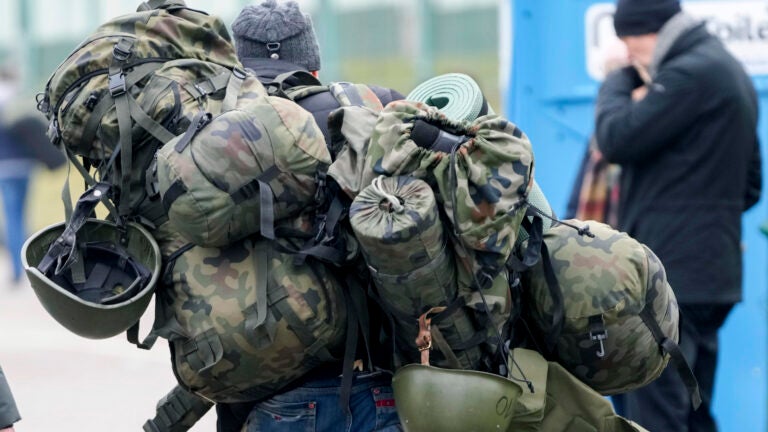
Byron’s soaring words could well serve as a credo for the 22,000 volunteers from around the world who have answered the Kyiv government’s urgent call and journeyed to Ukraine to resist the Russian invasion.
Western governments today are more critical of these efforts at heroics than they were in Byron’s time, when British authorities shrugged at the fact that the poet, who had already left England under a cloud of scandal and mounting debts, decided to take up arms. The U.S. and British governments now explicitly advise their citizens not to travel to Ukraine to join the International Legion of Territorial Defense of Ukraine, as the Kyiv government calls its volunteer force.
Other governments have permitted their citizens to fight for Ukraine, like that of Latvia, whose Parliament unanimously voted to allow its nationals to enlist shortly after the Russian invasion. According to the Latvian Ministry of Defense, seven Latvians have done so thus far.
But there are good reasons most governments are skeptical of having their nationals join conflicts in which they are still technically neutral, however they might sympathize.
For one, as history has shown, these starry-eyed volunteers often just wind up being killed.
That is basically what happened to the most famous volunteer group: the International Brigades of the Spanish Civil War.
Reportedly the idea of Joseph Stalin, the brigades were ad hoc military units established by the Communist International to assist the leftist Popular Front government of the Second Republic in its fight against the Nationalist forces led by Francisco Franco.
Immortalized by Ernest Hemingway in his novel “For Whom the Bell Tolls,” the brigades were the largest fighting force of their kind in history. An estimated 32,000 to 35,000 men and women from more than 50 countries, including the United States, rallied to the Republic’s flag during the two years the improvised army existed, from 1936 to 1938.
But the brigades’ combat record was little short of disastrous. Hobbled by lack of training, improper equipment and inept leadership, as many as 15,000 volunteers died – close to half the total force.
Among them were nearly a quarter of the 3,000 volunteers in the U.S. unit, the Abraham Lincoln Battalion. The battalion suffered its worst losses in April 1937 in the Battle of Jarama, when it was ordered to storm a fascist-held ridge south of Madrid without any artillery support.
“The men swept forward in a fearful machine gun barrage, but they kept going,” Herbert Matthews wrote in the New York Times. “Yet it was a hopeless charge. When it was over, the hill was [still] in Insurgent [Nationalist] hands and of the 400 Americans 108 were left.”
“The Americans,” Matthews wrote, “were ripe in spirit but raw as soldiers.”
In late 1938, the volunteer force was disbanded as part of an ill-advised effort to persuade Franco’s German and Italian backers to withdraw their troops and the Western democracies, which had remained neutral, to end their arms embargo of the moribund Republic. It didn’t work. In January 1939, the Republican capital of Barcelona fell to Franco’s forces; two months later, so did the rest of the Republic.
But the myth of the International Brigades had only begun, and it continues to the present day – thus the Ukrainian Ministry of Defense’s decision to name its own volunteer international force after its Spanish antecedent.
There is often a disconnect between the fame of volunteer groups and what they actually achieved.
That was the case with the most vaunted American volunteer group of the early 20th century: the Lafayette Escadrille, the French Air Force unit named after Marquis de Lafayette, the French hero of the American Revolution.
Formed in 1916, the third year of World War I, the improvised squadron of Francophile American pilots was intended to help inspire the United States to abandon its neutrality and join the Allies.
Ultimately, 38 American pilots donned their goggles and climbed into their Nieuport and Spad biplanes to dogfight with their German counterparts. Half of them perished.
The Escadrille’s combat achievements can only be described as average. During the 22 months of its deployment, the squadron downed 33 enemy aircraft, fewer than one per pilot. Half the bogeys were credited to its only ace, Raoul Lufbery.
Still, a legend had been formed. In the 1920s, it was common for men of a certain age to claim to have flown with the Lafayette Escadrille. By 1931, at least 4,000 impostors had boasted that they flew for the famed squadron, according to “The Lafayette Escadrille,” a 1964 book by Herbert Molly Mason, himself the son of an aviator in the Great War.
Hollywood also made movies about the unit’s exploits, including “Flyboys,” the 2006 film starring James Franco.
By contrast, the contributions of some of the most effective volunteer units have been largely forgotten.
Such is the case of the 1st American Volunteer Group, better known as the Flying Tigers, the volunteer air unit organized by veteran Army aviator Claire Chennault with the blessing of President Franklin D. Roosevelt to aid the Nationalist government of China against Japan in the Second Sino-Japanese War in late 1940 and early 1941, before American entry into World War II.
The 100-member, all-volunteer group consisted of three squadrons of P-40 Curtiss Warhawk aircraft, whose noses were painted with the unit’s signature shark face. When Japan attacked Pearl Harbor and the United States entered the war, the Tigers were already stationed in China.
Employing the novel aerial tactics devised by Chennault, which called for the pilots to dive, pass and shoot at the enemy rather than tangle with them head on, the Tigers dominated the skies over China and Myanmar, also known as Burma, while giving Americans something to cheer about during the trying days following Pearl Harbor.
Ultimately, the sharpshooting aviators, who were later absorbed into the 14th U.S. Air Force, destroyed 296 enemy aircraft while losing only 14 pilots in combat, making them one of the most successful aerial combat units in history.
Yet who remembers the Flying Tigers?
Another of the most successful, if overlooked, volunteer efforts is particularly relevant to the current war: the campaign by thousands of Swedes in the 1939-1940 Soviet-Finnish War, also known as the Winter War.
After the Soviet Union invaded Finland, more than 12,000 volunteers from around the world rallied to defend the besieged nation, much like those who are streaming to Ukraine now.
Most of the volunteers, including the 350 from the United States, arrived too late to have an impact. But the 9,000 young men who came from neighboring Sweden did. Swedish aviators formed their own squadron in the Finnish air force, which protected the skies over Lapland while their earthbound comrades defended the key Salla front in central Finland. A dozen Swedish volunteers were killed on the last day of the war, March 13, 1940, when the Soviet air force deliberately bombed a unit of Swedes and Norwegians near Salla one hour after the official 11 a.m. cease-fire.
“The number of Swedish volunteers dwarfed that of other countries, and the Swedes sent significant military supplies and humanitarian and monetary aid,” said Fredrik Logevall, a Swedish native who teaches history at Harvard University. “Overall, the Swedish assistance to the Finns exceeded that of any other nation.”
Ironically, though, history’s most effective volunteer fighter may have been Byron himself, even though he didn’t actually see any fighting.
The 35-year-old poet, whose arrival in Missolonghi, Greece, in January 1824 was greeted with jubilation by the rebels, was a flop as a revolutionary leader. He seems to have spent most of his time trying to make peace among bickering Greek factions, while chasing a page who had struck his fancy.
However, he made a great martyr.
On the eve of what was supposed to be his first action a month after his arrival, an attack on the Turkish-held fortress of Lepanto, the famous bard – who had a history of poor health – went out riding and fell ill.
His condition was not helped by his doctors’ use of “therapeutic bleeding,” after the fashion of the day. Two months later, on April 19, 1824, the aspiring revolutionary general was dead.
News of Byron’s death triggered worldwide mourning. It also shook the British authorities, who finally decided to get involved in the Greeks’ struggle, along with the French and Russians. Three years later, the Allies blasted the Turkish fleet to smithereens at the Battle of Navarino, leading the Turks to sue for peace.
A year later, Greece was free. The vision Byron had at Marathon had been achieved.
As for the modern-day Byrons who are descending on war-torn Ukraine to ensure that it too remains free, Michael O’Hanlon, senior military analyst at the Brookings Institution, is skeptical of what they will accomplish.
“There is no prospect of foreign forces adding fundamentally new offensive capabilities” to the Ukrainian side, he said. “On balance, they seem a secondary factor at most in the fight to date, and most likely in the future.”
But that is not to say that they won’t create a myth of their own.
Gordon F. Sander is a journalist and historian based in Riga, Latvia. He is the author of several works of politics and history, including “The Hundred Day Winter War,”about the 1939-40 Soviet-Finnish Winter War.




To comment, please create a screen name in your profile
To comment, please verify your email address
Conversation
This discussion has ended. Please join elsewhere on Boston.com