
Sign up for the Today newsletter
Get everything you need to know to start your day, delivered right to your inbox every morning.
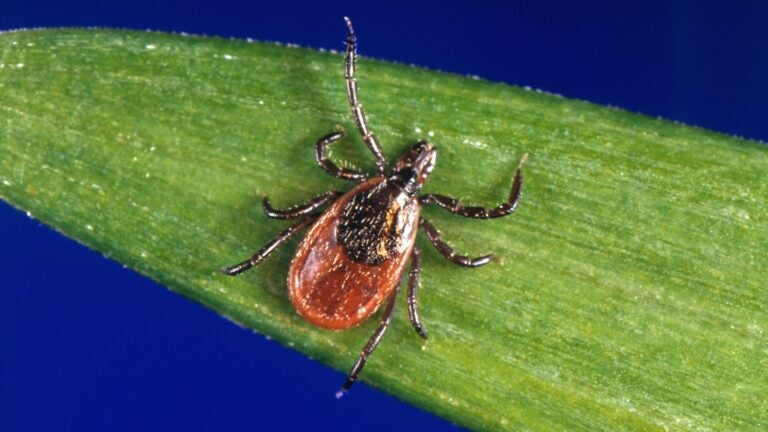
There are a number of steps you can take to protect yourself from ticks when you are in nature, but there is one you should take: Spray your footwear with the synthetic insecticide permethrin.
Reports of tick-borne diseases, such as Lyme disease and alpha-gal syndrome, an immune reaction that can cause a red meat allergy, peak in June and July in the United States.
Ticks latch onto skin, clothing and footwear below our knees. Shoes are often the “first point of contact for larval and nymphal-stage ticks,” said Thomas Mather, a public health entomologist who has been studying ticks for 42 years and goes by the nickname “the Tick Guy.”
Nymphs are the size of a poppy seed; larvae are even smaller. “If you’re not going to be able to see something,” Mather said, focus your efforts on “where it’s getting on you.”
Once a month, typically April through September, Mather places his shoes outside and sprays them with a product containing 0.5 percent permethrin until all sides are wet. The insecticide — a synthetic version of a compound found in chrysanthemum flowers — has been shown to reduce the risk of a tick bite.
Any shoes you’re going to wear in nature can be sprayed, Mather said. He has used permethrin on canvas, leather and rubber shoes and said he has never seen it harm the material.
“I would treat my bang-around shoes, I would treat my hiking boots, I would treat my golf shoes — if I had golf shoes,” Mather said. “I treat all the types of shoes that are going to be worn in tick habitat.”
Spraying your shoes with permethrin is often an easy first step for people who have never applied the insecticide before, he said.
Permethrin can also be sprayed on clothing and other gear. But don’t use it on your skin.
Permethrin should be sprayed only outdoors, and the treated items should be kept outside until completely dry. Permethrin can be toxic to cats when wet but is considered safe for pets and people once dry.
The Centers for Disease Control and Prevention has a video showing how to do it.
Natural alternatives for instance, botanical oils such as cedar, lavender and clove — do not appear to repel ticks as effectively, or for as long, Mather said, and he is not aware of well-controlled trials of these repellents. He is testing some existing natural products and some proprietary mixtures of botanical oils that are not yet on the market to see if they are effective.
“The majority of my concern is that they won’t have a very long-lasting effect,” Mather said. “Actual testing needs to be accomplished before we rely on them.”
There are other precautions you can take to protect yourself and your pets from tick bites.
Get everything you need to know to start your day, delivered right to your inbox every morning.





To comment, please create a screen name in your profile
To comment, please verify your email address
Conversation
This discussion has ended. Please join elsewhere on Boston.com