
Extra News Alerts
Get breaking updates as they happen.
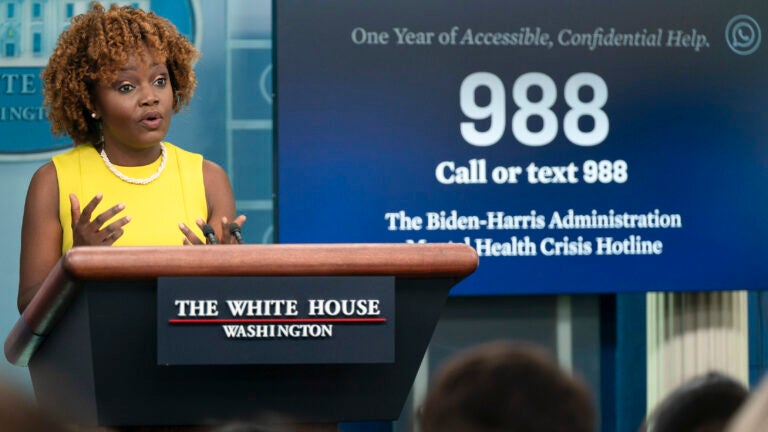
WASHINGTON — More than 10 million calls, texts and chat messages have been answered by counselors working for the National Suicide Prevention Lifeline’s three-digit hotline in the two years since it debuted, federal officials said on Tuesday.
The three-digit number, 988, was introduced in 2022 as a way to simplify emergency calls and help a metastasizing mental health crisis in the United States, accelerated by the COVID-19 pandemic and the social environments of younger Americans. The hotline previously used a traditional 10-digit number.
“People who felt like they didn’t have any other options got what they needed,” Andrea Palm, the deputy secretary of the Health and Human Services Department, said at a news briefing on Tuesday. The 988 line, Palm said, had resulted in “countless stories of real people whose lives have been changed forever.”
The 988 network has been a rare instance of bipartisanship in federal health policy. Massachusetts Rep. Seth Moulton was one of the lawmakers who introduced the bill that created 988. President Donald Trump in 2020 signed the law establishing the new number, and the Biden administration has implemented and expanded the network of more than 200 call centers, which typically operate around the clock.
A growing number of adults in the United States have reported feeling more anxious. Federal officials on Tuesday cited a 2022 national survey that found that more than 12 million adults and nearly 3.5 million adolescents had seriously considered suicide in the previous year. Roughly one in five adolescents reported symptoms of depression or anxiety in a federal survey of teen health from 2021 to 2022.
The condensed phone number was meant to function as a more memorable option for emergency calls, similar to 911. Yet only around a quarter of Americans are at least somewhat familiar with 988, according to a poll released this week by Ipsos and the National Alliance on Mental Illness.
“It’s not just the number,” said Jonathan Purtle, a health policy expert at New York University who has studied the rollout of the 988 line. “It’s about expanded branding and marketing.”
The updated phone line was also an effort to centralize the nation’s sometimes disparate emergency resources for mental health needs, bringing more cooperation between the call centers and state officials. The network of call centers has long operated as a conglomeration of mostly nonprofits that employ paid and volunteer counselors and sometimes oversee multiple hotlines.
Mental health experts said that 988, which depends on a patchwork of state and federal funds, is still in need of longer-term funding and a larger workforce in a field prone to burnout. In May — the most recent month with federal data — 88% of calls, 83% of chats and 97% of texts were answered, with calls answered more quickly than the other forms of contact.
Hannah Wesolowski, the chief advocacy officer of the National Alliance on Mental Illness, said call center counselors were often paid modest salaries to work grueling schedules. She pointed to the long list of job openings for positions at the call centers.
“There just isn’t the workforce to meet the demand,” she said.
Of the 3% of Americans who said they or a loved one had used 988 while in need, roughly 70% said they received adequate help, the NAMI-Ipsos survey found.
“We need that to be 10 in 10,” Wesolowski said. “You usually only get one bite at the apple when someone is reaching out for help.”
Purtle, who has received federal funding to examine state-level work on 988, said the line was vulnerable to the whims of state and federal lawmakers, who can adjust or withhold annual funding for the program and make it harder for call centers to function properly.
“You have to build systems here,” he said. “And you need to have some sense of how much money is coming in every year.”
Many states have committed their own funding to the call centers, and around 10 have moved to make funding permanent by applying small fees on monthly phone bills that subsidize the call centers. The 911 line is funded the same way.
The Biden administration has funneled almost $1.5 billion into 988, federal officials said on Tuesday, and more than $200 million in grants will be given to states in the 2024 fiscal year to support the work.
Federal officials said on Tuesday that the ability to connect with a counselor in multiple ways was leading to more interactions. Nearly 2 million of the 10 million interactions were text messages, while 1.2 million were calls answered by the Veterans Crisis Line, an option that allows service members and veterans to press 1 on a phone’s dial pad to reach help.
There are also special call options for LGBTQ youths and people who speak Spanish.
Federal and state officials still do not have sophisticated insight into who is placing calls, since users are not required to provide demographic information.
If you are having thoughts of suicide, call or text 988 to reach the 988 Suicide and Crisis Lifeline or go to SpeakingOfSuicide.com/resources for a list of additional resources.
This article originally appeared in The New York Times.
Get breaking updates as they happen.




To comment, please create a screen name in your profile
To comment, please verify your email address
Conversation
This discussion has ended. Please join elsewhere on Boston.com