
Sign up for the Today newsletter
Get everything you need to know to start your day, delivered right to your inbox every morning.
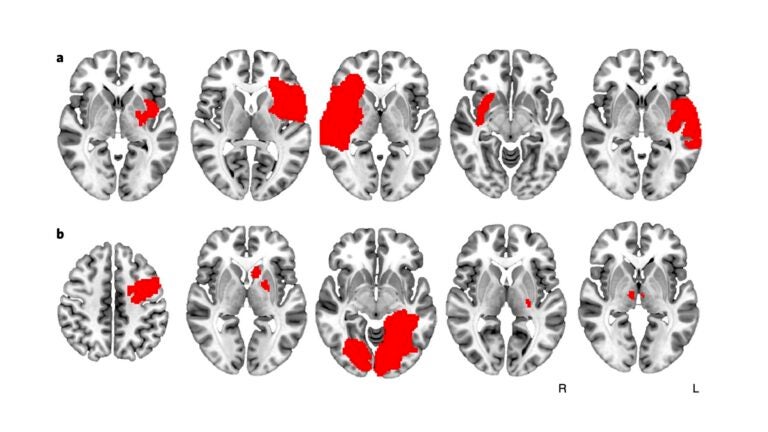
Taking a scan of an injured brain often produces a map of irretrievable losses, revealing spots where damage causes memory difficulties or tremors.
But in rare cases, those scans can expose just the opposite: plots of brain regions where an injury miraculously relieves someone’s symptoms, offering clues about how doctors might accomplish the same.
A team of researchers has now taken a fresh look at a set of such brain images, drawn from cigarette smokers addicted to nicotine in whom strokes or other injuries spontaneously helped them quit. The results, the scientists said, showed a network of interconnected brain regions that they believe underpins addiction-related disorders affecting potentially tens of millions of Americans.
The study, published in scientific journal Nature Medicine on Monday, supports an idea that has recently gained traction: that addiction lives not in one brain region or another, but rather in a circuit of regions linked by threadlike nerve fibers.
The results may provide a clearer set of targets for addiction treatments that deliver electrical pulses to the brain, new techniques that have shown promise in helping people quit smoking.
“One of the biggest problems in addiction is that we don’t really know where in the brain the main problem lies that we should target with treatment,” said Dr. Juho Joutsa, one of the study’s lead authors and a neurologist at the University of Turku in Finland. “We are hoping that after this, we have a very good idea of those regions and networks.”
The researchers replicated their findings in a separate group of patients with brain injuries who completed an alcoholism risk assessment. The brain network associated with a lower risk of alcohol addiction was similar to the one that eased nicotine addiction, suggesting that the circuit may underlie a broader set of dependencies.
“I think this could be one of the most influential publications not only of the year, but of the decade,” said A. Thomas McLellan, professor emeritus of psychiatry at the University of Pennsylvania and a former deputy director of the Office of National Drug Control Policy, who was not involved in the study.
This article originally appeared in The New York Times.
Get everything you need to know to start your day, delivered right to your inbox every morning.





To comment, please create a screen name in your profile
To comment, please verify your email address
Conversation
This discussion has ended. Please join elsewhere on Boston.com