
Sign up for the Today newsletter
Get everything you need to know to start your day, delivered right to your inbox every morning.
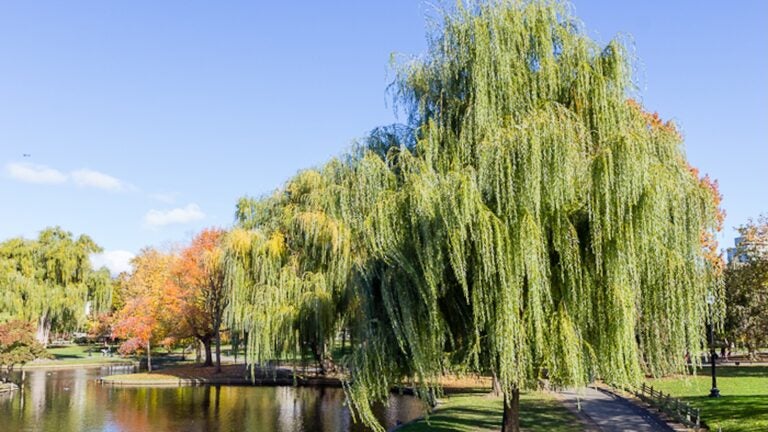
A weeping willow tree that has stood in the Boston Public Garden and overseen its lagoon for well over half a century is set to be removed by the Friends of the Public Garden and replaced in the spring.
“We’ll Miss You” is written on a sign seen at the bottom of the tree, according to published reports. The sign states that the tree is experiencing “disease pressure” and has not responded to treatment. Its declining health and internal decay poses a safety hazard for the public.
“We’re sad to say goodbye,” the sign reads, “but look forward to welcoming our new residents very soon.”
According to Rebecca DiTommaso, director of Capital Projects and Parks Care with the Friends of the Public Garden, the decision was based on a routine evaluation of each individual tree’s health condition.
“Back in 2024, we hired a consultant to take a look at the condition of each of the willow trees around the lagoon, and so based on that plan, we’re now able to thoughtfully plan for phase removals and replacements to ensure both the safety of the park and the aesthetics, and [make] sure that we continue to have the iconic willow trees that everybody loves so much,” DiTommaso told Boston.com.
The weeping willows, which provide a lush greenery aesthetic around the lagoon, are instantly recognizable to Public Garden visitors.
“We’re hopeful that our signage helps to let people know before the tree is removed so that they have the opportunity to take in that information [and] say goodbye to the tree,” DiTommaso said.
She further explained that the tree is simply nearing the end of its natural lifespan. The typical lifespan of a willow tree is approximately 30-50 years, while this particular tree is estimated to be between 50 and 70 years old.
“Willows, in particular, grow really fast, and so they’re considered weak wooded trees,” DiTommaso said. “At this point, the willow is just at the end of its natural life, and so there’s a lot of rotting and … it’s not very strong. And so our fear is that, given some sort of weather condition or something like that, the willow is susceptible to failure. So we want to get ahead of that by removing it.”
According to the Friends of the Public Garden website, willow trees were first planted in the Garden in the early 1900s. There are more than 400 varieties of the weeping willow with more than 80 varieties growing in the U.S. DiTommaso says that the regular removal of trees helps to ensure a diversity of ages in the canopy.
Many parkgoers are disappointed by the tree’s removal, but the Friends of the Public Garden say not to worry, as the tree will be replaced by a healthier willow in the spring.
“Our tree removals happen every winter, and then they’re replanted in the springtime,” DiTommaso said. “We will be removing seven trees in the public garden this winter, and will be planting eight in the spring. Two of those will be willows, and this location will be one of the places where a new willow tree is planted.”
DiTommaso expects that Boston parkgoers will form connections with the new trees, as they have done with the Public Garden willows for decades.
“We’ll put up signage letting people know that this is a new tree,” she explained. “And we tell them what the species is and some fun facts about this species so that they can really get to know the new trees that are in the park.”
Get everything you need to know to start your day, delivered right to your inbox every morning.




To comment, please create a screen name in your profile
To comment, please verify your email address
Conversation
This discussion has ended. Please join elsewhere on Boston.com