
Newsletter Signup
Stay up to date on all the latest news from Boston.com
Beachgoers north of Boston often complain about the surf’s chilling temperatures, saying they can barely put their toes in the water. But is the water really getting colder?
The answer might surprise you.
For years, the waters off the coast of northern New England have actually been hitting record-high temperatures. But lurking beneath the surface of the Gulf of Maine, the deep water temperatures this year have shifted to colder, fresher water.
To find out why, Boston.com spoke with Dave Reidmiller, the director of the Climate Center at the Gulf of Maine Research Institute.
Reidmiller says the Gulf of Maine is akin to a “bathtub.”
Georges Bank, a large elevated area of the sea floor between Cape Cod and Nova Scotia, separates the Gulf of Maine from the Atlantic Ocean and prevents deep water exchange with the open ocean.
Two major ocean currents influence the Gulf of Maine: the cold Labrador Current from the Arctic and the warm, salty Gulf Stream from the tropics.
The “bathtub” effect, combined with a shift from the Labrador Current to the Gulf Stream, has raised temperatures.
Despite surface temperatures continuing to warm, there are some indications that some of the deep waters in the Gulf of Maine have remained cool — at least over the past year or so.
The reason for the deep water cooling is unclear.
In a new report published in Oceanography, scientists say the shift is likely due to an influx of water from the Labrador Slope, a return to the way it was before a major warming event began in 2011.
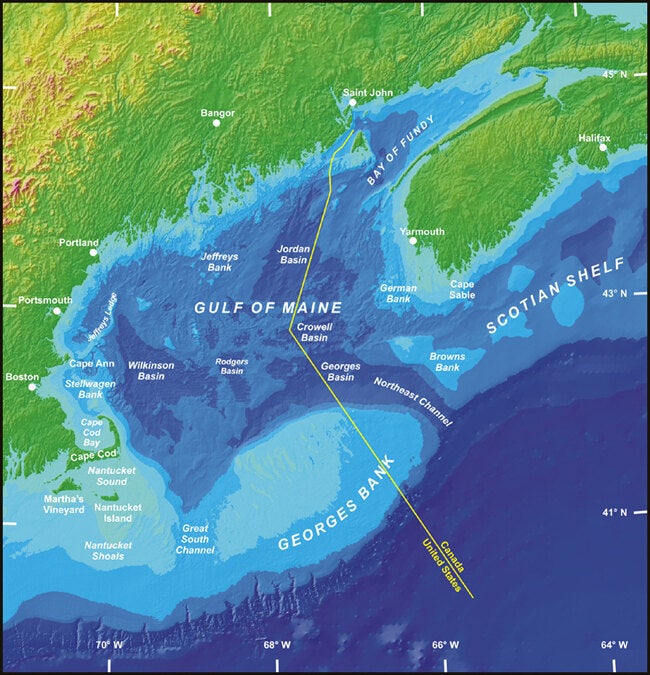
However, despite the discovery of colder temperatures in the deeper waters, surface temps continue to rise.
The water is actually “quite a bit warmer than usual — at the surface at least,” Reidmiller said. “But that’s a different story from what’s going on at depth.”
So, any complaints about the water being colder than normal this year might not hold up, at least over the long term. Surface water temperatures this spring were reported to be slightly lower than the previous few years, but they were rapidly rising by the end of June — a rise Reidmiller says he suspects will continue into the summer months.
Another reason for the variations in ocean temperatures is the world’s transition from El Niño to La Niña conditions, which favor cooler temperatures.
According to NOAA, El Niño and La Niña are climate patterns in the Pacific Ocean that affect weather worldwide.
But, Reidmiller was quick to note that even with the transition, water temperatures continue to break all-time highs.
“It’s a complicated story to tell,” said Reidmiller. “But suffice to say that the long-term warming trend has changed the way that all parts of the world are experiencing their weather and interacting with their natural environment.”
Deep-water oceanographic conditions strongly influence ecosystem dynamics, including the prey of critically endangered North Atlantic right whales, American lobsters’ seasonal and disease dynamics, and the distribution and abundance of kelp forest communities.
The Gulf of Maine was one of the first marine ecosystems to report a major ocean heatwave that lasted more than a year, from 2012 to 2013, and reached temperatures projected for the end of the 21st century.
The heatwave drove major ecological shifts, including historically low cod stocks, multi-year mortality events for the endangered North Atlantic right whale, the collapse of northern shrimp, and the near disappearance of blue mussels from the intertidal zone and more.
But it’s not all bad news.
The Gulf of Maine is seeing more species — such as black sea bass, longfin squid and blue crabs — than before. Blue crabs are typically found in Maryland and the Chesapeake Bay, but now they’re surviving through the winters in the Gulf of Maine — “which is quite unusual,” Reidmiller said.
A similar situation is happening to the lobster population, which generally likes cooler waters. There used to be a thriving lobster fishery in Long Island Sound.
“I liken the Gulf of Maine to that perfect bowl of porridge and the Goldilocks tale for lobster right now,” said Reidmiller. “The conditions in the Gulf of Maine are really pretty great.”

Stay up to date on all the latest news from Boston.com




To comment, please create a screen name in your profile
To comment, please verify your email address
Conversation
This discussion has ended. Please join elsewhere on Boston.com