
Newsletter Signup
Stay up to date on all the latest news from Boston.com
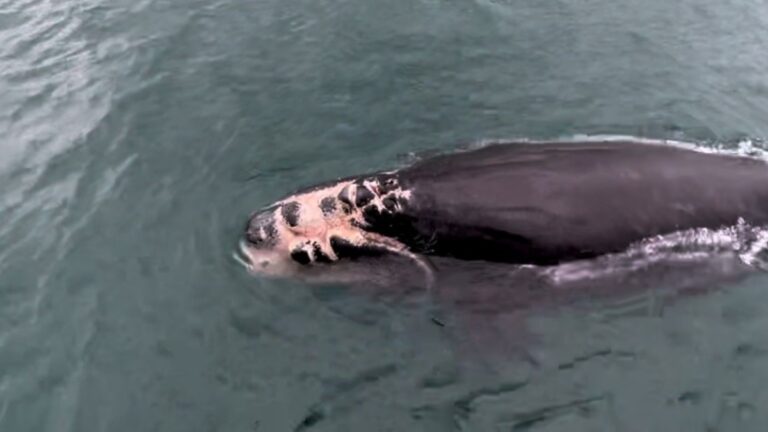
A dead North Atlantic right whale calf recently washed up on a Georgia beach, prompting researchers from New England to call for more protections of the critically endangered species.
There are only about 360 individual North Atlantic right whales left in the world, and that population was confirmed to have decreased by one this week. NOAA Fisheries was notified of the dead calf on Sunday, after it was found at Cumberland Island National Seashore in Georgia. The calf was first spotted by scientists in early January with serious injuries to its head, mouth, and lip from a vessel strike, according to NOAA.
Experts had been trying to track it since. The injuries were deemed bad enough in January that researchers began to worry whether or not it would be able to nurse successfully. NOAA biologists reviewed the case and officially classified the calf’s injuries as “serious,” meaning that it was likely to die as a result.
Due to the myriad of threats facing North Atlantic right whales, researchers meticulously document as many individuals as possible and catalog them in an online database. The dead calf is the offspring of a 38-year-old whale named “Juno,” which was the first female that was documented to have given birth this season, according to NOAA.
Researchers documented some evidence of the calf healing later in January but remained worried that the lip injury would stop it from being able to nurse. They estimated that the vessel strike occurred along the southeastern U.S. coast sometime between early December and early January. The vessel involved was likely 35–57 feet in length. Mother-calf pairs spend nearly all their time near the surface, making them very susceptible to vessel strikes.
The calf was spotted again in early February. Experts noted “apparent successful nursing,” but noted that its long-term prognosis was still considered “poor.”
When the carcass of the calf was found in March, it was identified by its unique injuries and markings. It had been “heavily scavenged” by sharks, NOAA said. The calf was the first of 19 known right whales born so far this season, according to the New England Aquarium. This is the second vessel strike death of a right whale documented in 2024; both occurred in the southeastern U.S. In January, a 3-year-old female washed ashore near Joseph Sylvia State Beach on Martha’s Vineyard. It died after being entangled in fishing gear.
Vessel strikes are one of the top threats to right whales. Speed restrictions are put in place at certain times and locations along the East Coast to protect them. Just last week, 31 right whales were seen by aerial surveyors in shipping lanes near Nantucket. The sighting triggered a temporary slow zone for vessels.
Last year, NOAA proposed changes to speed restriction rules that experts say would halt their population decline. The changes are now under interagency regulatory review, but scientists say the process is taking too long.
“Without question, it is time for the federal government to take immediate and urgent action to implement stronger measures to protect this species from vessel strikes,” Jessica Redfern, associate vice president of ocean conservation science in the Anderson Cabot Center at the New England Aquarium, said in a statement. “With less than 360 North Atlantic right whales left in the world, we do not have time to wait.”
Stay up to date on all the latest news from Boston.com




To comment, please create a screen name in your profile
To comment, please verify your email address
Conversation
This discussion has ended. Please join elsewhere on Boston.com