
Newsletter Signup
Stay up to date on all the latest news from Boston.com
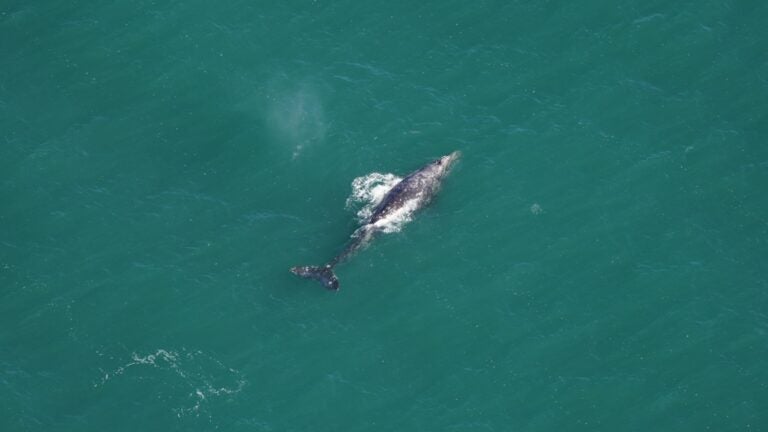
Scientists were shocked when they observed a whale that has been extinct in the Atlantic Ocean for centuries off the coast of Nantucket on Friday.
The New England Aquarium aerial survey team was flying 30 miles south of Nantucket March 1 when they saw an unusual animal they suspected to be a gray whale, the aquarium said in a statement. While the species disappeared from the Atlantic Ocean by the 18th century, there have been several sightings in the Atlantic and Mediterranean oceans in the past several years, a phenomenon experts say is a result of climate change.
Throughout the aerial team’s observation, the whale was seen feeding, a behavior marked by repeatedly diving and resurfacing. The plane circled above the whale for 45 minutes to allow the survey team to get pictures of the whale, which is distinguishable from other species by its lack of dorsal fin, grey and white skin, and dorsal hump followed by ridges.
“I didn’t want to say out loud what it was, because it seemed crazy,” said Orla O’Brien, associate research scientist in the Anderson Cabot Center for Ocean Life at the New England Aquarium.
O’Brien showed the photos to research technician Kate Laemmle, who agreed it was a gray whale.
“My brain was trying to process what I was seeing, because this animal was something that should not really exist in these waters,” Laemmle said. “We were laughing because of how wild and exciting this was — to see an animal that disappeared from the Atlantic hundreds of years ago!”
Gray whales are usually found in the North Pacific Ocean. But in the last 15 years, there have been five occasions of the species being spotted in Atlantic and Mediterranean waters. Scientists believe the whale observed off the coast of Nantucket is the same one scientists saw off the coast of Florida in December of last year.
Despite the excitement around the sighting, the whale’s presence in Atlantic waters is likely a sign of climate change, experts say. A passage that connects the Atlantic and Pacific oceans through the Arctic Ocean has been ice-free during summer months in recent years due to the warming climate.
The lack of thick winter ice allows the whales to travel the passage during the summer, which wouldn’t have been possible in previous centuries, the New England Aquarium said.
“These sightings of gray whales in the Atlantic serve as a reminder of how quickly marine species respond to climate change, given the chance,” O’Brien said.
Stay up to date on all the latest news from Boston.com





To comment, please create a screen name in your profile
To comment, please verify your email address
Conversation
This discussion has ended. Please join elsewhere on Boston.com