
Newsletter Signup
Stay up to date on all the latest news from Boston.com
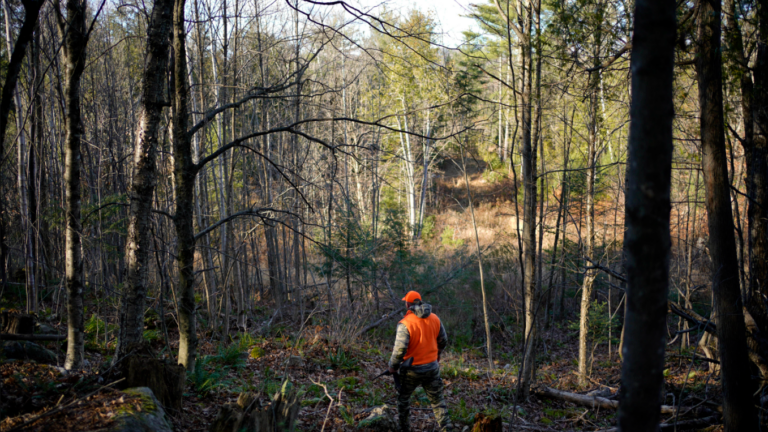
Massachusetts lawmakers are considering a bill that would lift the state’s 140-year-old ban on Sunday deer hunting.
Supporters say it’s a long-overdue step that would help farmers protect their land from a deer population that’s grown explosively in the past year.
Opponents counter that hunters already get six days of the week during hunting season — which lasts from October to December — and that non-hunters should be able to keep at least one day of the week to enjoy public lands without having to worry about getting shot.
According to MassWildlife, the agency that regulates deer hunting, there are more than 100,000 deer in the state right now. Deer densities range from an ideal 12-18 per square mile in central and western Massachusetts, to 30-50 per square mile in densely populated eastern parts of the state where hunting is restricted.
“Deer are common in Massachusetts, and their abundance is increasing statewide,” a spokesperson for MassWildlife told Boston.com. “MassWildlife uses regulated hunting during three distinct seasons (archery, shotgun, and primitive firearms) to manage deer numbers. MassWildlife’s deer management strategy seeks to keep deer numbers in balance with social tolerance and below the level where major habitat impacts are observed.”
When there are too many deer in a given area, the spokesperson explained, they over-browse the landscape and degrade the health of the forest. They also create a public safety risk when they jump out in front of moving vehicles: “Far more human injuries and deaths occur from deer-vehicle collisions than from hunting,” the spokesperson said.
Susan Murray, the executive director of the Southeastern Massachusetts Agricultural Partnership, testified to the Joint Committee on Environmental and Natural Resources on Nov. 29 in support of lifting the hunting ban, calling deer overpopulation in the commonwealth a “silent environmental crisis.”
“Today I’m here to advocate for farmers in Norfolk, Bristol, and Plymouth counties, where deer populations are three to six times above carrying capacity, resulting in over a million dollars in losses for farmers every year,” Murray told the committee.
“This is a crippling financial loss in an industry with tight margins and on the front line of climate change,” Murray said. “Farms are an oasis for deer when surrounding forests are depleted due to overpopulation and drought. Deer eat just about every crop we plant … But it isn’t just the direct costs. It’s also the amount of time and money farmers spend on monitoring fields and the labor of installing and maintaining fences and other deterrents.”
Dartmouth resident Alex Goodman testified that where he lives, the deer population has climbed as high as 56 per square mile — far above the goal density of 12-18.
“The only tool that we have to appropriately manage this deer population is recreational hunting,” Goodman said. “And not only does it manage the population, but it uses the resource as a valuable food for hunters and their families, and it also generates money for conservation and wildlife management in the state. It’s a huge win-win-win.”
The question of whether allowing deer hunting for one more day a week during hunting season would meaningfully impact deer populations is still up for debate. Murray herself testified in support of a bill to establish a deer population control commission, acknowledging that it may not be enough to simply hunt more deer.
Elizabeth Magner, the Massachusetts Society for the Prevention of Cruelty to Animals’ animal advocacy specialist, testified against the proposed ban, arguing that it wouldn’t significantly reduce deer populations.
“The consensus among experts [is]… that about 40% of female deer alone would need to be harvested for several years in a row in order to achieve a targeted reduced deer population density,” she said. “The deer harvest on Saturdays during archery season in recent years was 1 to 3% of the deer population … so it’s hard to see how one additional day of hunting a week could have an appreciable impact on deer populations.”
She added that public opinion is overwhelmingly positive towards the Sunday ban.
“Last year we commissioned a survey of Massachusetts voters and we found that 1.5 times more support the Sunday hunting ban than oppose it,” she said.
That figure was borne out in the Joint Committee on Environmental and Natural Resources hearing in November, when many residents gave passionate testimony in support of the ban. Some spoke about the cruelty of hunting animals for sport. Many said that while they normally love walking in the woods, they fear being accidentally shot during hunting season.
According to MassWildlife, hunting injuries are very rare for both hunters and non-hunters in Massachusetts: no non-hunter has ever been injured from archery hunting or killed from hunting of any kind. But Antoinette Pizzinato-Hatfield of Topsfield testified that those statistics are misleading.
“For all the discussion about few hunting accidents, it’s because people don’t go into the forest [during hunting season],” Pizzinato-Hatfield said. “The expectation is, we shouldn’t be in the forest.”
“Ninety-nine pecent of Massachusetts residents do not hunt, only 1% do,” she added. “But we, the 99%, only receive one day.”
Massachusetts is one of just two states, along with Maine, that still ban Sunday hunting. Opponents have been trying to repeal the ban for years without success.
Sorry. This form is no longer available.
Stay up to date on all the latest news from Boston.com




To comment, please create a screen name in your profile
To comment, please verify your email address
Conversation
This discussion has ended. Please join elsewhere on Boston.com