

Newsletter Signup
Stay up to date on all the latest news from Boston.com
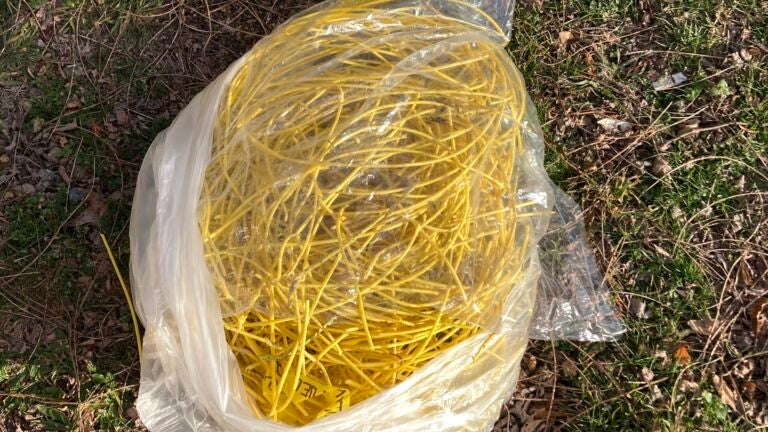
If you come across a particular type of yellow plastic tubing on Cape Cod while you’re out on the beach this summer, the Army Corps of Engineers asks that you report it.
The stringy plastic is called shock tubing, the Army Corps of Engineers explained in a news release. It was used to transmit a charge to underwater explosives during a Boston Harbor dredging project that ran from June 2021 to January 2022.
The Cape Cod Times reported that the tubing has been showing up on Cape Cod’s shores and other nearby beaches since the project started last summer.
It also wrote that volunteers cleaning up the beaches have removed 2,000 feet of the tubing.
People weren’t sure what the tubing was or where it came from until recently, the newspaper wrote. It was Laura Ludwig, manager of the Center for Coastal Studies Marine Debris and Plastics Program in Provincetown, who finally figured out what the tubing was.
In a news release from the Army Corps of Engineers, it explained that “though the contractor was attentive to clean-ups of this tubing after each blast, the deep channel conditions, and frequent flow of vessel traffic in and out of the harbor, unfortunately made it impossible to account for all the used shock tubing.”
The Army Corps of Engineers said in the news release that the contractor responsible for releasing the tubing into the ocean is helping with clean-up efforts.
The Corps also told The Cape Cod Times that it is still determining how much shock tubing was released into the ocean, and are looking at this incident as an “opportunity to learn,” so that it doesn’t happen again.
“The shock tube is made from low‐density polyethylene and is considered safe for humans to touch, but small pieces can create health problems for birds or other animals if ingested,” the Army Corps of Engineers wrote in the news release.
Anyone who sees shock tubing on the coastline is advised to contact Todd Randall at (978) 318-8518 or [email protected].
Stay up to date on all the latest news from Boston.com





To comment, please create a screen name in your profile
To comment, please verify your email address
Conversation
This discussion has ended. Please join elsewhere on Boston.com