
Sign up for the Today newsletter
Get everything you need to know to start your day, delivered right to your inbox every morning.
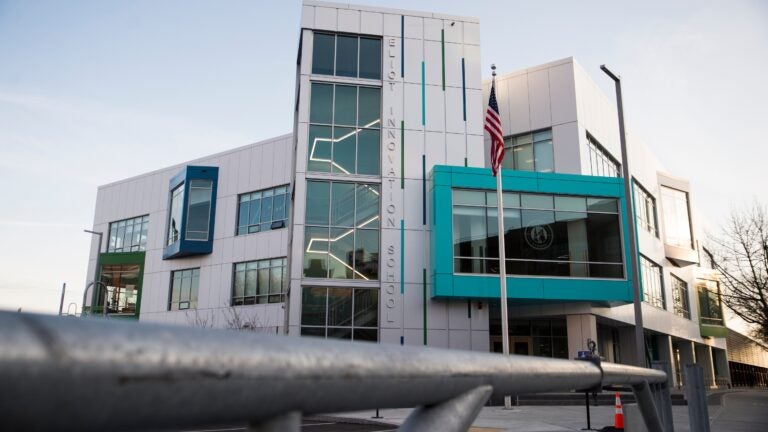
Boston will roll out a new artificial intelligence educational program this fall aimed at making it the first major U.S. city where all public high school graduates are proficient in AI.
Mayor Michelle Wu announced the initiative Thursday at Eliot K-8 Innovation Upper School in the North End, saying the program will begin September across Boston Public Schools.
The effort is designed to ensure students graduate with the skills to use AI in college and the workforce, Wu said.
“This is a public-private partnership between city government, higher education, and industry that will position Boston Public Schools as a leader in AI fluency, as well as the understanding of all of our students to recognize the full context of this world,” she said.
The program is backed by a $1 million seed grant from tech entrepreneur Paul English, co-founder of the travel site Kayak and a BPS graduate.
English said the funding will support training for one teacher from each of the city’s roughly two dozen high schools. Those teachers will undergo training this summer using a curriculum developed by the University of Massachusetts Boston and a local industry group.
Some students will also have the opportunity to take AI courses at UMass Boston, where English helped found the Paul English Applied Artificial Intelligence Institute.
BPS Superintendent Mary Skipper said the program aligns with her and Wu’s commitment to ensuring students graduate prepared academically, socially, and now technologically to be “responsible leaders of the next generation.”
Wu emphasized that the curriculum will focus on ethical and critical engagement with AI — rather than passive use of this technology.
“Part of the curriculum that [we’ve] already been planning and mapping out is really grounded in ethics and grounded in understanding how to maintain and develop creativity [and] leadership and enhance the learning that’s happening — not replace or substitute for it,” she said.
At the conference, a sixth-grade student from Eliot Innovation School said using AI in class has already helped improve their work.
“It helped me think more deeply about my answers,” the student said. “I still had to do the hard part, the brain work. I can see my writing improve every time I get new feedback.”
English said he looks forward to seeing Boston work toward becoming an “AI-forward city,” with graduates prepared to help businesses adopt and use the technology — whether that be building improved products or finding ways to attract more customers.
He added that through this program students could also play a role in bringing AI knowledge home to their families.
“It’s the young people who bring new technology in,” he said. “I look forward to the students of Boston Public Schools teaching their parents how to use AI and how they should think about AI ethically — how to tell when AI is not accurate and how to use AI critically.”
Get everything you need to know to start your day, delivered right to your inbox every morning.



Be civil. Be kind.
Read our full community guidelines.To comment, please create a screen name in your profile
To comment, please verify your email address