
Sign up for the Today newsletter
Get everything you need to know to start your day, delivered right to your inbox every morning.
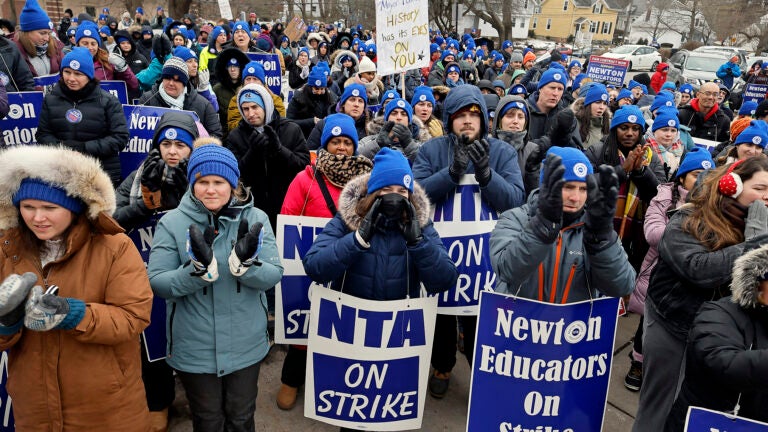
A judge dismissed the second class action lawsuit brought by parents of Newton students who missed classes during an 11-day educator strike last year.
Lital Asher-Dotan, Dmitriy Sokolovskiy, Dan Eshet, Barbara Cipriani, and Ronit Inbar all sued for $25 million on behalf of their children, who are Newton Public School students. The parents argued that the strike caused harm to students and families, driving parents “to a point of desperation.”
Newton teachers ended the then-historic strike after 11 days in February of 2024, winning improved parental leave, family leave, and minimum wages. Teachers in Brookline, Andover, Haverhill, Malden, and on the North Shore have also taken to the picket line in recent years to win contracts.
All public employees in Massachusetts are barred from striking by state law, including teachers, under Section 9A. The parents argued that the union leaders of the Newton Teachers Association, the Massachusetts Teachers Association, the National Education Association, and the UAW, the United Auto Workers union, who were named as defendants, all knew the strike was illegal and supported it publicly.
“When someone breaks the law, and causes damage to others, is it not right and just for the law-breakers to make whole the victims of their misconduct?” the parents write in their complaint.
Judge Christopher Barry-Smith ruled earlier this month that the union didn’t threaten, intimidate, or coerce as part of the labor strike and that students aren’t third-party beneficiaries to the educators’ collective bargaining agreement.
“Recent history, including in Newton, demonstrates that collective bargaining between a municipality and its public employees can be complex and very difficult. The interests of parents and students necessarily must be represented by their elected and appointed officials in public bargaining,” Barry-Smith wrote.
“To insert those parental and student interests into the already difficult process by way of a direct cause of action to enforce Section 9A, through damages, would wholly undermine the public employer-employee relations,” the judge continued.
The same parents were behind a separate class action lawsuit request within the state’s case against the union immediately after the strike. The request was dismissed because “the case is over, and this motion to intervene is denied as moot,” the judge said. The parents, represented by Boston-based Ilya Feoktistov and Chicago-based Daniel Suhr, then refiled as a separate lawsuit.
Barry-Smith also noted that the Commonwealth Employee Relations Board, which enforces the prohibition of strikes, “contain no reference to parents or any other third parties that may be entitled to enforcement” of the law.
Feoktistov and Suhr are also the attorneys behind a lawsuit filed in June against the Beverly Teachers Association after a 12-day strike last fall. Suhr, who did not return a request for comment for this story, also unsuccessfully sued the Chicago Teachers Union for their 2022 strike.
“When teachers go on an illegal strike, they are placing their own demands ahead of their students’ needs,” Suhr said previously. “The unions’ unlawful behavior here sets a terrible example for young, impressionable students who admire and respect their teachers.”

Get everything you need to know to start your day, delivered right to your inbox every morning.


To comment, please create a screen name in your profile
To comment, please verify your email address
Conversation
This discussion has ended. Please join elsewhere on Boston.com