
Sign up for the Today newsletter
Get everything you need to know to start your day, delivered right to your inbox every morning.
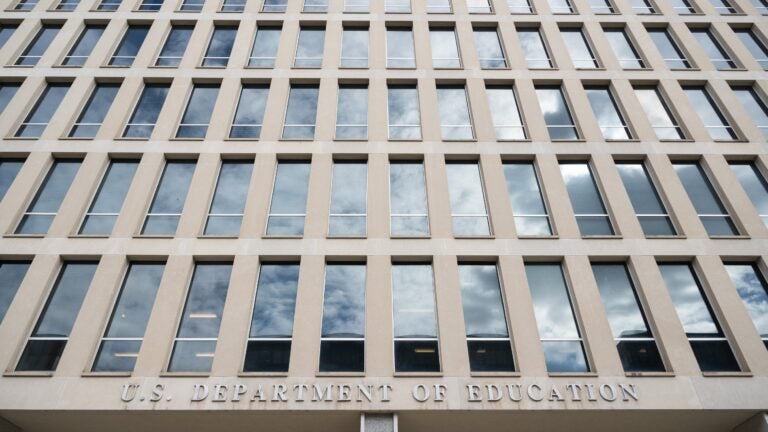
As uncertainty looms over the future of the Department of Education, school administrators across the state are bracing for impact. With budget season in full swing, many are preparing for deep cuts to crucial programs like special education and Title 1 services for low-income students.
The concerns follow the recent confirmation of Linda McMahon to lead the DOE. She recently called the department’s overhaul in a speech a “final mission.”
In her speech, McMahon said she aims to cut red tape; empower parents to make better educational choices; prioritize core subjects like math, reading, science, and history over DEI initiatives; and align post-secondary education with high-paying job opportunities.
But, what President Donald Trump’s administration’s proposed actions mean for schools in Massachusetts is another thing.
In response to McMahon’s confirmation, Gov. Maura Healey said that dismantling the DOE would mean that Massachusetts schools would lose $2 billion in federal funding for schools.
Healey said the funding cuts would result in larger class sizes, fewer reading specialists, and less support for students with an individualized education program. They would also mean less funding for poorer and rural school districts and the end of after-school programs.
“What Donald Trump, Elon Musk and Linda McMahon are doing is bad for children, bad for schools, and bad for our communities,” Healey said in a statement. “Congress cannot let this happen.”
Dismantling the DOE has been on the Republican wishlist since its inception in 1979, when President Jimmy Carter persuaded Congress to pass legislation to create it. Ronald Reagan ran on the platform of eliminating it in 1980.
However, there has never been enough support in the legislature to dismantle the department.
“It’s something that Trump can’t do unilaterally,” said Todd Gazda, the executive director of Collaborative for Educational Services. “But what he can do is start peeling stuff off the Department of Education, leaving it a shell.”
Paul Reville, the Francis Keppel Professor of Practice of Educational Policy and Administration at the Harvard Graduate School of Education, notes that the federal government doesn’t have a clear role in education. He added that the Constitution doesn’t even mention it.
However, Reville said Congress created the DOE. Therefore, “it can only be eliminated by Congress.”
“So, they may gut it in terms of personnel, poor capacity – which on one hand would fulfill some of their objectives, but on the other hand gives them fewer people to implement their education agenda,” he said.
Even if abolishing the department is impossible, it could still significantly impact local funding, particularly for special education through the Individuals with Disabilities Education Act (IDEA) and low-income students through Title I grants.
Early Education and Care Commissioner Amy Kershaw said the state wouldn’t be able to replace the more than $2 billion it receives annually in federal education funding.
Kershaw said the funding helps low- and middle-income students afford college. It also gives districts in low-income areas money to help pay for teacher salaries and benefits, school counselors, and homeless liaisons.
The funding also supports special education, including assistive technology for students with disabilities and professional development and salaries for special education teachers and paraprofessionals.
Gazda said schools are mandated to continue providing services to special needs students. If federal funding is reduced, state or local governments would have to cover the costs, potentially leading to cuts in elective courses, music, or athletics – the things that often “excite” students to come to school.
With so much “chaos” and mixed messaging coming out of Washington, Gazda says it is making it difficult for schools to enter the budget season, not knowing what funds will be available next year during an already challenging financial time for districts.
Gazda said the cuts would also affect research grants. The federal government has already cut $600 million in grants to help stimulate the teaching workforce, which is experiencing a shortage.
“I’m confident that the state of Massachusetts will do everything possible to ensure that all students are supported within our schools,” he said. “But it’s going to create difficult funding challenges at the state because they won’t be able to backfill all of the federal money depending on what is lost.”
The priorities the administration has touted so far appear to be “negative in nature,” said Reville.
Initiatives include eliminating Diversity, Equity, and Inclusion (DEI); making sure transgender athletes participate in sports according to their sex assigned at birth; “protecting” bathrooms; and allowing ICE to come into schools to detain people. They are all “disruptions” that will affect public education in Massachusetts, he said.
The attacks on DEI initiatives have created a lot of anxiety, said Gazda.
“The school districts strive to create an environment where every student feels included, where every student feels that they belong,” he said. “In Massachusetts, we’re committed to this.”
But now, the schools are receiving directives from the federal government saying DEI work needs to stop without explaining what this means. The directives are leaving districts confused about what they can and cannot do and whether it will put them at risk of losing federal funding.
“They’re still doing the work and making sure these students are supported,” Gazda said. “But it’s hard.”
Reville said McMahon’s “convictions,” highlighting the administration’s pro-choice education stance, could lead to many families exiting the public school system, and they will find ways to take that funding with them.
However, Reville said, a bipartisan agreement on the “school-to-career” initiative is possible.
But, he said implementing these initiatives could be challenging without sufficient personnel in the department.
“They’re way out over their skis in terms of making promises that seem better suited for the campaign trail than for how you’re going to govern,” Reville said.
Despite Republicans being respectful of state rights, Reville said, “they want to tell people what they can and can’t teach, or which books they can use in particular classrooms.”
Reville said he expects a lot of pushback in the courts.
“I think Massachusetts educators are proud of leading the nation’s top performing K-12 system and are putting their heads down and determined to deliver on behalf of children in Massachusetts,” he said. “So I’m confident that we’ll survive this period, but it’s going to be very tricky, and it’s going to be very turbulent.”

Get everything you need to know to start your day, delivered right to your inbox every morning.





To comment, please create a screen name in your profile
To comment, please verify your email address
Conversation
This discussion has ended. Please join elsewhere on Boston.com