
Sign up for the Today newsletter
Get everything you need to know to start your day, delivered right to your inbox every morning.
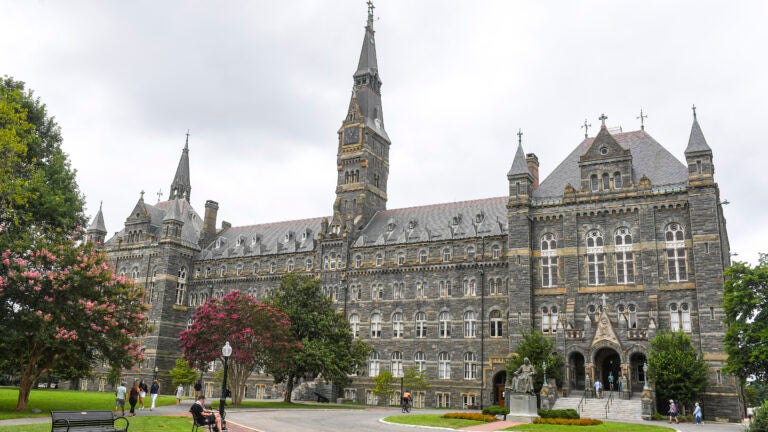
A filing in an antitrust lawsuit against some of the nation’s top universities alleges the schools overcharged students by $685 million in a “price-fixing” scheme, raising serious questions about their past admission and financial aid policies.
Documents and testimony from officials at Georgetown University, the University of Notre Dame, the University of Pennsylvania, MIT and other elite schools suggest they appeared to favor wealthy applicants despite their stated policy of accepting students without regard for their financial circumstances. That “need-blind” policy allowed the schools to collaborate on financial aid under federal law, but plaintiffs in the case say the colleges violated the statute by considering students’ family income.
Every year, according to a motion filed in federal court Monday night, Georgetown’s then-president would draw up a list of about 80 applicants based on a tracking list that often included information about their parents’ wealth and past donations, but not the applicants’ transcripts, teacher recommendations or personal essays.
“Please Admit,” was often written at the top of the list, the lawsuit contends – and almost all of the applicants were.
Former studentsaccuse 17 elite schools, including most of the Ivy League, of colluding to limit the financial aid packages of working- and middle-class students. Theclaimed damages of $685 million, which were detailed in the court filing Monday night, would automatically triple to more than $2 billion under U.S. antitrust laws.
The universities named in the suit have denied wrongdoing and sought to have the case dismissed. They say they have spent hundreds of millions of dollars on financial aid for students, and some have recently dramatically expanded their support for low-income and middle-class students. Attorneys for the defense questioned the $685 million estimate of claimed damages, calling it “junk science.” They argued since there was considerable variation in the expected family contribution at the different schools over the last 20 years, the universities could not have colluded to use one singular model.
“Penn continues to see no merit in this lawsuit,” a spokesman for the university said in a written statement. He said the plaintiffs’ main expert conceded in his deposition that Penn did not engage in the conduct the plaintiffs have argued is unlawful.“The actual evidence in the case makes clear that Penn does not favor in admissions students whose families have made or pledged donations to Penn, whatever the amount. In fact, the University takes great precaution to ensure that no such preference is given. As a result, only qualified candidates are admitted.”
A spokeswoman for Georgetown said the university strongly disagrees with the plaintiffs’ claims and will continue to vigorously defend itself in court. “We believe the university has acted responsibly and always with the goal of only admitting students who will thrive in, contribute to and further strengthen our community,” Meghan Dubyak said.
A coalition of highly selective universities, formed in the late 1990s and known as the 568 Presidents Group, collaborated on aid formulas under a 1994 federal antitrust exemption. The exemption applied only if schools engaged in need-blind admissions. But attorneys for the former studentssay at least nine universities maintained admissions policies that still favored wealthy students in violation of the antitrust exemption, which expired in the fall of 2022.
Meanwhile, according to court documents, the schools’ endowments grew dramatically from a collective total of about $55 billion in 2003 to more than $220 billion in 2022.
Details that emerged in the case Monday includedallegations that a former MIT Corporation chair applied pressure for the admission of two wealthy applicants; testimony from a former Harvard official who said the school had not joined the group because it would compel the school to reduce its financial aid awards; and a Vanderbilt University official writing in 2014 that if the statute expired, the school could be forced into a bidding war for students.
The court document contends Notre Dame has admitted that it sometimes granted admission to applicants based on factors that included the donation history, or future capacity, of the applicant’s family.
And at Penn, the suit says, applicants given a special-interest designation – indicating they were from a wealthy or donor family – were more likely to get in. A spokesman for the university said, “Penn’s dean of admissions testified the tag had ‘nothing’ to do with a family’s financial circumstances.” In 2020, Penn left the group to be more generous to students, according to the court filing.
The allegations stem from a class-action lawsuit brought in 2022 by eight former students who said the universities shared a methodology for calculating students’ financial need that reduced the amount of aid the schools provided to low- and middle-income students.
The lawsuit initially named 16 defendants: Yale University, Columbia University, Duke University, Brown University, Emory University, Georgetown, the California Institute of Technology, Northwestern University, Cornell University, Dartmouth College, Penn, Vanderbilt, MIT, Notre Dame, Rice University and the University of Chicago. Johns Hopkins University was later added.
The lawsuit says the methodology the group employed placed too much emphasis on an applicant’s ability to pay in calculating the net price – what students pay after taking grants, scholarships and tax credits into account. The schools that adopted the approach, the complaint argues, artificially inflated the net price of attendance for financial aid recipients for years.
The group dissolved after the lawsuit was filed.
Ten of the schools have settled, for a total of $284 million. Those schools have said that the case is without merit and they did nothing wrong, but that they wanted to avoid further expensive litigation. Many also noted they have spent hundreds of millions of dollars on financial aid for needy students. Last year, a spokesman for Vanderbilt noted, the school spent $401 million on financial aid.
The proceeds from the settlements will be pooled to provide cash payments to the entire classof 200,000affected undergraduate students at the 17 schools, not just those who attended the universities that have settled.
Georgetown, Penn, Caltech, MIT, Cornell, and Notre Dame continue to fight the lawsuit.
A spokesman for Johns Hopkins said Tuesday that the university is working on a settlement in the case.
A spokeswoman for MIT said the claims in the case are baseless. “MIT has no history of wealth favoritism in its admissions; quite the opposite,” Kimberly Allen wrote in an email. “After years of discovery in which millions of documents were produced that provide an overwhelming record of independence in our admissions process, plaintiffs could cite just a single instance in which the recommendation of a board member helped sway the decisions for two undergraduate applicants.”
The potential for philanthropic gifts had no bearing on these isolated cases, she said, and their records reflect that “the children of wealthy individuals routinely receive disappointing news from MIT.”
Cornell and Caltech declined to discuss the case.
A spokesperson from Notre Dame said the university is “confident that every student admitted to Notre Dame is fully qualified and ready to succeed. We continue to believe that there is no merit to the plaintiffs’ claims, and we will let our defense of the lawsuit speak for itself.”
Many of the schools have long touted their generous financial aid policies. Penn and MIT, for instance, have offered free tuition based on household income since 2008 and recently increased the earnings threshold to cover more students. Caltech also provides grant aid to fully cover tuition, fees, housing and food for students with family incomes of less than $100,000 and institutional aid to fully cover tuition for students with family incomes of less than $200,000. The vast majority of American households would meet the free-tuition thresholds at those three schools.
MIT’s history of financial aid makes clear that wealth is not a factor in admission, the school’s spokeswoman said. The institute spent $167 million this year on financial aid, Allen said, and about 60 percent of their undergraduates get support from the school.
Georgetown announced this year that it has devoted $285 million in university support for financial aid, its largest-ever commitment, and 15 percent of the freshman class – 263 students – are eligible for Pell grants.
Johns Hopkins launched a dramatic push to make its education more affordable in 2018, when a $1.8 billion gift from billionaire Mike Bloomberg went toward undergraduate financial aid and need-blind admissions; this year, a $1 billion gift went to medical and graduate school financial aid. Med students whose families earn up to $300,000 a year pay no tuition, and many have living expenses and fees covered, as well.
Attorneys for the plaintiffs argue that many of these schools became more generous with their financial aid after the Presidents Group disbanded in late 2022. They argue that every school named in the case could have awarded 10 percent to 20 percent more institutional aid from unrestricted endowment funds throughout the 20 years but chose to limit aid packages.
“Our motion today spells out very substantial evidence supporting our claim that the Defendants colluded with each other for twenty years on financial aid, and the illegal collusion resulted in the Defendants providing far less aid to students than would have been provided in a free market,” Robert Gilbert, co-lead attorney for the plaintiffs, said in a written statement.
At Georgetown, the lawsuit contends, the annual “President’s List” of 80 or so applicants was based on a tracking list of more than 200 names that often included financial information about the parents. The process was explained by the school’s longtime dean of admission in a 2022 deposition given to the Justice Department, according to the court documents.
The filing cited a memo describing a “special interest policy”at Georgetown thatwould allow “certain well-qualified candidates to be provided favored treatment in admission in exchange for the opportunity the university will have to develop a better association with th[eir] family or sponsor.” The memo also noted the school is “under-funded and under-endowed and we need to do a better job of enlisting the support of America’s wealthiest families and corporations in assisting us. Special interest admits should provide this type of opportunity to enhance and strengthen our future.”
Ted Normand, co-lead attorney for the plaintiffs, said in a statement that rather than competing based on the aid they could afford to distribute, the schools “saved themselves, and cost their students, hundreds of millions of dollars in aid.”
Get everything you need to know to start your day, delivered right to your inbox every morning.




To comment, please create a screen name in your profile
To comment, please verify your email address
Conversation
This discussion has ended. Please join elsewhere on Boston.com