
Judge denies Boston teachers’ request for remote-only teaching option
“Even once the 4% positive threshold is cleared, the Boston Public Schools can still compel teachers to work on-site if the Boston Public Health Commission determines that this can be done safely,” Suffolk Superior Court Judge Robert Gordon wrote in his decision Wednesday.
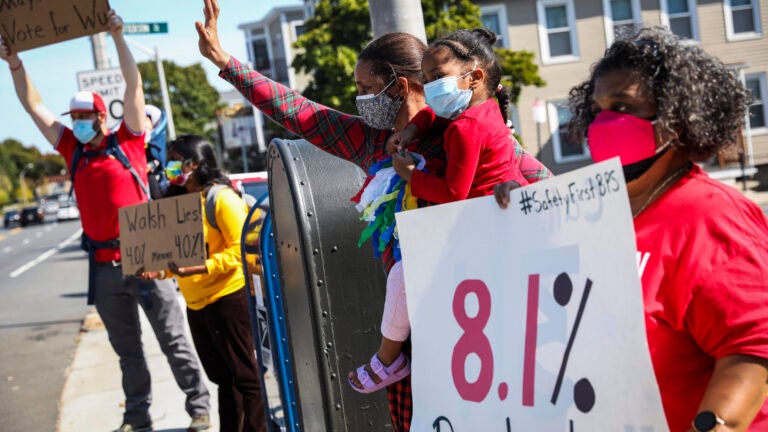
BOSTON (AP) — A judge has denied a request by Boston public school teachers for an injunction that would have allowed them to choose to teach remotely as long as the city’s coronavirus positivity rate remained higher than 4%.
“Even once the 4% positive threshold is cleared, the Boston Public Schools can still compel teachers to work on-site if the Boston Public Health Commission determines that this can be done safely,” Suffolk Superior Court Judge Robert Gordon wrote in his decision Wednesday.
The high-needs students who are currently attending school in-person would “suffer measurable deficits” if the district started holding classes entirely remotely, the judge said. Most Boston school children continue to be taught remotely.
The Boston Teachers Union filed its legal challenge on Oct. 8 after Mayor Marty Walsh said in-person classes would be pushed back for most students, but those already attending school would continue to do so. The union said that violated a memorandum of understanding with the city regarding school safety.
“We are pleased that the court has preserved the opportunity for our highest needs students to continue learning inside our schools, supported with the critical services that they require and deserve,” Walsh and Superintendent Brenda Cassellius said in a joint statement.
The union said it would continue to work with the city to make schools safe.
“Hopefully, this ruling will accelerate our ongoing conversations with the district so that students and staff are learning and working in the safest environment possible when in-person,” the union said in a statement.
Read the union’s full statement:
“While we view the language in the safety agreement differently, what is most important is that we figure out a collaborative plan as soon as possible that includes safe staffing ratios, that reduces the viral footprint in our school buildings, and that ensures high-quality in-person instruction for our highest-needs students. Since the start of the pandemic, we have affirmed the value and importance of in-person instruction for high needs students, and hopefully, this ruling will accelerate our ongoing conversations with the district so that students and staff are learning and working in the safest environment possible when in-person. That means having no more adults in the building than are necessary to ensure high-quality instruction for high-needs students and reducing the viral footprint through more collaborative and intentional scheduling. Safe staffing ratios and reducing the viral footprint are still possible with or without an injunction if the district works with us to formulate the safest possible plan. We will continue to advocate for the health, safety and equity of learning experiences for all of our students, and respect for our educators.”




To comment, please create a screen name in your profile
To comment, please verify your email address
Conversation
This discussion has ended. Please join elsewhere on Boston.com