
Ashish Jha says we have ‘one shot’ at opening schools in the fall. Here’s what he says needs to be maximized.
“We should be creative about getting kids together."
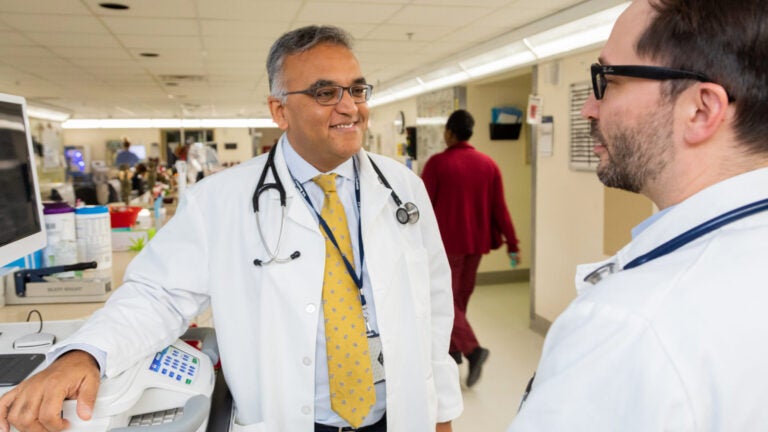
Dr. Ashish Jha, director of Harvard’s Global Health Institute, weighed in Thursday on how schools should approach plans for reopening in the fall, saying schools should maximize opportunities for in-person instruction as much as possible.
Related Links
“My overall sort of feeling on this is we have one shot at opening schools this fall,” Jha said during a live-streamed interview with The Boston Globe‘s editorial page editor, Bina Venkataraman. “Because if we open irresponsibly — there are large outbreaks and schools shut down again — they’re going to be very, very hard to reopen. Everybody is going to be much more gun-shy.”
Venkataraman asked during the “Op-Talk” if the Harvard doctor’s previous thinking for measures and metrics schools should take into account in their reopening plans had changed after seeing an outbreak explode quickly at a Georgia school that opened its doors to students in recent weeks.
Jha said what happened in Georgia was “completely predictable.”
“Georgia opened up irresponsibly, I believe,” he said. “They went against where the science and data were. They didn’t even ask people to wear masks — it was voluntary. We can’t have voluntary mask-wearing. We should expect that all the kids and all of the adults are going to wear masks.”
Massachusetts schools are required to submit their plans for reopening on Friday, with some districts already opting for different approaches to kicking off the academic year amid the ongoing pandemic. Many parents and teachers have expressed a preference for remote learning to continue.
Jha stressed that schools need to open “responsibly,” first taking into account the level of community transmission being seen in their district.
Massachusetts, he said, meets the criteria for being able to reopen safely.
“There isn’t a formal definition, and this will get to a broader point, which is there is no set point at which you say, ‘OK it’s totally safe, do it,’” Jha said. “There is only ‘safer’ and ‘less safe.’ Georgia, clearly unsafe — less safe. Massachusetts — in the safe range, overall. Again, some communities more than others.”
School reopenings shouldn’t be looked at as an “all or nothing” issue, he said.
“If you don’t have great ventilation in your schools, keep working on that, and try to have classes outdoors in September,” he said. “And then people say, ‘Well, what if it rains?’ Well, on those days, people will be at home. You’re not going to get it perfect, but if you can get a good number of in-person instruction days in September and October, use that time to really get schools ready, you can get kids back into school in November.”
The point is to explore all options and opportunities for safe in-person instruction. That way, if the flu season does end up being terrible and COVID-19 “comes roaring back,” students will have at least gotten a few months of in-person instruction before schools need to go back to all-remote learning, Jha said.
If more space is needed, schools should use libraries or other municipal buildings that aren’t being used by workers to spread out, he said.
“We should be creative about getting kids together,” he said. “And I think if we do it with good science, mask-wearing, reasonable ventilation, we can actually do this pretty safely.”
Jha said he’s concerned about a widening in the equity gaps for kids — which was already seen in the spring — should in-person learning not be maximized.
“Some kids were able to jump online and be reasonably OK and a lot of kids were not, and the kids who were not disproportionately came from poorer backgrounds and from minority communities,” the Harvard doctor said of his concerns. “There is no question in my mind that if we are online for the next 12 months, that what we’re going to see is a pretty substantial widening of the achievement gap between more privileged kids and less privileged kids. I’m also pretty clear that what we’re going to see is substantial labor market effects on women. Because whatever we may say about gender equity and kids, the reality is that women end up bearing the disproportionate brunt of extra child care. And that will have real effects on women’s earning potential, their jobs.”
None of those concerns mean districts should take a “willy nilly” approach, Jha said.
“But it does mean that we have to be thoughtful,” he said. “And defaulting to just being online for the next year because it feels safer should be seen in the context of the very substantial costs that are going to come on both gender equity as well as on racial and ethnic equity in our society.”
Watch the full “Op-Talk” below:



To comment, please create a screen name in your profile
To comment, please verify your email address
Conversation
This discussion has ended. Please join elsewhere on Boston.com