‘Why are you preying on our children?’ Fury over Mount Ida closure at hearing
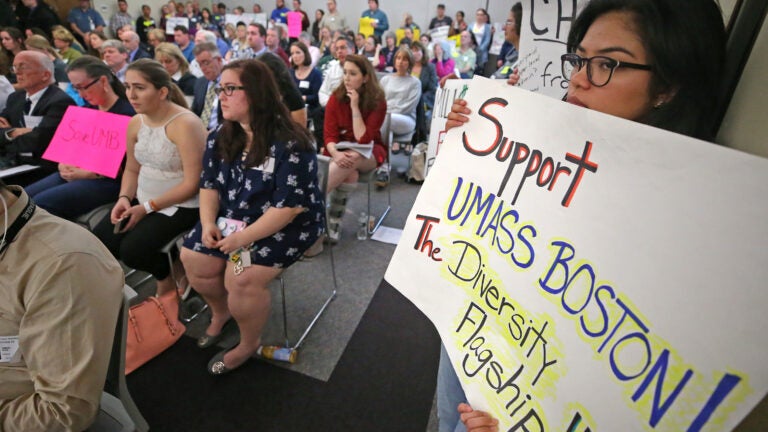
Students and parents voiced deep anger and a sense of betrayal toward Mount Ida College on Tuesday morning at the first public meeting held since the school abruptly announced its closure 2½ weeks ago.
Members of the state Board of Higher Education listened to their concerns, at times holding back their own tears, then expressed fury and skepticism about the deal Mount Ida struck for UMass Amherst to buy its 72-acre Newton campus for approximately $70 million.
“I feel like these students have really been ill-served, and their families,’’ board chairman Chris Gabrieli said after testimony concluded. The board also heard from UMass Boston students and professors who oppose the deal because they believe it will hurt the Boston campus.
Board members said repeatedly that they do not have the authority to stop the UMass Amherst purchase. But they said they have serious doubts that this deal makes sense for the public university system and certainly not for Mount Ida students.
“It seems to me that this is not only an example of system failure, this is an example of serious leadership failure,’’ said board member Fernando Reimers, a Harvard professor. “Leadership at Mount Ida and their board, leadership at UMass and their board.’’
Reimers said it is unacceptable that the Board of Higher Education be asked to remain bystanders in this process and urged UMass system president Martin T. Meehan to come answer questions about the deal.
Tuesday’s meeting stretched two hours in a standing-room-only conference room on the 21st floor of a state office building on Ashburton Place. The first to speak was the lawyer for the state Department of Higher Education, who expressed her displeasure with the chaotic way Mount Ida College has rolled out the closure. Then parents and students recounted the disruption, anxiety, and financial costs the closure has caused them.

Jeffrey Marshall, an associate professor of art at Mount Ida, asked the board to force Mount Ida to honor contracts for next year that it had signed with faculty just a month ago.
Parents described how they had carefully saved money for their children to be able to attend Mount Ida. Many said their children chose the school because of its serene campus, small classes, and specialized programs. Some said their children have special needs, and Mount Ida was the only school where they felt comfortable.
“This is not what my child signed up for. Someone needs to be held accountable,’’ Becky Bridges said. As part of its deal to buy the campus, UMass has agreed to allow all Mount Ida students in good academic standing to transfer automatically to UMass Dartmouth. But Bridges’s daughter studies veterinary technology, a program not offered at Dartmouth.
“As a mother, it’s been heart-wrenching,’’ Chris Connolly said as she choked back tears. Her daughter is in a specialized photography program that also is not offered elsewhere. “The rug was pulled out from underneath her.’’
Mount Ida officials did not speak at the hearing, but spokeswoman Amy Nagy provided a statement Tuesday afternoon in response.
“We recognize how emotionally trying this transition is for students and families alike. We are working as diligently and quickly as possible to help place students in programs that allow them to continue their studies in their desired major. We embrace the process established by the Department of Higher Education and the need for families to have a platform to have their concerns heard. We are working with the DHE to find solutions for all [our] students and thankful to have their support,’’ the statement said.
Some speakers described very practical implications of the closure; others asked overarching questions about the board’s role in protecting students.
One student in the dental hygiene program said if she can’t find a place to transfer for the fall, she will have to start repaying her student loans, which will be impossible if she doesn’t have a job. John Driscoll, a sophomore in the criminal justice program, asked that UMass allow all Mount Ida students to finish their degrees on campus.
Jeffrey Marshall, an associate professor of art at Mount Ida, asked the board to force Mount Ida to honor contracts for next year that it had signed with faculty just a month ago. It was wrong for the school to give them new contracts when it was on the brink of closure, he said.
“The fact that Mount Ida is closing is sad. The way it is closing is tragic and disgraceful,’’ he said.
In addition to the 850 students who must finish their degrees elsewhere, Mount Ida is also faced with how to assist the more than 200 students it admitted for the fall who now must make alternative plans.
Lissa McClain said her daughter is a high school senior who planned to study veterinary technology next year. Her daughter was awarded about $37,500 in scholarships from the school, which meant her family would have to pay just $6,000 per year, she said. Knowing what she does now, she questioned why the school offered such a generous scholarship if it did not have the funds to support it.
“Why are you preying on our children, luring them to come to Mount Ida with nonexistent money?’’ she said.
Notable among the speakers was Richard Freeland, the former president of Northeastern University and former state commissioner of higher education.
Freeland said the UMass trustees have a responsibility to build an excellent system of public universities and he is not sure this plan accomplishes that goal. The probable effect of having Amherst students in Newton, he said, will be the “cannibalization’’ of enrollment at UMass Boston.
“I am deeply skeptical,’’ said Freeland, speaking as the board and his successor, Carlos Santiago, sat at the long table in front of him. “This plan should not be allowed to go forward.’’
When a college closes, it is required to notify state officials in advance and provide agreements from other schools that will accept the students and allow them to complete their degrees.
Mount Ida administrators did not notify state regulators ahead of time that the college would close. Regulators found out through the press and are now rushing to facilitate the closure and help find programs for the students before the fall.
Dena Papanikolaou, the attorney for the state Department of Higher Education, said the department has dealt with several closures in the past and expects to see an increasing number because of national demographic trends that show a decreasing number of high schoolers.
Papanikolaou said many closures have been orderly and therefore less challenging for students and faculty. She said the worst kind of closure is a “padlocked door closure,’’ when the school gives no prior notification to its community.
“While by far these are the worst closures to manage, those are few and far between,’’ she said. “Unfortunately, Mount Ida is one of them.’’