
It’s been quite the year for Boston Public Schools
The district has dealt with student protests over the budget and elevated lead levels in the water fountains.
In his first year on the job, Boston Public Schools Superintendent Tommy Chang has faced some rocky moments, from dealing with heated debates over the school budget to instances of racism in one of the city’s most prestigious exam schools. He has also been able to celebrate more hopeful moments, from a teacher winning a $100,000 grant for his work with the Diploma Plus program to the community at the Burke high school rallying around its graduates just days after a shooting happened outside the school.
Here are some of the highlights from the past school year:
Boston Public Schools initially faced a $50 million budget gap
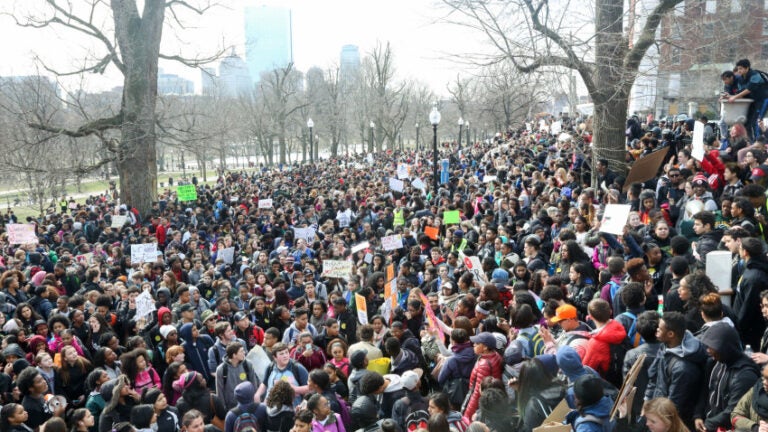
The budget deficit, which was due to rising expenses and a decline in state and federal aid, was announced in January. The announcement spurred a wave of activism, most notably a massive student walk out in March. Parents also protested, and, in addition to making themselves heard at school committee meetings, demonstrated outside the Mayor’s State of the City address in January.
More than 2,000 Boston public school students walked out of class to protest budget cuts
Thousands of students marched through downtown Boston
to protest planned budget cuts, carrying signs and chanting, “What do we want? Education!’’ as shoppers and onlookers walking down Newbury Street pulled out their cell phones to record the demonstration. Mayor Marty Walsh continually argued that adults were giving “misinformation to students,” to convince them to leave class. Walsh and Chang eventually found a way to avoid some cuts at the high schools by delaying investments in some of the Superintendent’s long-term initiatives.
Students continued to build momentum throughout the spring
From proving that they did organize the first walk out without coercion from adults, to planning a second a second march where they testified in front of City Councillors, students refused to be silenced when it came to expressing their concerns about the budget. Most recently, a group of students overtook a meeting with Chang on June 7 to ask him tough questions about why the schools weren’t receiving more funding. Mayor Walsh said Monday he plans to add nearly $5 million to the district’s allocation, and City council will make a final vote by June 29.
A new program gives Boston public school grads a shot at free community college
The city’s new program, which provides free admission to Bunker Hill Community College and Roxbury Community College, became available at all BPS high schools starting June 1.
Two Boston Latin School students brought attention to racist interactions they experienced in school
, Boston Latin students Meggie Noel and Kylie Webster-Cazeau cited incidents in which their white peers used racial slurs and weren’t reprimanded by school officials. The video launched an investigation by the district’s Office of Equity, which revealed that the school’s policy was violated in the handling of one of seven reported incidents. In that case, administrators did not properly investigate, discipline the student responsible, or take action to ensure the safety of the student subjected to the racist remark and threat. The NAACP called for the removal of the school’s headmaster, Lynne Mooney Teta, based on the findings.
The US Attorney launched an independent investigation into Boston Latin School
After receiving a complaint from eight civil rights organizations in February, the Civil Rights Unit of the U.S. Attorney’s office launched an independent investigation into incidents at Boston Latin School, which is ongoing.
A Charlestown High School teacher won a $100,000 award for work with Diploma Plus Program
Sunny Pai was named the winner of the Nellie Mae Foundation’s Lawrence W. O’Toole Award, which grants $100,000 to a school, community organization, or district to continue the advancement of student-centered learning approaches.
Several Boston Public Schools tested positive for elevated lead levels in drinking water
In late April, Boston Public Schools officials shut down fountains in four schools after a test revealed elevated levels of lead in the drinking water. A week later,the district said a third-party contractor mistakenly turned on fountains at six schools before testing was finished. The six schools were part of a pilot program to repair plumbing so that fountain water could be restored in the buildings, all of which had been using bottled water. Two district employees were placed on administrative leave.
Boston Public Schools unveiled an updated water policy in response to elevated lead levels
, which the school committee approved Wednesday, stipulates annual testing of all water sources used for drinking, food preparation, or medical services in all schools, but does not include classroom or bathroom sinks in any of these schools since they are not supposed to be used for drinking water.
There was heated discussion around the McKinsey report
, the report was touted in a statement from the district as a way to help Boston Public Schools “explore for more efficient operational approaches and suggests reallocating potential cost savings to better serve all students in the system,” but its calculations were questioned by critics and school officials alike. QUEST, a parent advocacy group, referred to the report last fall when it claimed the Mayor wanted to close 36 schools. The district has said that it will use the 10-year facilities master plan rather than the McKinsey report to assess its buildings.
The Burke school rallied around its graduates in the wake of a shooting
Days after tragedy struck the Jeremiah E. Burke school community with the death of 17-year-old Raekwon Brown, the school celebrated the success of its graduates, whose success allowed the school to rise out of the “turnaround” category.





To comment, please create a screen name in your profile
To comment, please verify your email address
Conversation
This discussion has ended. Please join elsewhere on Boston.com