
Obama expected to sign ‘No Child Left Behind’ rewrite into law Thursday
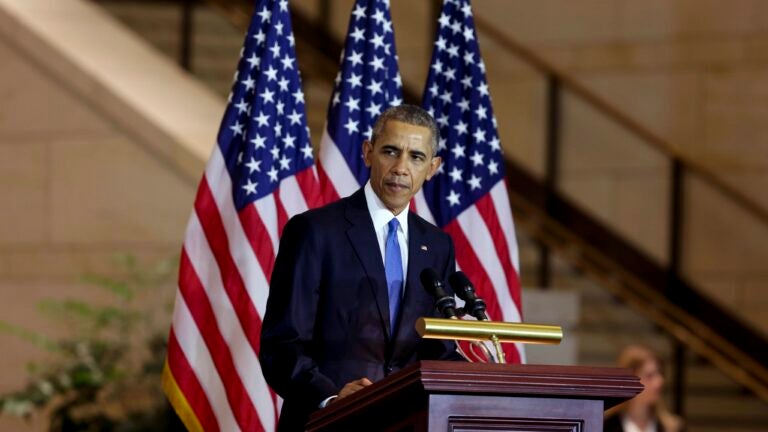
President Barack Obama is expected to sign the “Every Student Succeeds Act’’ into law Thursday. The legislation, which passed by an overwhelming 85-12 majority in the Senate Wednesday, overhauls George W. Bush’s contentious “No Child Left Behind Act.’’
When it was passed in 2001, the No Child Left Behind Act shifted much of the responsibility for K-12 education from states to the federal government. The bill required annual math and reading tests for students in grades three through eight, and one annual test during high school. It also imposed consequences for states and schools that didn’t perform well on standardized tests. The goal of the legislation was to have 100 percent of students reaching proficiency by the 2013-2014 school year.
The new act keeps some of the original policies, but notably shifts some power back to individual states and school districts and away from the federal government.
“Whereas No Child Left Behind prescribed a top-down, one-size-fits-all approach to struggling schools, this law offers the flexibility to find the best local solutions—while also ensuring that students are making progress,’’ Education Secretary Arne Duncan said Tuesday at an event in Washington.
Even though the one-size-fits-all approach Duncan described was criticized, the act did require schools to break down their standardized test scores based on categories that included income, race, and disability. If one group of students was struggling, it would be transparent in the test results, which helped highlight inequality in districts.
The Every Student Succeeds Act keeps the standardized testing requirement in place, as well as the mandate that schools must report the results by students’ race, income, and disability status. But the act gives states the freedom to choose how to evaluate teachers and how to hold schools accountable for students’ performance on these tests. Under No Child Left Behind, schools that performed poorly were subject to federal sanctions that ranged from hiring more tutors to closing a school.
The federal sanctions were soon deemed impractical, along with the goal of 100 percent proficiency by the 2013-2014 school year. In 2012, Massachusetts received a waiver on certain aspects of the law, and had a new goal of reducing proficiency gaps by half by the end of the 2016-2017 school year.
The new law ensures that, instead of evaluating school performance based solely on test scores, states will be allowed to consider other factors, such as graduation rates, in making their rankings. But if a school drops into the lowest-performing five percent of all schools, the state will be required to intervene to develop programs to help the school improve.
The legislation is considered a bipartisan victory. Many Republicans, such as Sen. Lamar Alexander from Tennessee, felt the government was micromanging education policy.
“It moves decisions about whether schools and teachers and students are succeeding or failing out of Washington, D.C., and back to states and communities and classroom teachers, where those decisions belong,’’ Alexander said Tuesday. “This law expired eight years ago. It has become unworkable. If it were strictly applied, it would label nearly every school in America a failing school.’’
Katherine Clark, a U.S. representative from Massachusetts, was one of seven Democratic representatives from the House who was chosen to work with Senate members on the final version of the bill. The final act includes a number of reforms Clark proposed that emphasized closing achievement gaps and expanding early education.
“For the first time, we have a bill that invests in early learning with Preschool Development Grants,’’ Clark said in a statement. “While not perfect, this legislation brings us closer to our fundamental promise to every child – that every child gets a fair shot at their dream.’’



To comment, please create a screen name in your profile
To comment, please verify your email address
Conversation
This discussion has ended. Please join elsewhere on Boston.com