
High rising college tuition might be leveling off
Even though students at four-year public colleges and universities pay 40 percent more for school than their peers did a decade ago, college costs seem to be leveling out, according to a report released by the College Board on Wednesday.
The College Board’s report details the prices charged by colleges and universities in 2015-2016, as well as how these prices have changed over time, and how they vary across different institutions, states, and regions.
The main finding: The soaring tuition costs and high borrowing rates that became common during the recession have leveled off.
“Significantly, and perhaps counter to public impressions, price increases are not accelerating over time,’’ the report said. “The increases in tuition and fee prices in 2015-16 were, like the increases in the two preceding years, relatively small by historical standards. However, the very low rate of general inflation makes this year’s increases in college prices larger in real terms than those of 2014-15 and 2013-14.’’
Borrowing has declined slightly for the fourth year in a row, default rates have stabilized, and tuition increases at public college and universities over the past three years have been at their lowest levels since the ’70s, according to this year’s report. Still, even though the increases are at their lowest levels in decades, the sticker price for the 2015-2016 school year tuition rose about 3 percent from last year.
During the recession, however, the report said public schools saw a 9.5 percent increase in prices for the 2009-2010 academic year from the year before.
Although slight increases are a relief compared to the drastic tuition hikes of the past, the report pointed out that even small increases in fees can hugely impact families. When adjusted for inflation, median family income in the U.S. declined at an average of 0.2 percent a year between 2005 and 2014. Essentially, this means families aren’t better off than they were in the past, which can make paying for college a strain.
Despite the financial burdens in financing education, the report said families have taken on less debt than in the past. Borrowing totaled $106 billion in 2014-2015, which is down 6 percent from the previous year, and down 14 percent from the high of $124 billion borrowed in 2010-2011.
Sandy Baum, a scholar at George Washington University who co-authored the report, told The Washington Post borrowing is declining because college enrollment is slipping while grant aid has remained steady.
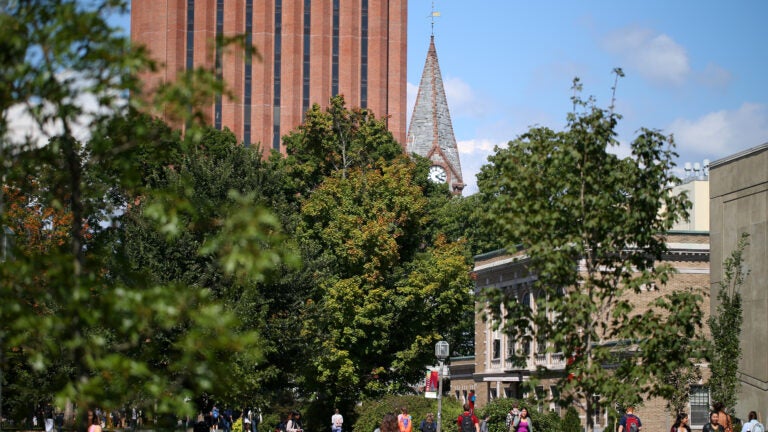
Tuition at public schools averaged $9,410 for in-state students this school year, which is a 2.9 percent annual increase when adjusted for inflation. By contrast, tuition at UMass-Amherst costs an estimated $14,171 for in-state students. Once you add room and board, fees total $25,674 per year.
Still, UMass students can take solace in the fact that in-state tuition could be worse. Public universities in New Hampshire are the most expensive in the nation for in-state students. At the University of New Hampshire, students paid $16,986 in tuition this school year.




To comment, please create a screen name in your profile
To comment, please verify your email address
Conversation
This discussion has ended. Please join elsewhere on Boston.com