
Largest campus assault survey shows more than one in five women are sexually assaulted
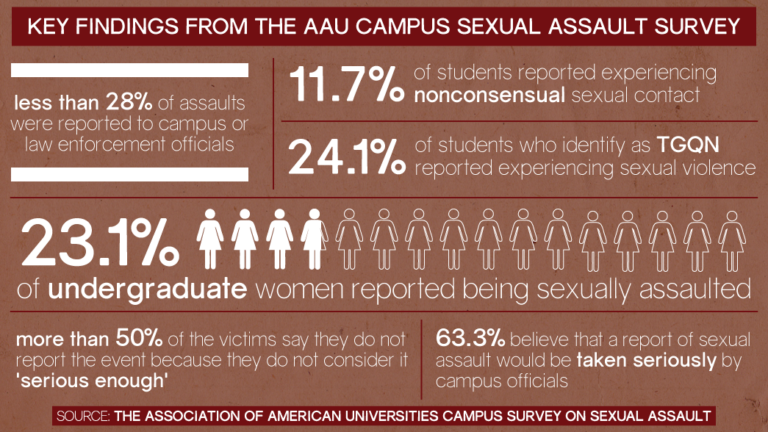
Women are more likely than men to earn college degrees. But they’re also more likely to be victims of sexual violence during their time on campus, according to a new survey.
On Monday, the Association of American Universities released the findings of what it called the largest ever survey conducted on college sexual violence. Approximately 150,000 students at 28 universities across the nation, including Harvard, submitted responses. The report, titled the “Campus Climate Survey on Sexual Assault,’’ showed that 23.1 percent of female undergraduates were victims of unwanted sexual conduct due to physical force or a threat of physical force.
The rates of sexual violence were also high for students who identified as transgender, genderqueer, non-conforming, and questioning, with 24 percent reporting sexual violence.
Another key finding dealt with measuring “affirmative consent.’’ The approach, which has also been called “yes means yes,’’ requires both parties to actively express their willingness to participate in sexual activity. According to the report, 11 percent of undergraduate women experienced penetration or oral sex without active agreement.
The AAU asked its 60 member universities to administer the survey in April. Only 27 took part, as well as one non-member university.
Locally, Boston University, Brandeis, and MIT, who are members of the AAU, declined to participate.
In April, BU said it wouldn’t take part because it was administering its own survey. A spokesman for BU said the university will publish the findings, but didn’t say when. A spokeswoman for Brandeis said the university conducted its own study last spring and will release the findings later this fall. MIT also conducted its own survey and publicly released the findings last fall.
Even though the findings released Monday are similar to other recent reports on campus sexual violence, the researchers behind the AAU survey said there’s a possibility the findings could reveal a respondent bias because people who were victims of sexual violence might be more likely to respond. Only 19.3 percent of the students contacted submitted responses, and the AAU said those who ignored the survey might not have filled it out because they didn’t experience sexual violence.
Still, the survey shows just how difficult it is to tackle the problem of campus sexual assault. Even though 11.7 percent of all respondents had experienced some form of non-consensual sexual contact, less than 28 percent of all incidents were reported.
More than half of people who didn’t report said they didn’t consider their assaults “serious enough.’’ Another significant percent said that reporting would be “too emotionally difficult,’’ or that they didn’t think anything would be done about it.
The good news is that more than half who did choose to report had positive experiences with the organization or agency to whom they reported.
The AAU’s report didn’t detail the victimization rates at each school, but many participating universities said they planned to publish their own findings.





To comment, please create a screen name in your profile
To comment, please verify your email address
Conversation
This discussion has ended. Please join elsewhere on Boston.com