
Back-to-school guide: Massachusetts Institute of Technology

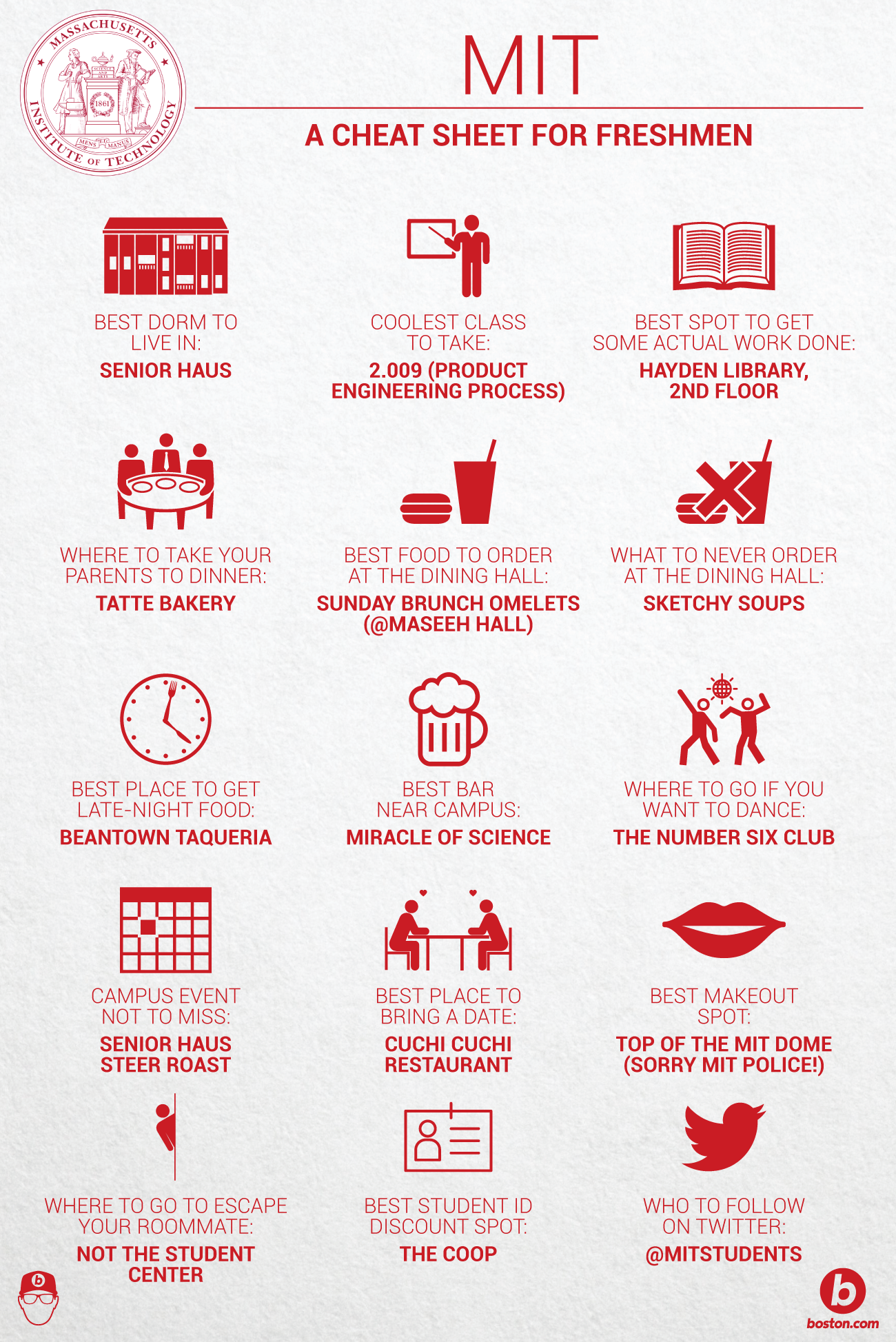
We asked current students and recent graduates to give us the inside scoop on their colleges before the school year begins. Here, current student Fabiana Zappala and recent graduate Zach Casas tell us the best and worst things about MIT, and also gives advice to incoming freshmen.

Click here for a full-sized version of the cheat sheet
Tell us about three things you think are “right’’ with your school:
1. What we appreciate the most are the countless ways to get hands-on experience throughout our undergraduate career. There are infinite areas of research we can get involved in (for credit or pay) on campus through the Undergraduate Research Opportunities Program (UROP). There are classes we have to take to graduate and others we can take based on our interests that allow us to work on hands-on projects with a team. We have a strong work-abroad program (MISTI) that will fund your whole summer in more than 20 countries. If the program of your personal interest has not been established, you can work with someone to get it started. We even have an alumni network that we can leverage to find what we call “Externships’’ which are 4-6 week internships during the month of January. (We don’t start until first week of February). If you come to MIT with good ideas, or you become curious about an industry or an area of research, there are so many ways to explore those options.
2. While the majority of our students majors in engineering, you might be surprised by how much academic flexibility you can enjoy at MIT. We take at least eight classes in total outside of our majors in all kinds of areas (lit, history, anthropology, arts, etc), but you can definitely fit more than eight if you want to. There are even a number of majors that offer a flexible engineering degree, which focuses only on the core classes. Learning a language is very common at MIT because the classes really prepare you in a short period of time. I have a lot of friends studying engineering at other great schools and they always comment that their engineering curriculums don’t allow them to study anything else. That is not the case at MIT. If the school doesn’t offer whatever you’re interested in, you can take it at Harvard or Wellesley, or you can ask the department to invite a professor for the semester.
3. I think most of us would agree MIT gets very hard at some points, but we also know how many tools are at our disposal to help us overcome all obstacles, both academically and in our personal lives. Beyond the established programs (such Student Support Services), every professor, TA, RA, and almost all other student understands what we’re going through and will listen and try to help you. Every single professor and TA I’ve had has office hours (all well-attended), and they open their doors whenever possible. When something sad happens on campus, they try to give us a lighter load that week. When we come in as freshmen, they hand us packets about “How to get help’’ with classes, finances, health, etc, and at that point maybe it freaks you out a little bit. Shortly after, you understand that it’s part of studying here, and that everyone around you is genuinely interested in helping you.
Tell us about three things that you think are “wrong’’ with your school:
1. Contrary to what some might think, there is very little grade competition at MIT. However, what I think we all dislike is the sort of “Who can work harder?’’ culture. What’s worse is that we generally lack direction. There is very little time to think about what we want to do after graduation, because we’re so busy trying to do everything at school. There are a number of career development tools on campus, but no one takes them very seriously. Most people will go to a few information sessions and the career fair, but not much more besides that.
2. Another complaint you often hear is about the social restrictions. While I understand we have to be safe and the administration is really just trying to protect us (from ourselves… and the media), there are some very unrealistic rules. For example, dry rush means no alcoholic beverages can be stored in fridges of student over 21. We need to learn to balance our needs for fun and safety.
3. Before coming to MIT I think a lot of us were proud of how hard we worked to get there. During our undergraduate time, that pride turns toward the friendships we made and how we have developed. Once we graduate, we hold on to very little school pride. I understand the administration can’t just show up one day and “start’’ school pride, but in 10 years when I come back, I would love to see that changed. I know my sister, for example, graduated from a school with a solid football team. She still meets up with her friends to watch some of the games. I wish there was something as tangible as that for us to hold on to.
What advice, specific to your school and campus, would you lend an incoming freshman?
I think the biggest thing to stress at MIT is the importance of mental health. MIT has a very high suicide rate compared to other colleges, and a lot of that, I think, can be because everyone is overworked, and some people don’t find a support network. Very often, students will stress too much about getting A’s, and will get too little sleep, eat poorly, and not take enough time to relax. Everyone at MIT was used to getting great grades in high school, but while everyone at MIT is extremely intelligent, not everyone can be the best there, and that’s ok. You have to realize that you have limits and that when you reach them, you need to give yourself a break. This can be hard when you have pressure from yourself, your professors and your family to excel at MIT. But no one can tell you what your limits are but you. Straight As don’t quite mean as much when you are depressed and beat down. Find a person, or a group of people you can vent to and have fun with. Study groups and social groups are extremely important in keeping you happy and healthy. MIT also has services to help you like MIT Mental Health and MIT Student Support Services, better known as S cubed. Professors will help, but only if you show that you are willing to help yourself. All you have to do is ask. Someone will always be there to help, or even just to listen. Everyone will struggle at MIT, and the only way to get through it is together.





To comment, please create a screen name in your profile
To comment, please verify your email address
Conversation
This discussion has ended. Please join elsewhere on Boston.com