
Pro-Democracy Group Shifts to Collaborate With Student Protesters in Hong Kong
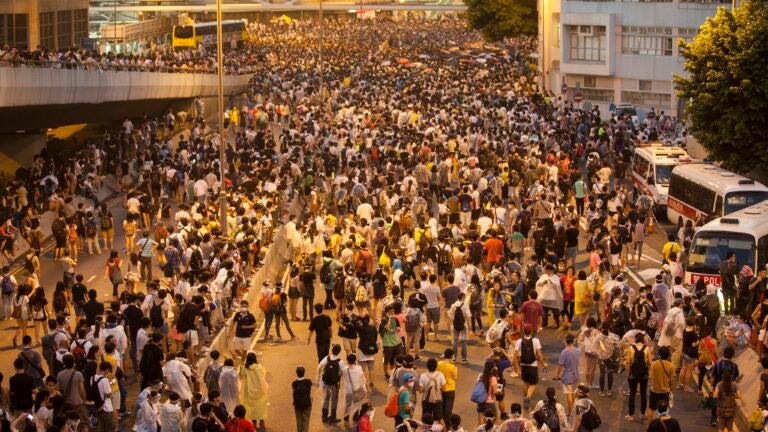
HONG KONG — A surging protest led by students in Hong Kong gained strength on Saturday, when thousands of supporters forced the police to retreat for a second straight night, prompting the leaders of the city’s most prominent pro-democracy campaign to join the young demonstrators in a campaign of defiance against the Chinese government and its local allies.
Several democratic politicians in Hong Kong said the unexpected strength of the young protesters, who have besieged the city’s government headquarters since Friday night, had persuaded an older generation to cede more influence to student activists, who seem less open to compromise with authoritarian Beijing.
“What happened since yesterday was beyond our expectation,’’ Albert Ho, 62, a member of the Democratic Party in Hong Kong’s Legislature, said in an interview late Saturday.
“Now the younger people have taken control and used their advantage of surprise,’’ Ho said at an exuberant rally attended by thousands of people, mostly in their 20s or younger, in front of the city government offices. “This is something that will deeply concern the government.’’
The power of the young activists was underlined when Hong Kong’s most prominent prodemocracy campaign, Occupy Central with Love and Peace, announced an abrupt change in its plans for civil disobedience protests in the city’s main financial district, known as Central. Those demonstrations, which the organizers said were likely to start on Wednesday, would oppose election proposals issued last month by the Chinese government that the campaign says do not offer authentic democratic options for choosing the city’s chief executive.
In the early hours of Sunday, Benny Tai, a co-founder of Occupy Central, announced that the students’ “occupation’’ in front of the city government offices would for now be the base for his group’s protests as well.
“Students have activated Hong Kong’s largest-scale civil disobedience campaign ever,’’ Tai said from a small stage, in a speech punctuated by roaring cheers and shouted slogans. He said the group was still examining how it might stage protests in Central, as it first planned. “We’ll begin,’’ he said, “by occupying the central government offices.’’
The Hong Kong government also appeared caught off guard. The chief executive, Leung Chun-ying, has been silent about the protests, and, despite months of training to quell Occupy Central, the police failed to disperse the activists who had turned the government area beside Victoria Harbor into a raucous but orderly camp.
“We think that this place is ours, not the government’s,’’ said Will Mak Wing-kai, a student from the Chinese University of Hong Kong.




To comment, please create a screen name in your profile
To comment, please verify your email address
Conversation
This discussion has ended. Please join elsewhere on Boston.com