
‘It’s on the app’: A New England police chief’s $4.5 million gambling secret
New Haven’s police chief, Karl Jacobson, resigned abruptly after his deputies saw red flags, including missing money. He has pleaded not guilty to embezzling city money to gamble on sports.
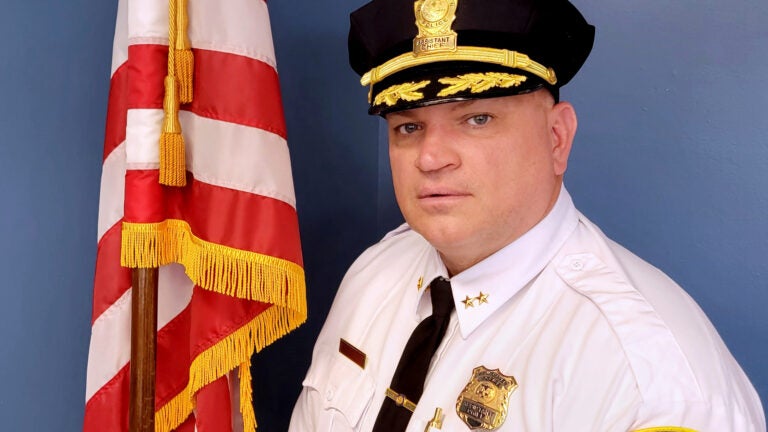
Karl R. Jacobson had what seemed like a model law enforcement career. He rose through the ranks of the Police Department in New Haven, Connecticut, to become the police chief in 2022, around the same time he earned his master’s degree in criminal justice.
As he completed what appeared to be a successful first term, he was on the cusp of reappointment. But those who worked closest to him had started spotting red flags.
In December, Jacobson asked one of his lieutenants for a $500 loan. He took money set aside to pay informants and left behind an IOU note. A department account he controlled was empty.
Three of his deputies confronted him in January. When they gathered in Jacobson’s office, he explained that he was addicted to gambling. The deputies were confused. They had “never seen him gambling,” one said, according to an arrest warrant.
Jacobson tapped his phone on a conference table. “It’s on the app,” he said. In a year he had wagered about $4.46 million on DraftKings and FanDuel accounts, two of the nation’s leading online sports betting sites, according to investigators.
He retired within hours. A little over a month later, Jacobson, 56, was arrested on charges of larceny.
The chief’s downfall rippled through New Haven and thrust the city into the middle of a national discussion about the increasing ubiquity of gambling and how insidious instantaneous betting can be.
Many states have legalized online sports gambling and casino games in recent years, raking in billions of dollars in tax revenue, while their residents are flooded with advertisements encouraging them to play. Platforms that let users wager on almost anything have seen people cash in on predictions such as the timeline for the removal of Nicolás Maduro and American strikes on Iran. And sports leagues have been mired in insider betting scandals.
Meantime, while prediction markets and the casino industry go to war over the booming online gambling world, more and more younger Americans have begun to seek help for gambling problems.
Jacobson began working at the New Haven Police Department in 2007, where by all accounts he seemed to build a happy and successful life. With two adult children and a wife, Jacobson had settled into his role, getting promoted and buying a house in a suburb two towns east of New Haven.
In Connecticut, everything changed once online gambling became legal in 2021, said Diana Goode, the executive director of the Connecticut Council on Problem Gambling. The council is not for or against gambling — “we are not the fun police,” Goode said. However, before online gambling, it was said that if you lived within 40 miles of a casino, the odds doubled that you would become a problem gambler, she said.
“Now, everyone has a casino in their house,” Goode said. “You add some alcohol and some marijuana and some gambling and there are a lot of decisions that are being made but with speeds that people don’t understand.” Calls to the council’s help line have soared about 50% since 2021.
Connecticut is home to two casinos and has three licensed online betting platforms: DraftKings, FanDuel and Fanatics. The state’s Department of Consumer Protection offers “self-exclusion,” where people can sign themselves up to be barred from legal gambling activities. The Council on Problem Gambling also offers resources for people concerned about their gambling habits.
In the middle of New Haven, just blocks from police headquarters, the Connecticut Community for Addiction Recovery has seen the impact of ubiquitous gambling.
Jason Dorsey, who manages the location, said that he had seen young people lured by the idea of making money fast and that gambling addiction can be devastating. He has worked with a man who owned a business that made half a million dollars a year in revenue, only to lose it all playing at a casino three or four times a week.
Now advertisements during sports games on television, and everywhere else, pushing easily accessible gambling platforms are luring more people in, he said. The center recently added a second monthly gambling group meeting.
“You’ve got Kevin Hart and LeBron James starring in those commercials,” Dorsey said. “It looks cool.”
Jacobson served as a police officer in East Providence, Rhode Island, for nine years before joining the New Haven police in 2007, eventually becoming an assistant chief. He was tapped to be chief at a tumultuous time for the New Haven police.
In June 2022, a man named Richard Cox was being transported in a police van unequipped with seat belts when he smashed headfirst into the van’s inside wall. When Cox told police officers he could not feel anything or move, officers mocked his inability to sit up. The incident was captured on video.
Cox, who is Black and was 36 at the time, was left paralyzed from the chest down. His mistreatment came following a time when protests against racial bias and brutality in policing swept the nation.
The following month, the city’s Board of Alders voted unanimously to appoint Jacobson chief, after having rejected the nomination of the acting police chief months before. At his swearing-in, his daughter — who studied criminal justice at the same time as he did — pinned his new badge on him.
In an interview at the time, Jacobson said his top priority was to win residents’ trust after what happened to Cox, “and move on from that and show our community that that’s not who we are.”
Throughout his first term, Jacobson succeeded at his goal, according to New Haven’s mayor, Justin Elicker. Residents across the city supported Jacobson throughout his tenure, he said.
“The one universal thing is everyone was totally shocked about this,” Elicker said of the gambling revelations. “The chief was beloved in many ways.”
When Jacobson confessed to his deputies that he had a gambling addiction, he said it was not his first private struggle.
“I have a problem,” he told them, according to an arrest warrant. “I fix my alcohol problem. I turned to gambling. I don’t know why it just got worse recently.”
Between January 2025 and January 2026, Jacobson’s accounts on DraftKings and FanDuel show that he wagered about $4.46 million and recorded a net loss of $214,365, investigators said.
When confronted, Jacobson told his subordinates that he had been taking money from the fund to pay confidential informants in drug cases for “just the month.” The account was empty, Jacobson said, and he admitted that $10,000 was missing.
He was charged with two counts of first-degree larceny related to $81,500 that was “unaccounted for or misappropriated” from the informant fund from 2024 through early 2026, as well as $4,000 taken from city Police Activity League funds in December 2025.
After Jacobson’s arrest was announced Feb. 20, scores of people — including members of the Police Department and others in law enforcement — have “offered support and encouragement” said his lawyer, Gregory Cerritelli. Jacobson is not his first client with a similar story, he said.
“Especially now with the ease at which gambling could take place, many people are affected by this and it has destroyed a lot of lives,” Cerritelli said.
This article originally appeared in The New York Times.




Be civil. Be kind.
Read our full community guidelines.To comment, please create a screen name in your profile
To comment, please verify your email address