
Sign up for the Today newsletter
Get everything you need to know to start your day, delivered right to your inbox every morning.
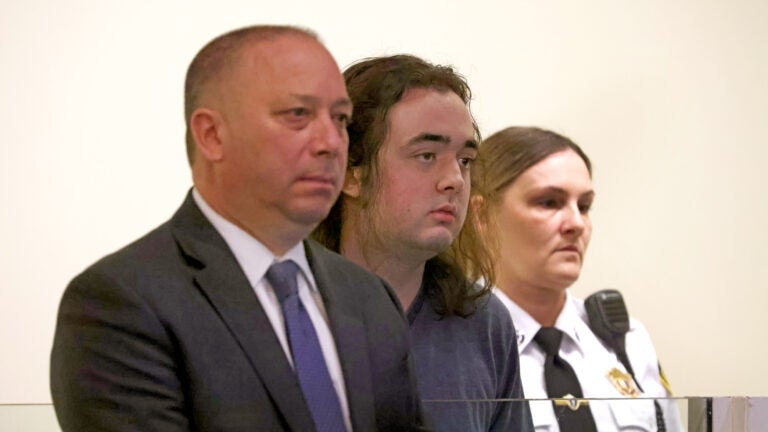
Last week, 18-year-old Anthony DeMayo allegedly told police he had “wanted to kill someone for a long time.”
After driving around the North Shore, the Bishop Fenwick High School student from Lynn allegedly came upon what appeared to be a random home at a corner lot in Danvers early Thursday morning. Investigators say he broke through a kitchen screen and walked into a bedroom, where he fatally stabbed 68-year-old Janet Swallows as she slept.
As charged, it was a brutal, bewildering act — the kind that defies motive.
“But sometimes we need to make sense of senseless murder,” says James Alan Fox, a research professor of criminology at Northeastern University.
Adults tend to kill for reasons based on logic, Fox said. Even though it is abhorrent, people understand killings out of jealousy, rage, revenge, and profit.
But, teenagers “often kill for no good reason,” he said.
DeMayo pleaded not guilty to murder and home invasion charges Friday. He was held without bail and was to undergo further evaluations at Bridgewater State Hospital.
Even though DeMayo is an adult under the law, Fox still considers him a teen.
Some teenagers, he said, could be considered temporary sociopaths who eventually grow out of it. For others, it is hard for them to conceptualize the future and make good decisions.
Research shows that the prefrontal cortex, or the frontal lobe, develops slowly and doesn’t fully develop until the mid-20s. This portion of the brain controls a person’s ability to make reasonable decisions and think about the consequences.
Fox said that many teenagers don’t think about the consequences for themselves, much less for their victims.
“This idea of trying to pursue a fantasy can become all-consuming because that fantasy of seeing what it feels like to kill does not take into account what’s going to happen,” he said.
Not only are teenagers’ brains still developing in terms of thinking through consequences, but they also don’t have strong ties yet to a job, children, or family. They are at the point in their lives where they are trying to establish independence.
“Teenagers will commit murder for the most trivial reasons — over a leather jacket, a pair of sneakers, a challenging glance, no reason at all,” Fox said. “They don’t need a reason, a reason that we can make sense of.”
Teenagers are far more likely than adults to kill with an accomplice, often out of loyalty to friends, though that purportedly wasn’t the case here.
An example was the 2009 murder of Kimberly Cates and the wounding of her 11-year-old daughter in their rural Mont Vernon home, located right over the border in New Hampshire.
The attacker, Christopher Gribble, told police he’d long wanted to kill someone, and he was one of five young men, ages 18 to 20, who randomly chose the house and agreed to kill anyone inside.
Such crimes often stem from a shared, unspoken pressure in which teens go along because they fear losing their peers’ respect, Fox said. “That’s why they often will perform these ridiculous deeds, particularly with other people,” he said.
Still, only about 30% of teen homicide cases involve accomplices.
In another similar case, Rod Matthews, who was 14 years old, told two of his classmates in the fall of 1986 that he “wanted to know what it was like to kill someone.”
After deciding to kill a classmate, Shaun Ouillette, because he would be the “least missed, because he didn’t have many friends,” he lured him into the woods and bludgeoned him with a baseball bat in Canton.
Fox said that in this case, the only reason for choosing Ouillette was that he was new to town. Matthews didn’t think about how his family would miss him.
(Matthews was released on parole in 2024 after serving 37 years in prison.)
The propensity toward violence peaks around 20 to 21 years old, Fox said, and then slowly declines with both maturation and social bonds.
Mental health certainly appears to play a role in the DeMayo case, Fox said.
“If you’re depressed and even thinking about ending your life, … then the consequence of being arrested, prosecuted, incarcerated — it just doesn’t have the impact,” he said.
There aren’t many public details about DeMayo’s life.
If a teenager is depressed and thinking about suicide, Fox said, hopefully parents and the education system are aware of it and don’t overlook it.
“His state of mind is an important contributor here,” he said.
Why kill other people? Fox said that people who suffer want others to suffer as well.
“Misery loves miserable company,” he said.
But Fox said, cases like these are still “an anomaly.”

Get everything you need to know to start your day, delivered right to your inbox every morning.




To comment, please create a screen name in your profile
To comment, please verify your email address
Conversation
This discussion has ended. Please join elsewhere on Boston.com